
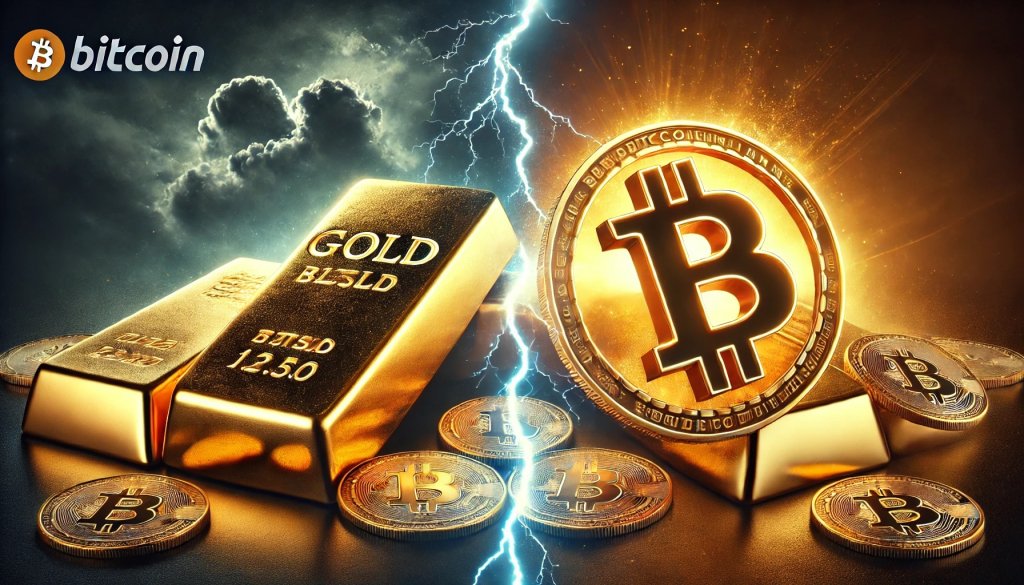
Bitcoin vs Gold: 7 Forces Shaping the Future of Value, Scarcity, and Inflation
Bitcoin vs Gold is no longer just a debate between enthusiasts and skeptics; it has become one of the most important conversations in modern finance. Bitcoin was born as a radical idea during a moment of global distrust, while gold has served as humanity’s store of value for thousands of years. Understanding how these two assets differ, how they behave under inflation, how scarcity shapes their value, and how regulation and institutional adoption influence their future is essential to grasping the economic landscape of the next decade.
In many ways, the Bitcoin vs Gold debate reflects a deeper question about how societies choose to preserve value when trust in traditional systems begins to shift.
Bitcoin was born as a radical idea during a moment of global distrust. At first it was an experiment, then a niche curiosity, then a speculative asset. Today it has become something more complex: a potential, still imperfect but increasingly considered, candidate to serve as a new form of store of value. To understand why many believe its price could rise in the coming years, it is essential to separate what is certain from what is possible, what is proven from what is only hypothesized. The truth lies in this balance.

The way Bitcoin works is now well established. It is not a file that can be copied, nor a number stored in a private database. It is a public, distributed ledger verified by thousands of computers around the world. Every transaction is recorded in a block, and every block is added to the blockchain through a process known as mining. This is where its scarcity originates: the total number of Bitcoin that will ever exist is limited to twenty‑one million units. Not one more.
This is not a political promise or an economic decision. It is a mathematical rule, written into the code and enforced by anyone participating in the network. Approximately every four years, the amount of new Bitcoin created is cut in half. This halving mechanism slows production until it eventually stops entirely. It makes Bitcoin an asset with programmed, predictable scarcity—something that does not exist in any other form of money.
The tension at the heart of Bitcoin vs Gold is not simply about price, but about two radically different philosophies of scarcity, technology, and monetary independence.
Gold, on the other hand, is scarce for completely different reasons. It is scarce because the Earth contains little of it and because extracting it requires time, energy, and technology. But its scarcity is not absolute. If the price rises, it becomes profitable to open new mines, exploit lower‑grade deposits, or invest in more advanced extraction techniques. Gold’s supply grows slowly, but it grows. And gold is not only a monetary asset: it is an industrial material. It is used in electronics, medicine, aerospace, telecommunications. Some of it is recycled, some of it is lost. This creates real demand independent of its role as a store of value.
Bitcoin, by contrast, has almost exclusively monetary and financial demand. Its value depends on the belief that millions of people hold: that it can preserve purchasing power over time. It has no industrial use, no physical utility, no external application beyond its monetary function. This is not a flaw, but a fundamental difference. Its strength lies not in material usefulness but in collective trust and mathematical scarcity.
This is where a fascinating, though distant, scenario emerges: the relationship between technology and gold. Today researchers discuss asteroid mining, deep‑sea extraction, and increasingly efficient industrial processes for recovering gold from electronic waste. These are real possibilities, even if far from becoming economically viable.
They do not pose an immediate threat to gold’s scarcity, but they reveal an important truth: the supply of gold ultimately depends on technology. If one day it becomes economically feasible to extract precious metals from space or from the ocean floor, the narrative of gold’s scarcity could change. It is not an imminent risk, but it is a hypothesis that cannot be ignored.
Bitcoin, however, cannot be “discovered” in new deposits. There is no asteroid full of BTC. Technology can make mining more efficient, but it cannot increase the supply. In a world where technology makes many physical resources more abundant, an asset with absolute, unchangeable scarcity becomes even more distinctive. This does not mean Bitcoin will replace gold, but it means it could increasingly stand beside it, reinforcing the ongoing Bitcoin vs Gold debate.
To understand why individuals and even states are turning to Bitcoin, one must understand inflation. Inflation is not simply rising prices; it is the erosion of purchasing power. If today one hundred euros buy a certain amount of goods and tomorrow they buy less, the currency has lost value. This happens when the supply of money grows faster than the real wealth produced. Central banks print money, governments accumulate debt, credit expands. These mechanisms can be useful in times of crisis, but over the long term they erode savings.
When analysts discuss Bitcoin vs Gold, they are really examining how digital scarcity competes with a physical asset that has anchored human economies for thousands of years.
In such an environment, people seek refuge in something that cannot be printed. Gold has been the natural answer for millennia. Real estate has been another. Bitcoin is the newest answer. Not because it is perfect, but because it offers something no other form of money offers: absolute, verifiable scarcity. It is not immune to risk. It is volatile, sometimes violently so.
It has experienced drops of seventy or eighty percent. It is not yet a stable store of value like gold. But its underlying logic is clear: in a world where everything can be duplicated, expanded, inflated, Bitcoin is one of the few things that cannot be multiplied.
Its future depends on one fundamental variable: demand. Scarcity alone does not guarantee value. Many things are rare but not valuable. Bitcoin has value because millions of people believe it does. If this belief grows—if more individuals, companies, and institutions choose to use it as a store of value—its scarcity could push its price upward. If demand stabilizes or declines, scarcity alone will not sustain it. This is a possibility, not a certainty.
Another crucial factor is regulation. Bitcoin was designed to be decentralized, but its adoption depends on the rules that governments and financial authorities choose to implement. Supportive regulation could accelerate adoption; restrictive regulation could slow it, at least temporarily. No financial technology grows in a regulatory vacuum. Bitcoin is no exception.
Finally, there is a silent but decisive shift: the arrival of institutional investors. For years Bitcoin was dominated by retail investors, enthusiasts, and early adopters. Today this is no longer the case. Investment funds, publicly traded companies, asset managers, and regulated ETFs are accumulating Bitcoin in increasing quantities. This does not guarantee future success, but it changes the nature of the market. It makes it deeper, more liquid, more integrated into global financial systems. And above all, it makes it harder to ignore.
The future of value will likely not be dominated by a single asset. Gold will remain important because it has a millennia‑long history and real industrial demand. Bitcoin may stand beside it, not because it will replace it, but because it offers something gold cannot: absolute scarcity and global portability. In a rapidly changing world, it is possible that both will find their place, each with a different role.
Bitcoin is not a certainty, but it is a possibility. It is a new answer to an ancient question: how to preserve value over time. And like all possibilities, it deserves to be understood, analyzed, and observed carefully, without blind enthusiasm and without prejudice. Its true strength lies in this balance.
The future of the Bitcoin vs Gold narrative will depend on how investors interpret risk, inflation, and the evolving role of technology in global finance.
As the debate around Bitcoin vs Gold continues to evolve, it becomes impossible to ignore how moments of systemic stress reshape the way investors perceive risk. A clear example of this shift can be found in The Month Crypto Lost Its Illusion of Safety: Inside the 2026 DeFi Meltdown, where the collapse of several decentralized finance protocols forced the entire industry to confront its own fragility. That moment didn’t just shake markets — it changed the psychology of value itself, pushing many to reconsider what “safe” really means in a digital age.