
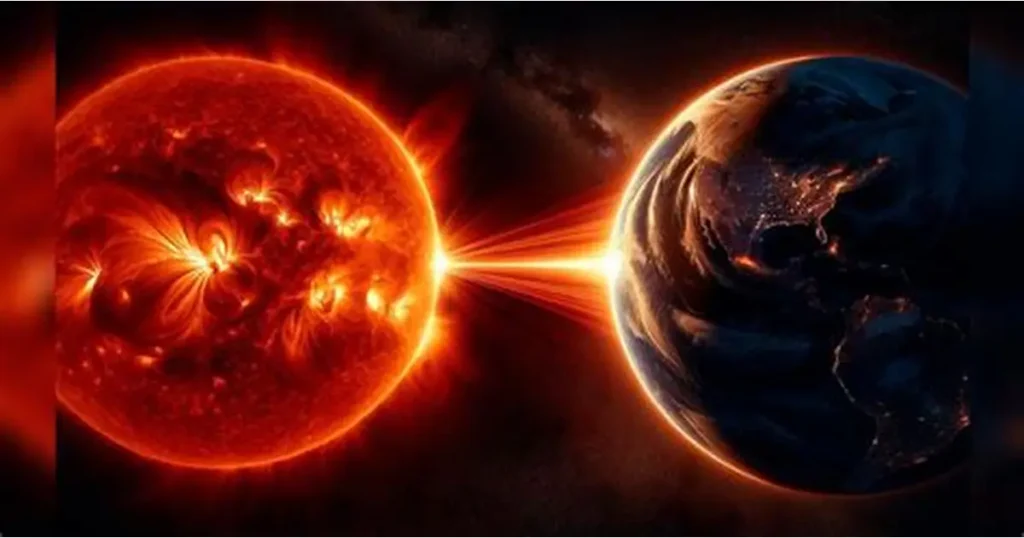
Powerful Geomagnetic Storm June 6 2026: The Sun Launches Three CME Toward Earth
A geomagnetic storm is expected between today and tomorrow. Forecast intensity: G3–G4. Three CME erupted from solar region AR4455. Possible disturbances to satellites, GPS, and radio communications. Auroras may be visible across the northern United States, Canada, and parts of Europe.
A New Geomagnetic Storm Is Approaching Earth
Geomagnetic storm June 6 2026 is expected to impact Earth as three powerful CME launched from solar region AR4455 move toward our planet, raising concerns about possible G3–G4 geomagnetic activity. The event has drawn significant attention from NOAA and NASA, as the combined CME structure could intensify once it reaches Earth’s magnetosphere.
The Sun has entered another phase of intense activity, and scientists are closely monitoring the evolution of the incoming solar plasma. According to the NOAA Space Weather Prediction Center, this geomagnetic storm could become one of the most notable events of the year, depending on how the magnetic field carried by the CME interacts with Earth’s magnetosphere.
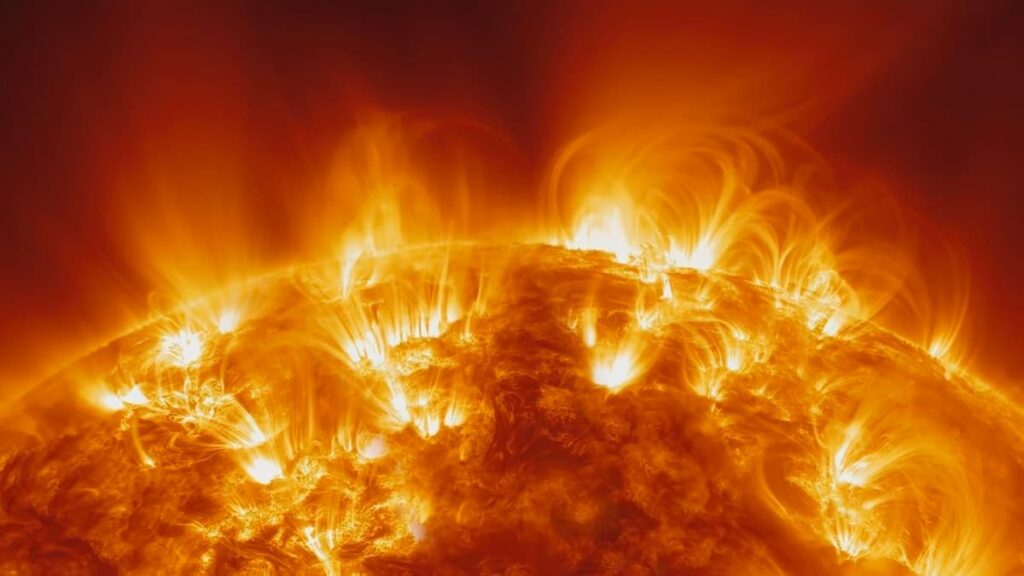
The Three CME From AR4455: What We Know
The first CME was the largest and is on a direct trajectory toward Earth. The second and third eruptions were initially directed farther north, but the last CME was significantly faster. It caught up with the earlier ones, merging into a more complex and potentially more energetic structure.
NOAA’s modeling suggests that this interaction could amplify the geomagnetic impact once the combined CME reaches Earth’s magnetic field. This is why the geomagnetic storm June 6 2026 is being monitored with particular attention.
What Scientists Call a “Cannibal CME”
When a fast CME overtakes a slower one, the two merge into a single, more powerful structure. Scientists refer to this phenomenon as a cannibal CME. It is rare, but when it happens, the resulting geomagnetic storm can be significantly stronger.
A similar event occurred during the extreme G5 storm of May 2024, the most powerful in two decades. Multiple CME merged into a single magnetic wave that triggered widespread auroras and caused disruptions across several technological systems.
While the current event is not expected to reach G5 levels, the underlying mechanism is similar — and that alone makes it worth monitoring closely.
Possible Effects on Earth According to NOAA and NASA
A G3 geomagnetic storm can cause voltage fluctuations in electrical grids, orientation issues for satellites, GPS inaccuracies, and disruptions to HF radio communications. If the storm reaches G4, the effects may intensify, including prolonged radio blackouts, satellite navigation failures, disturbances to high‑latitude power systems, and increased risk for spacecraft and astronauts.
NASA is monitoring the situation using the DSCOVR spacecraft and the SOHO satellite, which provide real‑time data on solar wind speed and magnetic field orientation.
According to NOAA, the probability of a G3‑level storm in the next hours is high.
Will Auroras Be Visible in the United States or Europe?
One of the most common questions during a geomagnetic storm is simple: “Will we be able to see the aurora from where we live?”
According to NOAA and several space‑weather researchers, the incoming storm could push the aurora oval far enough south to make the phenomenon visible in several mid‑latitude regions.
Auroras may be visible across the northern United States, including Montana, North Dakota, Minnesota, Wisconsin, and Michigan, and possibly in parts of the northeastern U.S. such as New York, Vermont, and Maine. Much of Canada, including southern provinces like Ontario and Quebec, also has a strong chance of visibility.
In Europe, auroras may appear across the UK, Ireland, Germany, Poland, the Netherlands, Denmark, and the Czech Republic. Scandinavia — Norway, Sweden, and Finland — has an almost guaranteed view, while Iceland remains one of the most favorable locations.
Visibility will ultimately depend on the orientation of the magnetic field carried by the CME — a factor that can only be measured shortly before impact.
Why the Sun Is So Active During This Phase of the Solar Cycle
Although the Sun is entering the descending phase of Solar Cycle 25, energetic events remain common. The Sun does not follow a perfectly predictable rhythm. Its magnetic dynamics are complex, chaotic, and often surprising.
Sunspots can reactivate suddenly, producing flares and CME even during periods considered “quiet.” Scientists at NASA and ESA continue to study these mechanisms to better understand and predict solar behavior.
A Reminder of the Fragility of Our Technological World
Every geomagnetic storm reveals how dependent we are on delicate infrastructures: satellites, electrical grids, navigation systems, global communications. Earth’s magnetic field protects us from the worst effects, but even moderate storms can cause disruptions in a world that relies heavily on space‑based technology.
At the same time, these events highlight the beauty of a living system. The Sun breathes, pulses, erupts. Earth responds, defends itself, and interacts with the solar wind in a cosmic dance that has been ongoing for billions of years.
A similar event was analyzed in a previous report on Zemeghub, where a solar superstorm severely compressed Earth’s plasmasphere, revealing how fragile our planet’s invisible magnetic shield can be. You can read that analysis here: A Solar Superstorm Crushed Earth’s Plasmasphere — Revealing the Fragility of Our Planet’s Invisible Shield.
A Storm Worth Watching
The geomagnetic storm June 6 2026 does not pose a danger to the population, but it is a scientifically significant event. Astronomers will continue to monitor the evolution of the CME in the coming hours. The actual intensity of the storm will depend on the magnetic field orientation — a crucial factor that can only be measured shortly before the solar plasma reaches Earth’s magnetosphere.
Whether auroras appear or not, the Sun has once again shown that it remains a powerful, unpredictable, and endlessly fascinating force.