China vs United States Artificial Intelligence: Two Nations Building Different Futures for AI
China vs United States artificial intelligence competition has become one of the defining technological confrontations of 2026, revealing two radically different visions for how AI should evolve and shape the future.
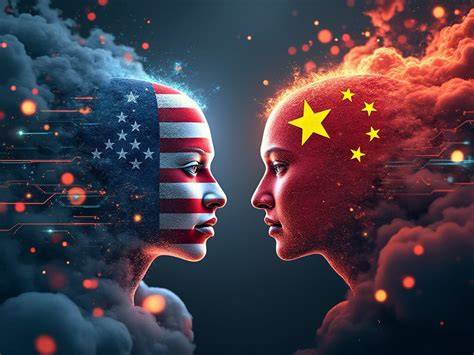
In 2026, the competition between the United States and China in artificial intelligence is no longer just a technological contest. It has become a philosophical, cultural, and industrial confrontation. Two civilizations are building AI according to different principles—almost incompatible ones—as if they were programming two parallel futures. On one side stands America, with its private, chaotic, hyper‑competitive ecosystem where innovation emerges from corporate initiative and the freedom to experiment. On the other side stands China, with a centralized, state‑driven strategy that integrates AI into governance, industry, and urban management. These two models are not simply competing; they are defining what AI will become for the rest of the world.
In the United States, artificial intelligence is a child of Silicon Valley. It is a product of the market, of open innovation, of the belief that technology must always outrun everything else. In 2026, American companies continue to lead frontier‑model research: OpenAI, Anthropic, Google DeepMind, and Meta are the protagonists of a race that never slows down. According to the Stanford AI Index, private AI investment in the U.S. reached new highs in 2025, and the trend continued into 2026, with strong growth in generative models, robotics, and industrial automation. There is no single definitive figure, but every major analysis agrees on one point: AI has become one of the primary engines of the American economy.
China has chosen a different path. Beijing does not merely want to innovate; it wants to weave AI into the fabric of society. Since 2023, the government has introduced strict regulations on generative models, requiring registration, compliance checks, and guidelines that define what a model may or may not generate. This approach has slowed down speculative research but accelerated practical adoption. Today, hundreds of Chinese cities use AI systems to manage traffic, monitor public safety, optimize healthcare services, and coordinate urban logistics. AI is not a gadget—it is a national infrastructure.
The deepest difference lies in the relationship between the state and technology. In the United States, the government is trying to regulate a sector that moves faster than politics. Discussions about frontier‑model safety, compute governance, and systemic risks have become central in Washington. The Department of Commerce has imposed increasingly strict export controls on advanced GPUs destined for China, aiming to slow Beijing’s ability to train frontier models. There are no federal laws that set specific FLOP thresholds, but the debate is active and involves think tanks, corporations, and institutions. It is a climate reminiscent of the rising technological tension described in AI Cold War: 5 Ways the U.S. Is Turning AI Into a Weapon, where artificial intelligence becomes a strategic instrument of American foreign policy.
China has responded with a quiet but determined strategy: building its own hardware autonomy. In recent years, SMIC has shown significant progress in advanced chip manufacturing, though it still lags behind global leaders like TSMC and Samsung. Huawei has continued developing its Ascend line, producing accelerators designed to compete in specific inference and training workloads. This is not technological parity with NVIDIA, but it is a path toward independence—one that reduces vulnerability to American restrictions. China does not aim to surpass the United States in chip technology; it aims to ensure that no one can stop its progress.
The cultural dimension of AI is another point of divergence. In America, artificial intelligence is seen as an extension of human creativity. Generative models are tools for expression, research, and experimentation. AI is an open laboratory where any idea can become a product. In China, AI is conceived as an extension of social order. It must be reliable, predictable, and aligned with the goals of the Party. It is no surprise that Chinese models tend to be less oriented toward creativity and more toward stability. They are designed to function, not to astonish.
Yet despite these differences, the competition between the United States and China is not a technological cold war. It is a bifurcation of the future. The United States is building a world where AI is a driver of open innovation, where research is global, and where private companies set the pace of progress. China is building a world where AI is a public infrastructure, where technology is part of governance, and where stability matters more than speed.
The rest of the world is watching closely. Europe debates regulation; India invests in national models; Southeast Asia adopts Chinese smart‑city systems; Africa looks to American platforms for access to generative AI. There is no single direction—there are many trajectories, intersecting and influencing one another.
The question is not who will win. The question is which vision of AI will become dominant. America has speed; China has stability. America has creativity; China has discipline. America builds the future; China organizes it. And perhaps, in the end, the world will need both.
