

Dual Comet Showdown: R3 Pan‑STARRS & A1 MAPS — April’s Celestial Drama Unfolds
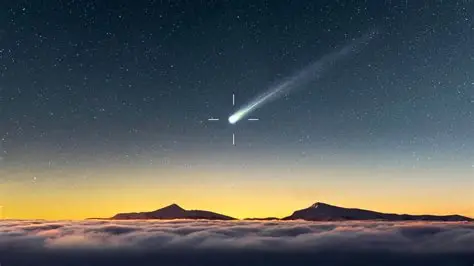
April opens with a rare kind of cosmic tension, the kind that makes astronomers pause and look twice at the night sky. Two comets—R3 Pan‑STARRS and A1 MAPS—are moving through the inner Solar System almost simultaneously, each carrying its own story of survival, transformation, and mystery. One brightens as it approaches the Sun, shedding ancient dust into a glowing tail. The other has already risked everything in a perilous dive toward the solar furnace, leaving behind a trail of uncertainty and speculation.
It is the kind of celestial convergence that reminds us how alive and unpredictable our cosmic neighborhood truly is, echoing the same sense of wonder sparked by unusual stellar events like the strange supernova that may solve a major cosmic mystery —A Strange Supernova May Solve a Major Cosh/mic Mystery — A New Light in the Dark.
R3 Pan‑STARRS: The Survivor Nears the Sun
R3 Pan‑STARRS is now on its final approach toward perihelion, the moment when it will skim closest to the Sun. As it warms, the comet awakens. Ices that have remained frozen since the dawn of the Solar System begin to sublimate, releasing gas and dust that form a luminous coma and a tail stretching across the darkness.
Night after night, astronomers report subtle changes—an expanding halo, a more defined tail, a steady increase in brightness. R3 Pan‑STARRS behaves like a seasoned traveler, a comet that has survived previous passages and knows how to endure the Sun’s heat without breaking apart.
A1 MAPS: The Sungrazer That Challenged the Solar Furnace
A1 MAPS chose a far more dangerous path. As a sungrazer, it plunged extremely close to the Sun on April 4, entering a region where heat, radiation, and tidal forces tear apart almost anything that ventures too near. Many comets do not survive such encounters, and early observations suggest that A1 MAPS may have partially—or completely—disintegrated.
Some astronomers report faint dust remnants, a ghostly streak that could be all that remains of its nucleus. Others believe a fragment may have endured, too small to shine brightly but still drifting outward on a new orbit. The truth may take days or weeks to emerge. Sungrazers are unpredictable, and their fate often reveals itself only after the solar glare fades.
A Rare Duel in the Inner Solar System
Two comets arriving in the same month is unusual enough to capture global attention. Their contrasting destinies—one brightening, one possibly destroyed—highlight the delicate balance that governs cometary life cycles.
For skywatchers, April becomes a window into deep time, a chance to witness relics from the Solar System’s earliest days. For scientists, these comets offer fresh data on the composition and evolution of icy bodies that predate Earth itself.
The cosmos is not quiet. It is restless, dynamic, and full of surprises. And this month, two comets have stepped into the spotlight to remind us of that truth.