
Matter–Antimatter Comparison Reaches Record Precision: CERN’s Historic ALPHA Breakthrough (2026)
On 28 May 2026, in the underground halls of CERN, a new chapter opened in one of the most profound scientific quests of our time. The ALPHA collaboration announced its most precise Matter–Antimatter Comparison ever performed using antihydrogen, pushing experimental physics closer to answering a question that has haunted cosmology for nearly a century: why does the Universe contain matter at all?
A New Milestone in the Search for the Universe’s Missing Symmetry
The result does not reveal a violation of symmetry, nor does it overturn the Standard Model. But it sharpens the tools with which physicists probe the foundations of reality. And as reported by Phys.org, this new level of precision marks a decisive step forward in the decades‑long effort to understand whether matter and antimatter are truly perfect mirror images — or whether a tiny asymmetry hides at the heart of existence.
Why the Matter–Antimatter Comparison Matters
Every atom in the Universe — from the iron in Earth’s core to the hydrogen in distant galaxies — exists because matter somehow survived the primordial annihilation that should have erased everything. According to the laws of physics, the Big Bang should have produced matter and antimatter in equal amounts. They should have destroyed each other completely.
Yet the Universe is made of matter.
The ALPHA experiment focuses on the simplest possible system: hydrogen and its antimatter counterpart, antihydrogen. If even the smallest difference exists between them — in mass, charge distribution, spectral transitions, or gravitational behavior — it could reveal the mechanism that tipped the cosmic balance.
This is why the new measurement matters. It is not merely a refinement; it is a narrowing of the corridor through which new physics might emerge.
What Is Antihydrogen?
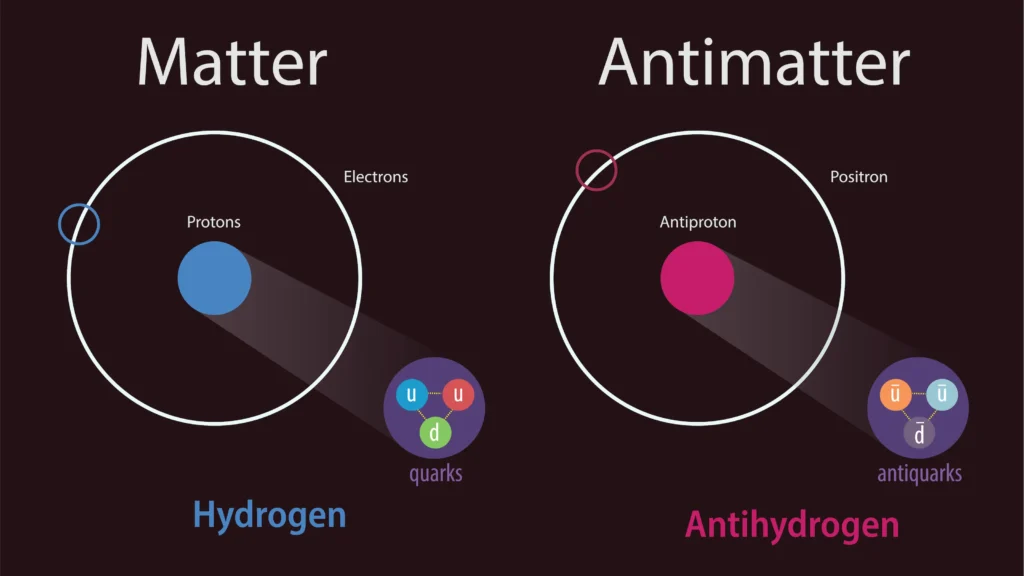
Antihydrogen is the antimatter counterpart of hydrogen. Instead of a proton orbited by an electron, it consists of an antiproton orbited by a positron. According to the CPT symmetry principle — one of the most fundamental pillars of modern physics — antihydrogen should exhibit the same spectral properties as hydrogen.
Any statistically significant deviation from the predicted spectral properties would challenge CPT symmetry and could point toward physics beyond the Standard Model.
Testing this prediction with increasing precision is one of the central goals of the ALPHA collaboration.
How ALPHA Achieved Its Most Precise Measurement Yet
The new precision achieved in 2026 does not rely on a single technological leap, but on the cumulative refinement of multiple components of the ALPHA apparatus. The increased precision results from continued improvements in antihydrogen trapping, spectroscopy techniques, and experimental control within the ALPHA setup.
Antihydrogen atoms are produced, cooled, and confined in a magnetic trap at temperatures near absolute zero. Once stabilized, they are probed with ultra‑precise laser systems that measure the 1S–2S transition — one of the most fundamental spectral lines in atomic physics.
The result: hydrogen and antihydrogen match within the experimental uncertainties, reinforcing CPT symmetry at a level never reached before.
This achievement resonates with the quantum logic explored in our internal article Quantum Superposition: How Particles Exist in Multiple States at Once, where the delicate structure of quantum states becomes the key to understanding the deepest layers of reality.
What About Gravity? Does Antimatter Fall the Same Way?
For decades, one of the most intriguing questions in physics was whether antimatter might respond differently to gravity. The idea was speculative, but not impossible. However, recent measurements — including those from ALPHA‑g — indicate that antihydrogen falls downward under gravity in the same direction as ordinary matter, within current experimental uncertainties.
Although recent measurements indicate that antihydrogen responds to gravity in the same direction as ordinary matter, future experiments may still test whether tiny deviations exist beyond current precision limits.
This nuance is essential: the door to new physics is not closed, but the window is narrower.
What This Breakthrough Means for the Future of Physics
The new ALPHA result does not solve the matter–antimatter mystery, but it reshapes the battlefield. Each increase in precision places tighter constraints on theoretical models and forces physicists to search for increasingly subtle violations of fundamental symmetries.
Some possibilities remain open. Some theoretical frameworks explore whether antimatter and dark matter could exhibit subtle interactions not yet observed experimentally. Tiny CPT‑violating effects might appear at energy scales not yet accessible. Or the asymmetry might be encoded in processes so rare that only the next generation of detectors will reveal them.
What is certain is that the Matter–Antimatter Comparison has entered a new era. The precision achieved in 2026 is not an endpoint but a foundation — a platform from which deeper questions can finally be asked with scientific rigor.
Matter–Antimatter Comparison and the Future of Fundamental Physics
The history of physics is a story of instruments becoming sharp enough to reveal what was once invisible. From the first telescopes to the first particle accelerators, every leap in precision has opened a new chapter in our understanding of the cosmos.
The ALPHA experiment’s latest achievement belongs to that lineage. It does not claim victory over the antimatter mystery, but it brings us closer than ever to the moment when the Universe may eventually reveal physical mechanisms that remain hidden today.
The revolution is not the symmetry we confirm — it is the asymmetry we may soon be able to detect.
Source (CERN)
According to the official CERN release, the ALPHA team has now measured an extremely small energy gap in antihydrogen with even greater precision, reinforcing the remarkable stability of fundamental symmetries. As highlighted in the report, this refined measurement marks a significant step toward a deeper understanding of how antimatter behaves in the Universe.