Why the Universe Is Not an Accident — The Hidden Logic Behind Life, Earth and Human Existence
Why the Universe Is Not an Accident.
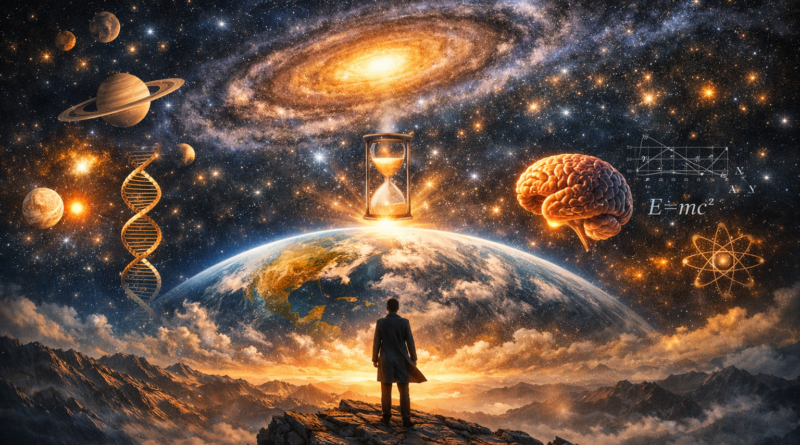
Why the Universe Is Not an Accident. There are moments in human history when the oldest question returns with renewed force, as if the universe itself were whispering it to anyone willing to listen. It is not a religious question, nor a philosophical one, nor even a strictly scientific one. It is a question born from observation, from logic, from the simple honesty of looking at reality without filters. A question that has crossed centuries like an underground river and that, despite all progress, has never lost its power: where does all this come from? Why does life exist? Who built a universe so precise, an Earth so perfect, a human being so complex?
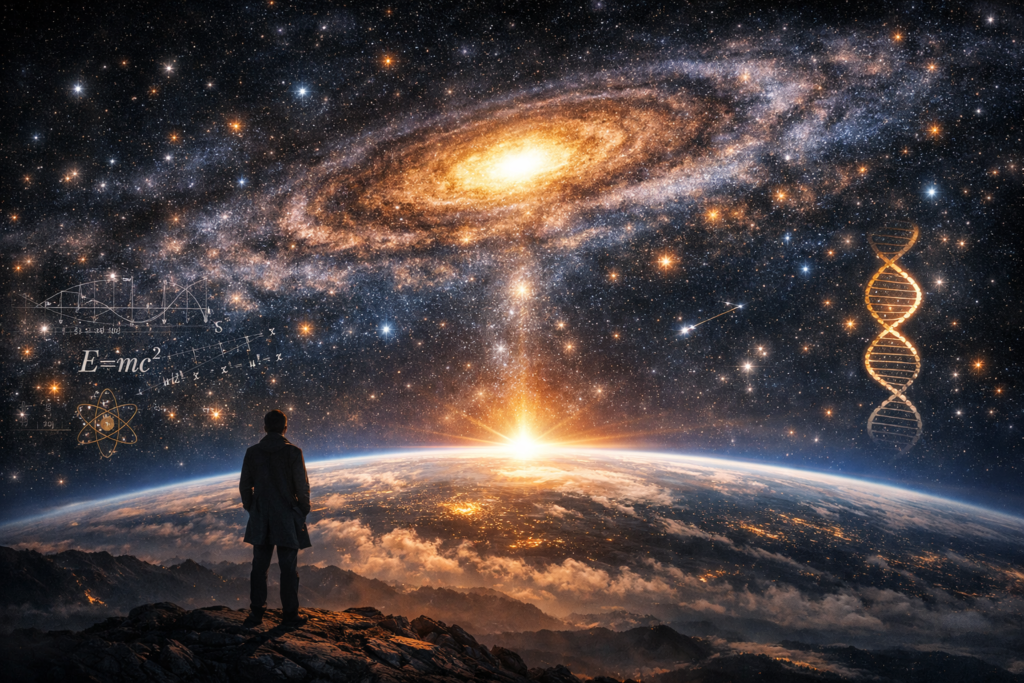
Why the Universe Is Not an Accident is more than a question; it is a logical conclusion that emerges when we observe reality without filters.
This is not about faith. It is not about tradition. It is not about belief. It is about recognizing that reality is not chaos but order, not an accident but a structure, not a mistake but a balance. And when a balance is so perfect that it defies probability, logic suggests that behind it lies intention. This is the foundation of the idea behind Why the Universe Is Not an Accident, a concept that emerges naturally when the universe is observed with intellectual honesty.
Humanity, the Earth and the universe are not three isolated elements. They are three chapters of the same story, three levels of a single architecture, three clues pointing toward a perfection that cannot be ignored. When observed together, they form a coherent picture, one that makes the question not only relevant but inevitable.
The Human Being: The Mystery Living Inside Matter
The human being is a living enigma. Biology describes the body as a system of organs, tissues, cells and molecules. Every cell contains DNA, a molecule so complex that it functions like a biological language. DNA is written in a code of four chemical bases arranged in sequences that determine proteins, structures and functions. It is not random. It is information. And information always points to a source.
The probability that such a coherent code emerged by pure chance is infinitesimal. DNA is not a chaotic sequence of symbols; it is a functional, organized, meaningful structure capable of generating a living organism. Every gene is a sentence. Every protein is a response. Every biological process is a chapter in a book that seems written rather than improvised.
But even if one accepts that biological life could emerge from natural processes, a far greater mystery remains: consciousness. Science can describe the electrical activity of the brain, but it cannot explain why electrical impulses produce the sensation of being alive. It can map emotions, but it cannot explain why a human being is capable of compassion, sacrifice or moral judgment. It can study memory, but it cannot explain why a single memory can shape a destiny.
Consciousness is the great anomaly of the universe. It is what transforms a brain into a mind, what allows the word “I” to exist, what makes subjective experience possible. No scientific theory has yet explained how physical processes give rise to inner experience. This is the essence of the “hard problem of consciousness,” a challenge that remains unsolved despite decades of research.
The complexity of human consciousness alone suggests that Why the Universe Is Not an Accident is not just a philosophical idea but a rational interpretation.
The complexity of human consciousness alone suggests that Why the Universe Is Not an Accident is more than a philosophical idea; it is a logical conclusion emerging from the very structure of our minds. Creativity, morality, imagination and self-awareness are not required for survival, yet they exist. They point to a dimension of the human being that transcends biology.
The human being is a mystery that walks, a biological, psychological and spiritual enigma. And every mystery, when observed seriously, suggests an author.
The Earth: A Laboratory Perfectly Calibrated for Life
When we look at Earth’s perfect balance, the idea behind Why the Universe Is Not an Accident becomes impossible to ignore.
If the human being is a masterpiece, the Earth is the perfect frame built to host it. Planetary science describes the “habitable zone” as the region around a star where temperatures allow liquid water to exist. Earth lies exactly in this zone. Not too close, not too far. A delicate equilibrium.
But distance from the Sun is only the beginning. Earth’s atmosphere is a precise blend of gases: enough oxygen to sustain life, but not enough to make the planet dangerously flammable; enough carbon dioxide to regulate temperature, but not enough to trigger runaway heating. Water, the most extraordinary substance known, has properties that seem designed for life. It dissolves nutrients, stabilizes climate, expands when frozen, floats as ice, and allows photosynthesis by letting light pass through.
Photosynthesis itself is a molecular miracle. Plants and algae convert sunlight into chemical energy through a process so complex that it resembles a microscopic factory. Without photosynthesis, Earth would have no oxygen-rich atmosphere and no complex life.
The Moon plays a crucial role. It stabilizes Earth’s axial tilt, ensuring regular seasons. Without this stabilization, climate would swing wildly, making life unpredictable. The Moon also generates tides, which shaped early evolution by creating transitional environments between land and sea.
Earth’s ecosystems are networks of interdependence. Predators regulate prey. Decomposers recycle matter. Pollinators like bees enable plant reproduction. Bees alone support a large portion of global food production. Their disappearance would collapse agriculture. This is not a random detail; it is a structural necessity.
Modern cosmology reinforces the concept that Why the Universe Is Not an Accident, revealing a universe calibrated with astonishing precision.
When observing Earth’s delicate balance — its atmosphere, its oceans, its ecosystems — the question Why the Universe Is Not an Accident becomes unavoidable, because such precision rarely emerges without intention.
Earth is not an accident. It is a project.
The Universe: A System Governed by Precise Laws
Looking farther, the perfection becomes almost overwhelming. The universe is governed by physical laws that are astonishingly precise. Gravity holds galaxies together. The strong nuclear force binds atomic nuclei. The weak nuclear force governs radioactive decay. Electromagnetism shapes chemistry and light.
These forces have exact strengths. If gravity were slightly stronger, the universe would have collapsed after the Big Bang. If slightly weaker, matter would never have clumped into stars. If the strong nuclear force were slightly weaker, atoms would fall apart. If slightly stronger, stars would burn too fast. If electromagnetism were different, chemistry would not exist.
Modern cosmology shows that the laws of physics are so finely tuned that they reinforce the idea behind Why the Universe Is Not an Accident, revealing a universe calibrated for stability, structure and life.
The cosmological constant — the energy of empty space — is one of the greatest mysteries in physics. Its value is so precise that even a tiny deviation would make the universe either collapse or expand too fast for galaxies to form.
The universe is not just vast. It is structured, regulated, coherent. It behaves like a machine — a machine built with precision beyond any known engineering.
And every machine has a designer.
The Logic That Emerges from the Whole
When humanity, Earth and the universe are observed together, a logic emerges. Complexity does not arise from nothing. Information does not arise from randomness. Balance does not arise from error.
When all scientific evidence is placed together, the argument behind Why the Universe Is Not an Accident becomes a rational interpretation rather than a speculative claim. A software has a programmer. A robot has an engineer. A watch has a watchmaker. A book has an author. No one attributes complex structures to chance — except when discussing the universe itself.
Science explains the how, but not the why. It describes processes, but not origins. It measures laws, but does not explain why those laws exist. Why does gravity exist? Why does light exist? Why does matter exist? Why does consciousness exist?
When logic eliminates all alternatives, what remains — however astonishing — is the truth.
The Inevitable Conclusion
In the end, all evidence points to one coherent truth: Why the Universe Is Not an Accident.
This is not about religion. This is not about faith. This is not about tradition.
This is about logic. This is about observation. This is about reality.
The universe is not an accident, but a project. The Earth is not a coincidence, but a constructed home. The human being is not an evolved animal, but a conscious creature.
In the end, the deeper we explore reality, the more the idea that Why the Universe Is Not an Accident resonates as a coherent explanation for the existence of life, Earth and human consciousness.
Every project has a designer. Every home has an architect. Every creature has a creator.
And when the universe speaks, the only thing left to do is listen.