The New Global Order: A Troubling Shift in Global Power
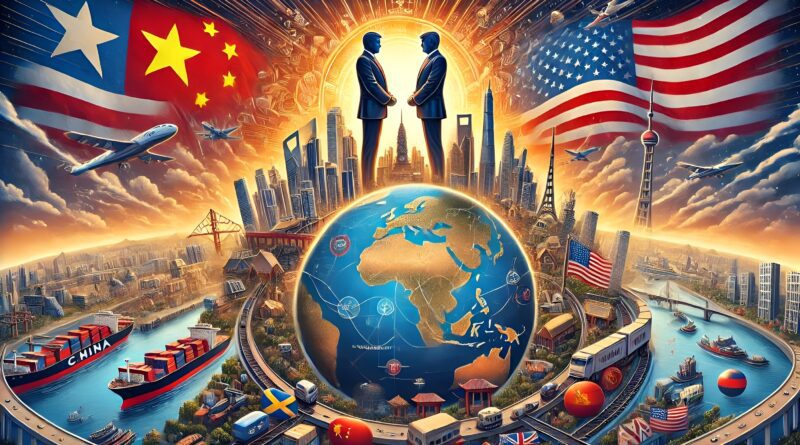
The new global order is taking shape in real time. Across Washington, Beijing, Brussels, New Delhi and Moscow, the balance of power is changing, not because one country has suddenly replaced another, but because the foundations of global influence are being redistributed.
The world that emerged after the Cold War was largely defined by American economic, military and technological dominance. Today, that system is becoming more fragmented and competitive. China has expanded its economic and technological reach, India is gaining strategic weight, Europe is reconsidering its role in global security, and countries across the Global South are demanding greater influence over the institutions and rules that shape international affairs.
The result is not simply a transition from an American-led world to a Chinese-led one. It is something more complex: a new global order in which power is increasingly distributed across several major centres, while trade, technology, energy, military capabilities and access to critical resources have become instruments of geopolitical competition.
For much of the 20th century, the international system could be understood through relatively clear centres of power. First came the rivalry between the United States and the Soviet Union. After the collapse of the Soviet Union, the world entered a period in which American military, financial, technological and diplomatic power had no comparable rival.
That period is now ending.
Not because the United States has suddenly become weak, and not because another country has simply taken its place. The more important transformation is that power itself is becoming more dispersed. Economic strength, military capability, technological leadership, control over critical resources and political influence are increasingly distributed among several centres.
The result is not yet a new world order in the traditional sense. It is something more complicated: a world in which the rules are being renegotiated while the institutions created after the Second World War are struggling to adapt.
The global economy itself tells part of the story. The International Monetary Fund projects global growth of 3.0 percent in 2026 and 3.4 percent in 2027, but the distribution of that growth is highly uneven. The IMF’s April data projected real GDP growth of 2.3 percent for the United States, 4.4 percent for China and 6.6 percent for India in 2026, illustrating the continuing shift toward Asia even as the United States remains the world’s most powerful advanced economy.
These numbers matter because geopolitical power has always depended partly on economic capacity. A country that controls capital, technology, industrial production, energy or strategic resources possesses options that weaker states do not.
But economic size alone no longer tells the entire story.
The new global competition is increasingly about who controls the technologies and supply chains that will define the next decades.
The United States Is Still the Central Power, But the System Around It Is Changing
The United States remains the most powerful military actor in the world by a substantial margin. According to SIPRI, American military expenditure reached approximately $954 billion in 2025, representing about 33 percent of global military spending. China was second at approximately $336 billion, followed by Russia at around $190 billion. Global military expenditure reached $2.9 trillion in 2025, the highest level recorded by SIPRI.
These figures make one thing clear: reports of the disappearance of American power are premature. Washington still possesses a combination of military reach, financial influence, technological capacity, intelligence capabilities and global alliances that no other state currently matches in aggregate.
But American power operates in a different environment than it did twenty or thirty years ago.
China is now a technological and industrial competitor on a scale that the Soviet Union never achieved. India is becoming a major economic and demographic power. European countries are increasing defence spending. Middle Eastern states are building more autonomous foreign policies. Countries across Africa, Asia and Latin America are increasingly unwilling to define their interests exclusively through the rivalry between Washington and Beijing.
This does not necessarily mean that these countries are abandoning the United States. It means that many of them are trying to avoid having to choose.
That distinction may define the geopolitics of the coming decades.
The emerging international system is increasingly based on what could be called strategic flexibility. Countries want access to American technology and financial markets while maintaining economic relations with China. They want security partnerships with Western states while buying energy from Russia or the Middle East. They want investment from Europe, infrastructure from China and defence cooperation with multiple partners.
The traditional idea of geopolitical blocs is therefore becoming less reliable. The world is becoming more transactional. And that transformation is already visible in global trade.
The World Trade Organization’s 2026 World Trade Report warns that the distribution of economic power has become increasingly dispersed. Since 1995, low- and middle-income economies have almost doubled their share of global merchandise trade and now account for approximately 45 percent. The WTO also estimates that a deeply fragmented global economy divided into geopolitical blocs could reduce global GDP by 5.1 percent and global exports by 18.6 percent compared with a more integrated system.
That is an extraordinary figure. It suggests that fragmentation is not simply a diplomatic problem. It has a direct economic price.
China, Technology and the Battle for the Foundations of Power
If the United States remains the central military power, China represents the most consequential long-term challenge to the existing balance. The competition between Washington and Beijing is no longer primarily about tariffs or trade deficits. It is increasingly about the foundations of technological power.
Semiconductors, artificial intelligence, telecommunications, batteries, electric vehicles, rare earth elements, advanced manufacturing and energy technologies have become strategic assets.
The recent struggle over critical minerals illustrates the point. China currently dominates global production of several niche materials essential to advanced technology and defence. Reuters reports that China accounts for approximately 98.9 percent of global gallium production and 68.6 percent of germanium production. Both are important for semiconductors, fibre-optic systems and other advanced technologies.
This creates a different type of geopolitical weapon.
In the twentieth century, power was often measured through tanks, aircraft carriers, nuclear weapons and oil reserves. In the twenty-first century, power can also reside in a mine, a semiconductor fabrication plant, a data centre, a satellite constellation or an artificial-intelligence model. The strategic importance of supply chains has therefore increased dramatically.
The United States and its allies are trying to diversify away from excessive dependence on Chinese supply chains. China, meanwhile, is seeking greater technological self-sufficiency and attempting to protect its own position in critical industrial sectors.
This is why the competition between Washington and Beijing cannot be understood simply as a trade dispute.
It is a struggle over technological sovereignty. And technology is increasingly becoming inseparable from national security.
Artificial intelligence is accelerating this process. The IMF has already noted that AI-driven demand is supporting countries integrated into the global technology value chain, while simultaneously warning that geopolitical conflict and financial repricing remain important downside risks for the global economy.
The next phase of globalisation may therefore look very different from the previous one. The question will no longer be simply who can produce goods most cheaply.
It will increasingly be who can produce the most strategically important goods without becoming vulnerable to political pressure from another country.
Europe, India and the Rise of a More Fragmented World
Europe occupies a particularly complicated position in this transformation.
The European Union remains one of the world’s largest economic blocs, but its geopolitical influence has historically been constrained by its dependence on American military capabilities and by the different strategic priorities of its member states.
That equation is changing.
Russia’s war against Ukraine has forced European governments to rethink defence spending, military production and energy security. SIPRI estimates that European military expenditure increased by 14 percent in 2025 to approximately $864 billion, while Europe’s military burden rose to 3.2 percent of GDP. This does not mean Europe is becoming a unified military power.
It means that the political cost of strategic dependence has become much more visible. At the same time, Europe is attempting to develop greater autonomy in areas ranging from energy and defence to semiconductors, artificial intelligence and critical minerals.
Canada is becoming part of this conversation as well. Ottawa’s growing engagement with Europe reflects a broader reality: middle and major powers are increasingly searching for additional strategic options rather than relying exclusively on one relationship.
India may be an even more important example.
With projected growth substantially above that of the United States and Europe, India is becoming increasingly central to the global economy. Its population, industrial ambitions, technology sector and geographic position between the Middle East, Central Asia and the Indo-Pacific give New Delhi a strategic importance that extends well beyond its economic statistics. Yet India has also resisted the logic of choosing a single geopolitical camp.
It maintains a strategic partnership with the United States while remaining part of groupings such as BRICS and maintaining long-standing defence and energy relationships with Russia.
This is the new pattern.
Countries increasingly want the benefits of several systems at the same time. The result is a world of overlapping partnerships rather than rigid alliances.
Russia, the Middle East and the Return of Hard Power
Russia’s position in the new global order is more complicated. Its economy is considerably smaller than those of the United States, China or the European Union, but its military capabilities, nuclear arsenal, energy resources and permanent seat on the UN Security Council give Moscow influence far beyond its economic weight.
The war in Ukraine has demonstrated that conventional military power remains central to international politics. SIPRI describes the current period as one of systemic disruption, highlighting the return of large-scale interstate war, the deterioration of traditional arms-control structures and the intensifying strategic competition between major powers.
This is one of the paradoxes of the twenty-first century.
Technology is becoming more important, but old-fashioned territorial power has not disappeared. Drones can change the battlefield, artificial intelligence can accelerate decision-making and satellites can transform intelligence gathering. Yet states still fight over territory, borders, ports, energy infrastructure and strategic depth.
The Middle East demonstrates the same reality.
Energy remains a source of geopolitical influence, even as the global economy moves toward electrification and renewable technologies. Conflicts affecting oil and gas production or maritime transportation can still reverberate across the global economy.
This is why the geography of energy remains important even in an increasingly digital world.
The Global South Is No Longer Waiting for Permission
Perhaps the most underestimated transformation is taking place outside the traditional centres of Western power. Countries across Asia, Africa, Latin America and the Middle East are gaining greater bargaining power because the international system now offers them more than one potential partner.
China wants their markets and resources. The United States wants their strategic cooperation. Europe wants trade, energy partnerships and political influence. India is expanding its economic and diplomatic presence. Gulf states possess capital and energy resources. Russia continues to offer military and energy relationships. This does not mean that the Global South is becoming a unified geopolitical bloc. In reality, these countries have very different interests.
What is changing is their ability to negotiate. The WTO’s latest data capture this transformation economically: low- and middle-income economies now account for about 45 percent of global merchandise trade, almost twice their share in 1995.
The political consequence is significant.
A world in which economic power is more widely distributed is also a world in which diplomatic influence becomes more distributed. The future international order will therefore not be determined exclusively in Washington, Beijing, Brussels or Moscow. It will also be shaped in New Delhi, Riyadh, Abu Dhabi, Brasília, Jakarta, Ankara, Pretoria and other capitals that increasingly have the ability to negotiate between competing centres of power.
The Most Important Battle May Be Over Rules, Not Territory
The deepest transformation may ultimately concern the rules themselves.
The international institutions created after 1945 were designed for a different distribution of power. The United States and its allies occupied a dominant position, international trade was progressively liberalised, and multilateral institutions were built around the assumption that economic integration could reduce the probability of major conflict.
That model produced extraordinary economic expansion.
But it also produced dependencies.
Global supply chains became highly efficient, yet vulnerable. Trade increased, yet economic inequality persisted in many societies. Technology became globally distributed, yet strategic control over critical technologies became concentrated.
The WTO’s 2026 report makes the choice unusually clear. A fragmented global economy based on geopolitical blocs could impose substantial economic costs, while stronger multilateral cooperation could increase global GDP and trade.
The dilemma is therefore not simply between globalisation and nationalism. The real question is whether the world can preserve the economic benefits of interdependence while reducing the strategic vulnerabilities that interdependence has created. That may be the defining geopolitical problem of the next decade.
The New Global Order Will Not Have a Single Capital
The twentieth century was shaped by the rise and confrontation of superpowers. The twenty-first century is likely to be different.
The United States will remain a central power. China will remain its principal systemic competitor. India will become increasingly important. Europe will attempt to convert economic weight into greater strategic capacity. Russia will continue to use military and energy power to maintain influence. Middle Eastern states will exploit their energy, financial and geographic advantages. And the Global South will have more room to negotiate between competing powers.
The important point is that none of these actors operates in isolation. The United States needs European allies and Asian partners. Europe needs American security cooperation while seeking greater autonomy. China needs global markets even as it seeks technological independence. India wants Western investment without abandoning strategic flexibility.
Europe and Canada are deepening their relationship while remaining closely connected to Washington. Even geopolitical rivals remain economically interconnected. This is why the phrase “new global order” should not be interpreted as the arrival of a completely new hierarchy.
It is better understood as the transition from a relatively concentrated system of power toward a more fragmented and competitive one. The danger is that fragmentation can produce instability. The opportunity is that a more distributed system can also give more countries greater agency. The decisive question will be whether the world’s major powers can create new rules before the old ones become too weak to contain competition.
The numbers already tell us that the transition is underway. Global military expenditure has reached $2.9 trillion. Global trade is increasingly distributed among a wider group of economies. China dominates important segments of critical-mineral supply chains. India is growing faster than most major economies. Europe is increasing defence spending. And the United States remains by far the world’s largest military spender.
None of these facts, taken individually, defines the future. Together, however, they reveal something important. The global order of the twenty-first century is not being built in one place. It is being built simultaneously in Washington, Beijing, Brussels, New Delhi, Moscow, the Gulf, Africa and across the wider Indo-Pacific.
And the defining characteristic of this new era may not be the rise of one new superpower. It may be the end of a world in which one country could reasonably expect to shape the international system largely on its own.
The changing balance between North America and Europe is one of the clearest examples of this broader transformation. Canada is increasingly seeking to strengthen its economic, political and strategic relationship with Europe while navigating a complex relationship with the United States. This shift is part of a wider realignment of traditional alliances and partnerships. For a closer look at these developments, read our analysis of Canada Europe Relations: Major Crisis and a New Balance with the US.