6 Deep Mantle Anomalies — A Stunning Discovery 2,900 Kilometers Beneath Our Feet
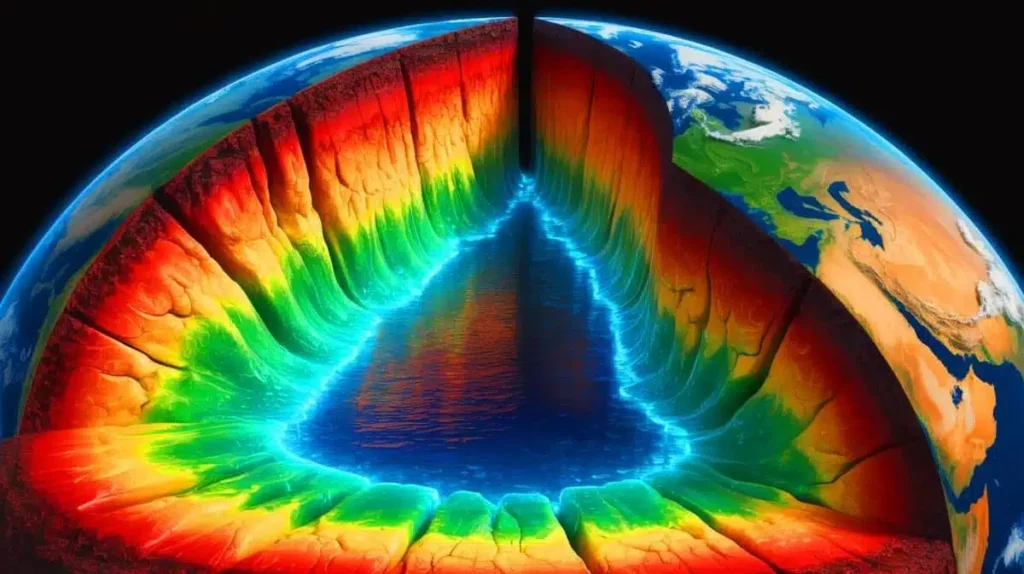
Deep mantle anomalies lie nearly 2,900 kilometers beneath our feet, hidden in a region no human has ever reached. Through millions of seismic signals and advanced deep learning, scientists have uncovered six mysterious zones at the mantle–core boundary, revealing a world far more complex than we ever imagined.
Deep Mantle Anomalies at 2,900 Kilometers Beneath Our Feet
Beneath our feet exists a world no human being has ever seen. A world we cannot reach, cannot photograph, cannot touch. And yet it is there—immense, silent, in constant motion. It is the deep mantle of the Earth: a remote, shadowed region living under impossible temperatures and crushing pressures.
The deepest point ever reached by human drilling is nothing more than a scratch on the planet’s surface. And yet scientists can still reconstruct what happens thousands of kilometers below.
How? By using earthquakes.
Every major earthquake sends waves through the Earth—waves that behave like the pulses of a gigantic natural scanner. Some travel straight through, others bend, others scatter when they encounter regions with different physical properties. These signals are tiny, fragile, difficult to distinguish. But inside them lies a story.
And by analyzing millions of these waves, a team of researchers has built a new map of the planet’s interior. A map that reveals something surprising: six mysterious anomalies near the boundary between the mantle and the Earth’s core.
A Giant Natural Scanner
Imagine the Earth as a perfect sphere. We cannot cut it open. We cannot look inside. But every earthquake produces a natural scan that travels through the planet.
Seismic waves pass through different types of rock and change behavior when they encounter materials with different properties. Some of these signals are so faint that, for decades, they remained invisible.
Among the most valuable are the so‑called PKP precursors—tiny waves created when the main seismic waves scatter off irregularities in the deepest parts of the mantle.
The problem? They are incredibly hard to find. You must search for them inside an enormous ocean of data.
This Is Where Artificial Intelligence Steps In
The research team used deep learning techniques to analyze more than 2 million seismic waveforms recorded between 1990 and 2024.
From this immense archive, the AI identified 174,929 possible PKP precursors—a dataset roughly an order of magnitude larger than anything previously used for this type of research.
In practice, artificial intelligence did what no human could have done manually: it found tiny, scattered signals that reveal the story of Earth’s deepest interior.
At Nearly 2,900 Kilometers Below Us
Now comes the most fascinating part.
The analyzed signals allow scientists to study the lowest region of the mantle, near the boundary between the mantle and the core. This boundary lies at about 2,900 kilometers beneath the surface.
It is one of the most mysterious zones of our planet. Here, the rocky mantle meets the outer core, composed mainly of molten metals under extreme temperature and pressure. No probe has ever reached this depth. No drill. No camera. Only seismic waves traveling through the Earth.
Six Anomalies Draw Attention
The new global map has revealed six regions with anomalous characteristics, associated with the distribution of seismic scatterers in the deep mantle.
These anomalies lie beneath or near:
– the Iberian Peninsula and Central Europe – northern Eurasia – the northwestern Pacific and Alaska – southern Africa and the Mozambique Channel – the southern sector of the Atlantic Ocean – the Antarctic platform
They are not “six objects.” They are not solid structures. They are not caverns or hidden mountains. They are zones of scattering, regions where seismic waves behave in unusual ways. Which means one thing: something down there is different.
What Are These Anomalies?
Science does not yet have a definitive answer.
They could be:
– variations in mantle composition – unusually hot regions – zones with different mineral structures – material from ancient tectonic plates that sank into the mantle through subduction Or something we have not yet imagined. The new map does not reveal what they are. It reveals where they are. And that is the first step toward understanding what lies in the planet’s depths.
Why Is This Region So Important?
The boundary between mantle and core is one of the key zones for understanding Earth’s internal dynamics. The mantle is constantly moving. Heat rising from the core drives convection processes that, over millions of years, influence plate tectonics, continental formation, and volcanic activity.
Understanding the small variations at the base of the mantle means understanding the thermal and dynamic history of the planet.
Earth Is Far More Irregular Than It Appears
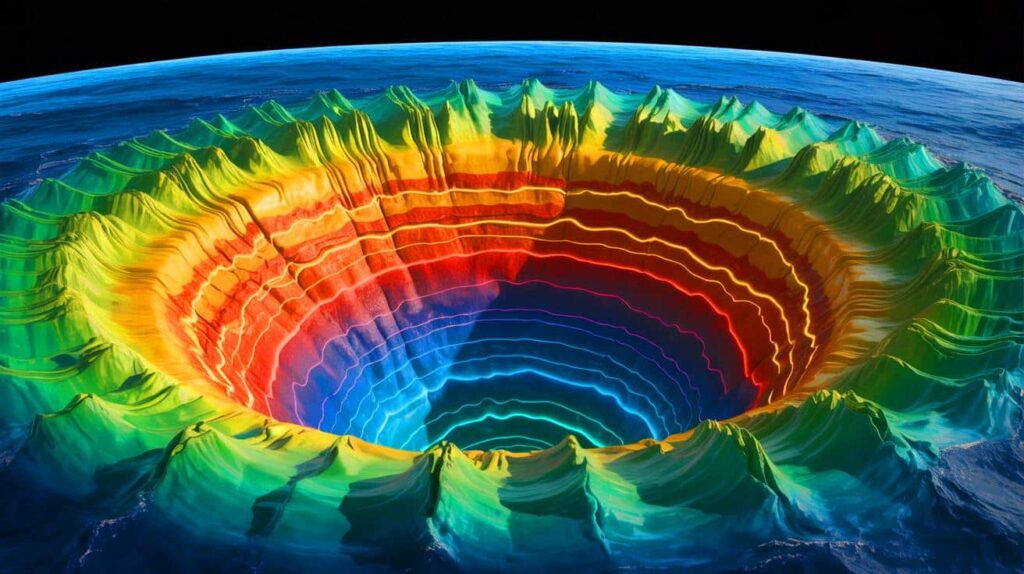
From space, Earth looks like a smooth, uniform sphere. But beneath the surface lies a world of contrasts—complex, irregular, full of hidden structures. The new map suggests that deep‑mantle heterogeneities are far more widespread than previously thought. And this changes the way we imagine the planet.
Artificial Intelligence Did Not “See” Inside the Earth
This point is crucial. AI did not produce an image of the mantle. It did not “see” the anomalies. It identified signals—tiny signals. And scientists interpret those signals using the physics of seismic waves. Technology made it possible to analyze far more data. But understanding that data remains a complex scientific challenge.
A Discovery That Opens New Questions
The study was published on August 23, 2026, in the Journal of Geophysical Research: Solid Earth. And like every major discovery, it does not close a story. It opens one.
Are the anomalies remnants of ancient tectonic plates? Are they unusually hot regions? Do they have a different chemical composition? How large are they? How deep? How did they form? These questions may take years—or decades—to answer.
A Planet We Can Explore Without Reaching It
Perhaps this is the most astonishing aspect. We cannot send a camera 2,900 kilometers down. We cannot drill to the mantle‑core boundary. We cannot collect a rock sample. And yet we can study that hidden world. An earthquake occurs somewhere on Earth. Its waves travel through the planet. Instruments record what arrives on the other side.
After millions of recordings—and with the help of deep learning—those signals become a language. And that language is telling us that Earth’s deep interior is far more complex than we ever imagined.
The Mystery Is Still Beneath Our Feet
The new research did not find hidden cities, giant caverns, or mysterious objects. It found something far more scientifically intriguing: traces of heterogeneity in the extreme depths of the Earth.
Tiny signals from a region no human has ever reached. And because we still cannot fully explain what produces them, the story does not end here.
It begins here.
Because every future earthquake may add another small piece to the map of a world that, despite living on its surface for thousands of years, remains almost completely hidden.
Deep inside Earth’s crust, there are places where the planet itself seems to vibrate with a low, unexplained resonance. These phenomena echo the same sense of hidden complexity we find in the deep mantle anomalies, reminding us that Earth’s interior is full of mysteries we can detect only through indirect signals. Explore this strange acoustic phenomenon in The Mountains That Hum.
Just as seismic waves reveal the presence of deep mantle anomalies, the airflow inside breathing caves shows how invisible forces move through Earth’s hidden spaces. These caverns inhale and exhale with temperature shifts, creating natural rhythms that mirror the dynamic processes occurring far below the mantle. Discover how these underground passages come alive in Breathing Caves.
