
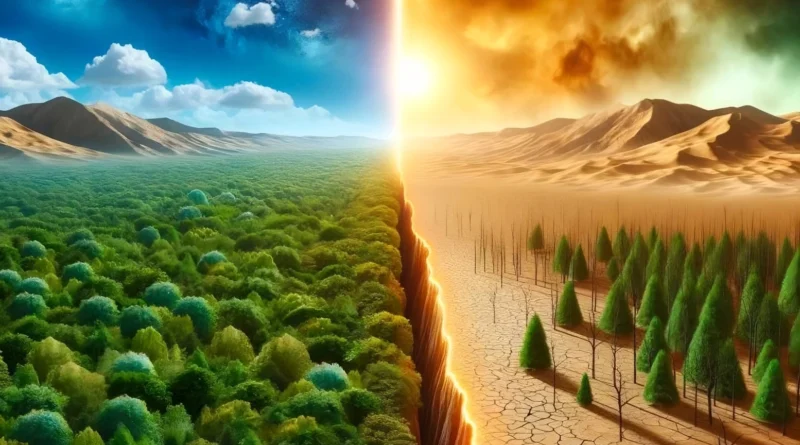
The Urgent Science Behind Climate Migration: How Environmental Change Is Reshaping Humanity
by Aria Lorne — Environmental Issues & Climate
Climate migration is no longer an abstract concept. It is a measurable, modeled and systematically discussed phenomenon within the scientific community and major international institutions. The World Bank’s Groundswell report shows that, without effective climate and development policies, up to 216 million people could be forced to migrate within their own countries by 2050 across the six macro‑regions analyzed. This is not a single event, but a slow structural transformation driven by three major dynamics: water stress, declining agricultural productivity and rising sea levels.
In South Asia, rising temperatures and intensifying heat stress are reducing the capacity for outdoor labor. Recent studies on rural‑to‑urban migration hotspots in India estimate a 10% decline in work capacity between 1980 and 2021 due to the combined increase in temperature and humidity. This does not mean outdoor work has become “impossible” everywhere, but in many regions it is becoming progressively more dangerous, less productive and increasingly dependent on adaptation measures such as modified schedules, protective infrastructure and cooling strategies. When the climate pushes the human body toward its physiological limits, mobility becomes one of the possible responses.
In the United States, the trend is already visible. In 2023, Phoenix recorded 31 consecutive days above 110°F, a record that strained healthcare systems, infrastructure and energy networks. Events like this are not just meteorological extremes; they are signals of a climate that is making certain areas increasingly difficult to inhabit without significant adaptation.
Water, soil and productivity form the core of climate‑driven pressure. The Colorado River Basin, which supports roughly 40 million people, is in the midst of a multi‑decade drought that paleoclimate studies describe as one of the most severe in the past 1,200 years. When a water system of this scale enters stress, the consequences are not local: they affect agriculture, energy, cities, labor and, ultimately, mobility decisions.
In Sub‑Saharan Africa, the most scientifically solid picture is not that of a desert “advancing by kilometers every year,” but of land degradation. UNCCD data indicate that between 2015 and 2019 the share of degraded land increased from 7.14% to 14.5% across the region. A more accurate formulation is that land degradation and desertification are reducing the productivity of vast areas, increasing pressure on communities that depend on agriculture and water resources. In many contexts, migration is not the first response, but it becomes a concrete possibility when local adaptation and institutional support are insufficient.
Sea‑level rise is one of the clearest and most precisely measured signals of climate change. In several areas of Latin America and the Caribbean, sea levels are rising at rates above 3.5 mm per year. Along the Atlantic coast of South America south of the equator, the WMO recorded an increase of 3.52 mm per year between 1993 and 2021. This is not a uniform value for the entire region, but a precise regional measurement showing how some coastlines are experiencing growing pressure.
A rate of 3.5 mm per year does not automatically mean that communities “cannot adapt.” Vulnerability depends on subsidence, erosion, infrastructure, economic resources, urbanization, coastal defenses and institutional capacity. A more rigorous formulation is that these rates increase pressure on coastal communities and make adaptation more complex, especially in areas already exposed to erosion, subsidence and flooding. In contexts where resources for coastal protection are limited, migration can become one of the options on the table.
Scientific literature increasingly discusses adaptation limits: thresholds beyond which local strategies—new crops, infrastructure, protective systems, modified work schedules—are no longer sufficient to ensure stable living conditions. When the climate approaches or exceeds these limits, mobility becomes a possible strategy, but never the only one, nor automatically “inevitable.”
Migration decisions depend on income, employment, policy, conflict, family networks and access to information. Only part of these choices is directly attributable to climate. It is therefore more accurate to say that climate change increases the likelihood that migration becomes a response, especially in areas where environmental conditions reduce agricultural productivity, water security or urban livability.
Scientifically, climate migration remains a social phenomenon strongly influenced by physical factors (climate, soil, water), economic conditions, political decisions and demographic dynamics. Describing it as a “physical phenomenon” would be incorrect: climate is the driver, migration is the human response.
The picture emerging from World Bank projections is that of a structural transformation: up to 216 million internal climate migrants by 2050 across the six macro‑regions analyzed, with migration hotspots potentially emerging as early as 2030 and intensifying thereafter. At the same time, the same models show that effective climate and development policies could reduce this scale by up to 80%, if emissions, resilience, urban planning and resource management are addressed decisively.
Climate migration is not only a signal of crisis; it is also an indicator of the capacity—or incapacity—of societies to adapt. It is a global story that involves those who leave, those who stay and those who receive, highlighting the direct link between political choices, climate justice and the future of communities. For Zemeghub, telling this phenomenon with scientific rigor means holding together numbers, adaptation limits, regional variability and the human dimension—not as an isolated alarm, but as a central part of the world that is emerging.
The Hidden Signals of a Warming Autumn A deep look at how rising temperatures and shifting seasonal patterns reveal early climate signals that often go unnoticed.
Extreme Heat 2026: A Dangerous New Era of Global Warming An analysis of the global temperature anomaly map that shows how 2026 pushed heat levels far beyond historical averages.
