
Megacities of the Future: How Humanity Will Live in the Urban Giants of 2050–2100
Megacities of the Future will define the next century, reshaping how billions of people live, move and survive inside the largest urban environments humanity has ever created.
Megacities of the Future and the Global Shift Toward Urban Density
By the middle of the twenty‑first century, the world will enter an era defined not by nations, but by cities. The United Nations projects that by 2050 the global population will reach 9.7 billion, and nearly seventy percent of humanity will live in urban areas. This shift will not simply expand existing cities; it will create a new class of urban organisms: megacities exceeding thirty, forty, even fifty million inhabitants. These cities will not resemble anything humanity has built before.
They will be dense, vertical, technologically integrated, and shaped by demographic pressure, climate change, and economic gravity. They will become the engines of civilization, the places where culture, innovation, conflict, and survival converge.
The rise of megacities is not a distant scenario. It is already happening. Tokyo, with its 37.2 million residents, is the largest metropolitan area on Earth, but it will not remain alone at the top. Lagos, Mumbai, Dhaka, Karachi, and Kinshasa are growing at rates that exceed historical precedent. According to the World Urbanization Prospects, Lagos could surpass thirty‑two million inhabitants by 2050 and approach forty‑five million by 2100.
Kinshasa, which had fewer than ten million residents in 2020, may exceed thirty million by mid‑century. Dhaka, already one of the densest cities in the world, is projected to reach thirty‑five million inhabitants by 2050. These numbers are not speculative; they are grounded in demographic trends that have remained consistent for decades.
The megacities of the future will not grow uniformly. Each will evolve according to its geography, culture, economy, and political structure. Tokyo will become a hyper‑connected vertical labyrinth. Lagos will expand outward and upward simultaneously, driven by necessity rather than design. Mumbai will compress itself into towering districts that rise hundreds of meters above the Arabian Sea.
Dhaka will struggle against climate pressure, building elevated districts to escape rising waters. São Paulo will expand its metropolitan footprint until it merges with neighboring cities, forming a continuous urban corridor. These transformations will redefine what it means to live in a city.
Tokyo offers the clearest preview of the future. Although Japan’s population is aging and shrinking, Tokyo’s density will increase as the city reorganizes itself into vertical districts. The “Smart Tokyo” initiative is already laying the foundation for this transformation. More than three million sensors have been installed across the metropolitan area, feeding real‑time data into an artificial intelligence system that monitors traffic, weather, energy consumption, and public movement.
The metropolitan government expects this system to reduce congestion by twenty percent by 2030 and cut emissions by thirty percent by 2040. Tokyo will become the first megacity where artificial intelligence functions as an invisible infrastructure, coordinating transportation, energy, public safety, and environmental management. It will be a city where data flows as freely as water, shaping the rhythm of daily life.
Mumbai represents a different kind of future. India’s population is still growing, and Mumbai’s metropolitan area is projected to reach twenty‑eight million inhabitants by 2050. The city has no room to expand horizontally; it is trapped between the sea and the mountains. As a result, Mumbai will grow vertically. The Indian government is already planning districts composed of towers between four hundred and six hundred meters tall, connected by high‑speed underground transport systems and supported by energy‑independent residential zones.
These towers will not be luxury skyscrapers; they will be essential infrastructure, housing tens of thousands of people each. Mumbai will become a city where vertical expansion replaces horizontal sprawl, a place where daily life unfolds hundreds of meters above the ground.
Lagos is the most dramatic example of future urban pressure. With more than fifteen million inhabitants in 2020, Lagos is already one of the largest cities in Africa. By 2050 it will exceed thirty‑two million, and by 2100 it may reach forty‑five million. This growth will require infrastructure capable of absorbing nearly one million new residents every three years.
Lagos will need autonomous transportation systems, distributed energy networks, and neighborhoods capable of producing their own resources. It will become a megacity defined by necessity, a place where innovation emerges from the urgency of survival. The city will face challenges that no urban center has ever confronted: extreme density, climate vulnerability, and rapid demographic expansion. Yet Lagos will also become one of the most dynamic cities in the world, a hub of culture, commerce, and technological experimentation.
Dhaka will face a different kind of pressure. Bangladesh is one of the countries most vulnerable to climate change, and Dhaka’s future will be shaped by rising sea levels, extreme weather, and population growth. The city is projected to reach thirty‑five million inhabitants by 2050, but much of its surrounding land is at risk of flooding.
As a result, Dhaka will build elevated districts, floating infrastructure, and climate‑resilient housing. The city will become a laboratory for survival in a warming world, developing technologies and architectural solutions that other coastal megacities will eventually adopt. Dhaka’s future will be defined by adaptation, a continuous struggle against environmental forces that threaten its existence.
Kinshasa, the capital of the Democratic Republic of Congo, will become one of the largest cities in Africa. With a population that could exceed thirty million by mid‑century, Kinshasa will face challenges related to infrastructure, governance, and economic development.
Yet it will also become a cultural powerhouse, a center of music, art, and innovation. The city’s growth will be driven by a young population, with a median age under twenty. This demographic energy will shape Kinshasa’s future, making it one of the most vibrant megacities of the twenty‑first century.
São Paulo will expand its metropolitan footprint until it merges with neighboring cities, forming a continuous urban corridor that stretches for hundreds of kilometers. The city already has more than twenty‑two million inhabitants, and its growth will continue as Brazil’s economy evolves.
São Paulo will become a megacity defined by scale, a place where urban life extends beyond traditional boundaries. It will develop advanced transportation systems, including autonomous buses and high‑speed rail, to connect its sprawling districts. The city will also invest in vertical housing, green infrastructure, and digital governance to manage its complexity.
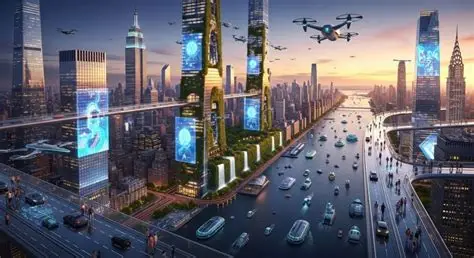
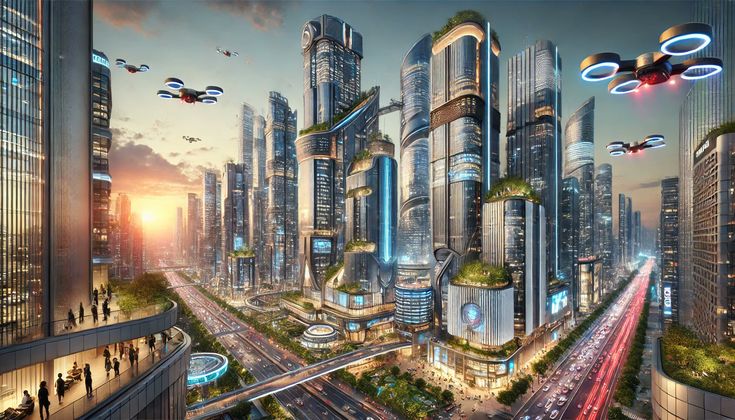
The megacities of the future will share certain characteristics. They will be vertical, with towers rising hundreds of meters above the ground. They will be autonomous, producing their own energy through solar, wind, and bio‑composite systems. They will be managed by artificial intelligence, which will coordinate transportation, energy, public safety, and environmental management.
They will rely on aerial mobility, with electric vertical takeoff aircraft transporting residents across the city in minutes. They will develop self‑sufficient districts, where housing, work, education, and healthcare are integrated into a single ecosystem. They will function as living organisms, adapting continuously to climate, population, and technological evolution.
By 2100, according to the IPCC, more than seventy‑five percent of the global population will live in cities. The megacities of the future will become the engines of civilization, shaping culture, innovation, and economic growth. They will also become the places where humanity confronts its greatest challenges: climate change, resource scarcity, and social inequality.
These cities will not be optional. They will be necessary. They will emerge from the intersection of technology, demography, climate, energy, and culture. And they will become the places where humanity learns to live differently, not because it chooses to, but because it must.
Technologies That Will Change the World by 2050 — The Astonishing Future Taking Shape Today A concise exploration of the breakthroughs that will redefine global society by mid‑century, from AI‑driven infrastructures to transformative energy systems already reshaping the foundations of our future.
