
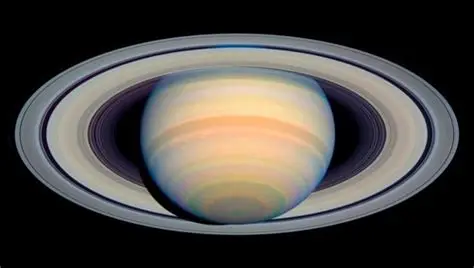
The Astonishing Saturn South Pole Decagon: A New Atmospheric Geometry Emerges
Saturn south pole decagon. That’s what astronomers have begun calling the gigantic ten‑sided atmospheric structure emerging at Saturn’s south pole. A new phenomenon, never seen before, captured by Hubble as it was forming and growing stronger.
Saturn has always looked like a world borrowed from science fiction. Its rings, its storms, and the famous hexagon swirling at the north pole have made it one of the most iconic planets in the Solar System. And yet, just when we thought we understood its signature features, Saturn has revealed something entirely new.
A decagon. A gigantic ten‑sided atmospheric structure circling the planet’s south pole. Something Cassini never saw during its thirteen years in orbit. Something that seems to be forming right now, becoming stronger, as if the planet were sketching a new geometric symbol inside its own atmosphere.
And this time, astronomers have caught it in the act.
The astronomers did not expect the Saturn south pole decagon to appear so quickly, almost as if Saturn had decided to reveal a new part of its atmospheric identity.
Saturn South Pole Decagon: A New Atmospheric Geometry Appears
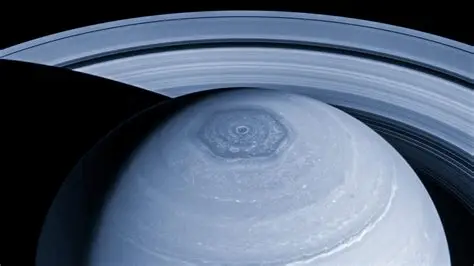
Observations from NASA’s Hubble Space Telescope show that the structure is not solid, not artificial, not drawn onto a surface. Saturn has no surface. What we are seeing is an atmospheric wave, a colossal oscillation embedded inside one of the planet’s powerful jet streams.
NASA describes it as a ten‑sided wave extending across multiple atmospheric layers. This detail matters. It means the decagon is not a single cloud formation at one altitude. It is vertical, stratified, shifting slightly depending on the wavelength used to observe it. A sign that the structure is three‑dimensional, complex, alive.
And absolutely real.
When Hubble confirmed the presence of the Saturn south pole decagon, many researchers realized they were witnessing a phenomenon that had never appeared in Cassini’s historical images.
The Ghost of the North Pole
To understand how extraordinary this discovery is, we only need to look at the opposite pole. Saturn’s north pole hosts a massive hexagon, a perfectly shaped atmospheric structure observed for more than forty years. Cassini photographed it endlessly. Voyager saw it. Hubble continues to monitor it. It has become part of Saturn’s identity.
For decades, scientists searched for something similar at the south pole. Cassini observed that region from 2004 to 2017 and found nothing. The south pole seemed quiet, featureless, almost indifferent.
Then, suddenly, in 2023, something changed.
How the Saturn South Pole Decagon First Emerged in 2023
The first hints of the structure appeared in 2023 through the Outer Planet Atmospheres Legacy (OPAL) program. At first, they were barely noticeable: a faint wavy band, a subtle distortion.
In 2024, Earth‑based observations began to show a weak atmospheric ripple around the south pole. Among the first to notice it were Agustín Sánchez‑Lavega and two amateur astronomers, Trevor Barry and Jean‑Paul Oger. It is a strangely poetic detail: a planetary‑scale phenomenon first spotted by people observing Saturn from Earth, with instruments far less powerful than Hubble.
The Saturn south pole decagon is not just a geometric curiosity; it is a window into atmospheric processes we still do not fully understand. Their observations drew scientific attention. Hubble turned again toward the south pole. And the decagon emerged, clearer, sharper, unmistakable.
In 2024, Earth‑based observers began to notice that the Saturn south pole decagon was becoming more visible, as if Saturn were strengthening its new structure.
A Geometry That Should Not Exist
The question everyone is asking is simple: Why a decagon?
Atmospheric waves inside jet streams can form regular shapes when certain dynamic conditions are met. This is the same principle behind the famous hexagon at the north pole. But the south pole had never shown anything similar. For decades, it remained free of persistent geometric structures.
Now, Saturn seems to be writing a new chapter.
The decagon is not yet stable. It is not fully formed. It appears to be strengthening, evolving, as if the planet were slowly carving a new atmospheric signature into its southern hemisphere.
Why the Saturn South Pole Decagon Is Strengthening Over Time
Saturn is a natural laboratory that Earth could never replicate. Its atmosphere is a colossal weather engine driven by internal heat, rapid rotation, temperature gradients, and winds that can exceed 1,000 km/h. The new decagon may help scientists understand why the two poles behave so differently. Why the north has hosted a stable hexagon for forty years. Why the south is only now beginning to generate a regular structure.
Astronomers plan to continue observing the phenomenon with Hubble, the James Webb Space Telescope, and advanced atmospheric models.
The questions are many, and none have answers yet.
How did the decagon form? Why did it appear only recently? Will it last? Will it become stable like the northern hexagon? Or is it a temporary phenomenon destined to fade?
Saturn Is Showing Us Something New
For now, everything remains open. For more than forty years, Saturn has been defined by its hexagon. It was a certainty, a symbol, a familiar mystery.
Now the planet is showing us another geometry. A decagon that should not exist, yet is clearly there, circling the south pole like a message from a distant, unpredictable world.
It is not a fantastical mystery. It is something far more interesting: a real atmospheric phenomenon that science is witnessing as it forms, changes, and grows. And perhaps, for the first time, we have the chance to watch a giant atmospheric structure evolve before our eyes.
For scientists, the Saturn south pole decagon represents a rare opportunity: watching a massive atmospheric structure as it forms and transforms over time.
Scientific Source
Study published in Science Advances in September 2026, based on Hubble/OPAL observations and Earth‑based observations.
As Saturn reveals its new atmospheric geometry, it’s impossible not to think of other places where nature behaves in unexpected ways — like the Earth’s own Breathing Caves, where air moves through stone as if the planet were alive.
And just as the decagon challenges our expectations of planetary behavior, so do the Rivers That Flow Backwards, moments in which water defies gravity and logic, reminding us that Earth too has its impossible stories.
