
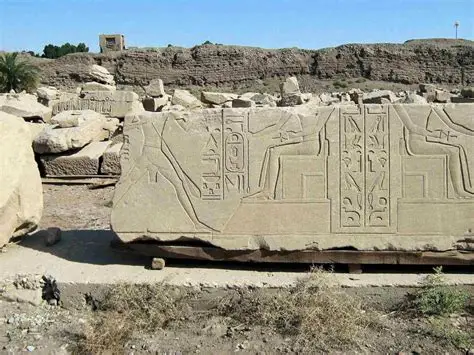
Thutmose II Tomb Discovery 2025 — The Lost Pharaoh’s Burial That Redraws the Theban Necropolis
Thutmose II tomb discovery 2025 marks one of the most significant breakthroughs in modern Egyptology, as archaeologists finally identified the long‑lost burial of the 18th‑Dynasty pharaoh in the remote Western Wadis of the Theban necropolis. The announcement, made in February 2025 by a joint Egyptian‑British mission, has reshaped the archaeological map of ancient Thebes and reopened a century‑old mystery surrounding the short and enigmatic reign of Thutmose II.
In February 2025, in a remote and almost forgotten sector of the western Theban necropolis, a joint team of Egyptian and British archaeologists announced a discovery that immediately captured global attention: the identification of the tomb of Pharaoh Thutmose II, one of the most enigmatic rulers of Egypt’s 18th Dynasty. This was not just another archaeological find, but a missing piece scholars had been searching for over a century.
The tomb is not located in the Valley of the Kings proper, as many headlines simplistically reported, but in the Western Wadis, a rugged desert region situated about 2.4 kilometers west of the main valley. It is a harsh landscape of rocky canyons, where fine sand settles into every crevice and the sun beats down with a force that seems determined to erase the past. It was here, in a wadi known as Wadi C (Gabbanat el‑Qurud), that the mission of the New Kingdom Research Foundation, working alongside Egypt’s Ministry of Antiquities, identified a structure initially believed to be a minor tomb belonging to a high-ranking official.
Everything changed when archaeologists began clearing the interior walls. Beneath layers of debris and disintegrated limestone, scenes from the Amduat emerged—the sacred text describing the pharaoh’s journey through the afterlife. This type of iconography was reserved exclusively for kings. Soon after, fragments of inscriptions revealed two unmistakable names: Thutmose II and Hatshepsut. At that point, all doubt vanished. The tomb belonged to the fourth pharaoh of the 18th Dynasty, husband of Hatshepsut and father of Thutmose III.
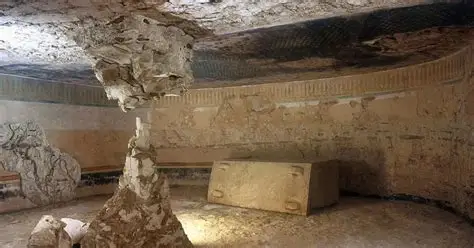
The burial chamber, carved into the limestone, has a simple yet solemn structure. The walls, though damaged by ancient collapses, still preserve traces of red and black pigments. The partially collapsed ceiling reveals the construction techniques typical of early New Kingdom royal tombs. Yet what surprised archaeologists most was not what they found—but what they didn’t find.
The tomb was almost completely empty.
There were no intact sarcophagi, no funerary objects, no amulets, no canopic jars. Only scattered fragments remained, as if someone had carefully cleared the chamber. At first, scholars suspected ancient looters, but a closer analysis revealed a decisive detail: evidence of flooding.
Fine sediment deposits, mineral crusts on the walls, and a clear erosion line indicated that the tomb had been inundated shortly after the burial. Perhaps a sudden flash flood in the wadi, or water infiltration caused by an exceptional climatic event. Whatever the cause, the flooding would have rendered the burial chamber unusable. It is likely that priests retrieved the pharaoh’s body and his funerary equipment, transferring them to another, still‑unknown tomb.
This possibility immediately sparked debate within the scientific community. If a second, intact tomb of Thutmose II exists, it may still lie hidden beneath the desert hills surrounding Luxor. Such a discovery would rival, in importance, the finding of Tutankhamun’s tomb in 1922.
The 2025 discovery also carries immense historical value. Thutmose II is a complex figure: his reign was relatively short, overshadowed by the powerful Hatshepsut and by his son Thutmose III, and for centuries his burial remained a mystery. Identifying his tomb allows scholars to reconstruct the royal genealogy, the political dynamics of the early 18th Dynasty, and the evolution of funerary practices at the dawn of the New Kingdom.
From a methodological standpoint, the discovery is a perfect example of modern archaeology. The team combined 3D mapping, geophysical surveys, stratigraphic analysis, and a fresh reading of excavation diaries from the 19th and 20th centuries. It was a small detail noted by an archaeologist in 1914—ignored for decades—that suggested the area might hide something far more significant than previously believed.
Today, as researchers continue to examine every fragment recovered from the site, the tomb of Thutmose II has become an open‑air laboratory. Every pigment, every scratch, every mineral deposit tells a story. And each new analysis brings archaeologists closer to the possibility of locating the pharaoh’s true final resting place.
The discovery is not just a scientific milestone—it is an invitation to look at the Theban necropolis with renewed curiosity. Despite more than two centuries of exploration, the desert still guards secrets waiting to be revealed.
And for readers fascinated by the world of pharaohs and the extraordinary objects that accompanied them in life and death, this story connects naturally to another remarkable topic already explored on Zemeghub.
👉 Tutankhamun’s Meteoric Dagger: A Celestial Gift That Rewrites Ancient Egyptian History