
Curiosity Rover Wheel Damage: What 14 Years on Mars Reveal About the Rover’s Survival
Written by Bernardin Moreardino
A New Image Reveals Significant Wear on Curiosity’s Wheels
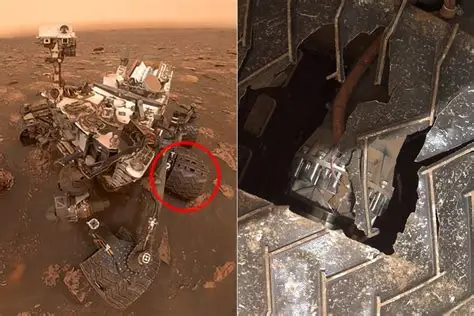
Curiosity rover wheel damage is clearly visible in a new close-up image captured on July 23, 2026, during Sol 4963 of the rover’s mission. The photo shows deep cracks and collapsed sections on one of Curiosity’s aluminum wheels, revealing the physical impact of fourteen years of continuous exploration on Mars.
A recently released close-up image from NASA’s Curiosity rover shows extensive damage to one of its aluminum wheels. The photo, taken on July 23, 2026 (Sol 4963), using the rover’s Mars Hand Lens Imager (MAHLI), highlights deep cracks, collapsed sections, and structural fatigue caused by fourteen years of continuous movement across the Martian surface.
The wheel appears heavily stressed, with multiple fractures that expose the internal structure. This level of wear is not unexpected, but it is a clear reminder of the extreme conditions Curiosity faces daily.
Fourteen Years of Harsh Terrain
Curiosity landed in Gale Crater on August 5, 2012. Since then, it has traveled more than 20 miles (32 kilometers) across terrain that is far more abrasive than anything found on Earth. Mars lacks weathering processes such as rain, wind erosion, or biological activity. As a result, rocks remain sharp, angular, and capable of puncturing metal.
The rover weighs over one ton. Every rotation of its wheels presses that mass into the ground, grinding aluminum against jagged rock. Over time, this has produced:
- punctures
- cracks
- bent sections
- collapsed tread areas
NASA engineers anticipated wheel damage, but the long duration of the mission has pushed the hardware far beyond its original design expectations.
Why the Wheels Are Breaking
Curiosity’s wheels are made of thin aluminum to reduce weight. They include open treads designed to grip loose soil and distribute stress. However, Mars presents several challenges:
- Sharp basalt fragments that cut into metal
- Steep slopes that twist the wheel frame
- Hidden rocks beneath dust layers
- Extreme temperature swings that weaken structural integrity
The damage seen in the latest image is the cumulative result of thousands of sols of exposure to these conditions.
NASA’s Assessment: Still Operational
Despite the visible damage, NASA and JPL report that Curiosity’s wheels remain functional. The rover team regularly inspects them using MAHLI and adjusts driving strategies to reduce stress. These strategies include:
- selecting smoother routes when possible
- reducing wheel rotation on sharp terrain
- using onboard navigation software to avoid hazards
In a 2024 update, NASA stated that the wheels are “holding up well despite taking some of the worst abuse from Mars.” The latest image confirms that while the damage is significant, it is not mission-ending.
Curiosity continues to operate normally.
Impact on the Mission
The rover is currently exploring the lower regions of Mount Sharp, analyzing sediment layers that record Mars’ ancient environmental history. The wheel damage does not prevent Curiosity from:
- driving
- drilling
- collecting samples
- performing chemical analysis
- sending data to Earth
However, engineers will continue to monitor the wheels closely. If damage progresses, they may further limit travel over hazardous terrain.
Lessons for Future Rovers
Curiosity’s wheel degradation provides valuable data for future missions. Engineers designing next-generation rovers — including those planned for Mars Sample Return — now have real-world evidence of how long-term exposure affects mobility systems.
Key lessons include:
- thicker wheel materials may be necessary
- improved tread patterns could reduce punctures
- adaptive driving algorithms can extend hardware lifespan
- terrain mapping should prioritize wheel preservation
Curiosity’s experience is shaping the future of planetary exploration.
A Realistic Look at Mars Exploration
The cracked wheel is not a symbol or a metaphor. It is a technical reality.
Mars is a hostile environment for machinery. Every rover sent there will accumulate damage over time. Curiosity’s latest image simply shows the cost of operating on a planet where nothing softens the terrain and every movement is a mechanical challenge.
Despite this, Curiosity remains one of NASA’s most successful missions. Its instruments continue to function, its scientific output remains high, and its endurance provides critical insights into Mars’ geological and environmental history.
The new wheel image is a clear reminder of the physical stress Curiosity endures. Fourteen years of exploration have left visible marks, but the rover continues to operate effectively. NASA’s monitoring and adaptive driving strategies ensure that Curiosity can keep moving, keep analyzing, and keep contributing to our understanding of Mars.
The damage is real. The mission continues.
