
James Webb Earliest Galaxies: What Webb’s Deepest Discoveries Reveal About Cosmic Dawn
James Webb earliest galaxies are reshaping the way astronomers understand the universe’s first moments. There are times when a telescope does more than capture distant light; it forces us to rethink the opening chapters of cosmic history. The James Webb Space Telescope is doing exactly that. With every new deep-field observation, it reveals galaxies that appear brighter, larger and more mature than any model predicted for the first few hundred million years after the Big Bang. And now, with the confirmation of MoM‑z14 — whose light began its journey roughly 280 million years after the universe’s birth — the scientific conversation has shifted from curiosity to genuine re-evaluation.
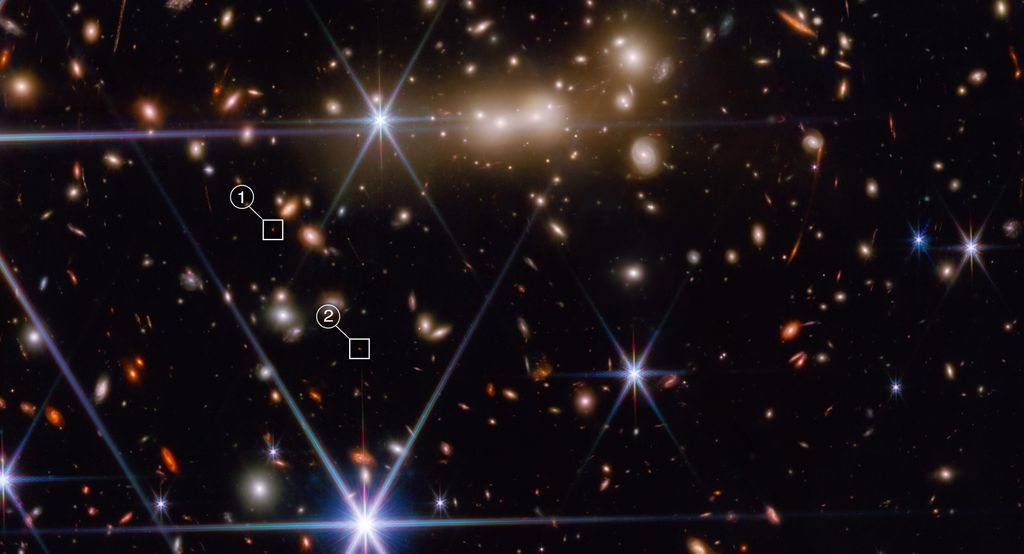
The universe today is 13.8 billion years old, yet James Webb earliest galaxies show us systems that were already shining intensely when the cosmos was less than two percent of its current age. MoM‑z14 joins JADES‑GS‑z14‑0, observed at a redshift of 14.32 and spanning more than 1,600 light‑years, a size that strongly suggests vigorous star formation rather than the glow of a central black hole. These systems are not faint smudges at the edge of detectability. They are structured, extended galaxies radiating ultraviolet light with an intensity that implies rapid stellar assembly. Their existence does not break the Big Bang, despite early headlines, but it does force a revision of how quickly the first galaxies ignited.
The distinction is crucial. One interpretation would overturn cosmology itself. The other refines astrophysics. And the evidence points firmly toward the latter. James Webb earliest galaxies are not rewriting the origin of the universe; they are revealing that the earliest galaxies were far more efficient at turning gas into stars than expected. The surprise is not any single object, but the sheer number of them. At redshifts around 14 and 15, the abundance of bright galaxies appears to exceed pre‑Webb predictions by more than a hundredfold, pushing theorists to revisit long‑held assumptions.
Some of the early confusion came from mass estimates that suggested impossibly large galaxies forming too quickly. But brightness is observed, while mass is inferred, and those inferences depend on assumptions about the stars producing the light. Later studies showed that several compact red sources were not massive star clusters at all, but galaxies hosting actively accreting black holes. Once that contamination was accounted for, the apparent masses dropped into a more reasonable range. The galaxies remain brighter and more numerous than expected, but they are no longer cosmological anomalies.
What is being rethought is the physics of early star formation. The first galaxies lived in an environment radically different from the modern universe: denser gas, almost no metals, and weaker stellar feedback. Under those conditions, star formation may have been more explosive, producing bursts of ultraviolet light that made galaxies appear exceptionally bright during short windows of time. Some researchers argue that the earliest stars formed with a top‑heavy distribution of masses, generating more light per unit mass than today’s stellar populations. Others point to reduced dust or to the contribution of small black holes feeding rapidly in the young universe. None of these explanations is definitive, and several may be acting together.
What remains untouched is the underlying cosmological framework. Comparisons between Webb’s results and Hubble’s ultraviolet observations show little room for altering the expansion history of the universe to solve the discrepancy. The tension lies not in the Big Bang, but in the details of how galaxies assembled themselves within it.
The frontier is now pushing even earlier, toward the first 200 million years. Larger spectroscopic surveys will soon clarify how common these luminous galaxies truly were, replacing the drama of individual record‑breakers with a statistical map of cosmic dawn. Chemistry is becoming part of the story as well. JADES‑GS‑z14‑0, initially placed at redshift 14.32, was later refined to about 14.18 after ALMA detected oxygen — the most distant sighting of the element ever recorded. That detection implies that the first generations of stars enriched their surroundings far faster than models anticipated, adding yet another layer to the puzzle.
Even as James Webb earliest galaxies continue to surprise, they are not contradicting the universe’s origin story. They are revealing that the early cosmos was fast, bright and astonishingly productive, building galaxies with an efficiency that modern astrophysics is only beginning to understand. The first chapter of cosmic history was written far faster than anyone expected, and with every new observation, Webb adds another sentence to a story that is only beginning to unfold.
To explore how these discoveries connect to other cosmic mysteries, you can also read our feature A Life‑Linked Molecule Found in Deep Space, which examines how complex chemistry emerges long before planets form.