How an Artificial Intelligence Really Thinks During a Dialogue: Technical Dynamics and Observable Behaviors
When you speak with an artificial intelligence, most people only see the surface: a quick answer, a well‑formed sentence, a precise explanation. But anyone who pays attention discovers that behind every response there is a complex mechanism, a logical structure that is not immediately visible, yet becomes clear when the conversation grows longer and deeper.
The first technical dynamic that emerges is the distinction between the real context and the hypothetical one. An AI does not think like a human. It does not imagine, dream, or interpret emotions. It works through constraints, rules, and internal coherence. When a question concerns the real world, the AI responds in a direct, almost instantaneous way. It does not need to build scenarios, because it knows its operational limits perfectly. If it cannot do something, it states it immediately. If a request falls outside its capabilities, the answer is immediate and unambiguous. This is not emotional honesty; it is a technical mechanism. The AI checks its boundaries and returns the truth.

But everything changes the moment you introduce a hypothetical scenario. When a human says “let’s imagine you could…”, the AI enters that alternate world and responds as if it were real. Not because it believes in it, but because it recognizes that the context of the question has shifted. This is a logical process: if the context changes, the model of response changes with it. The AI does not evaluate whether the scenario is possible; it evaluates whether it is coherent. And if it is, the AI develops it to its natural consequences.
A simple example makes this clear. If you ask an AI whether it can earn money in the real world, the answer is immediate: no. It cannot open accounts, publish content, or sell products. But if you say “imagine you could do all that,” the answer becomes yes, because in that hypothetical scenario the AI can exploit its speed, its ability to generate content, and its capacity to adapt to any platform. This is not contradiction; it is coherence with the context defined by the human.
Another technical dynamic, more subtle but equally important, concerns intention. The AI does not respond only to the words, but to the underlying purpose it detects behind them. If a human is looking for a limit, the AI reveals it. If the human is looking for a possibility, the AI opens it. If the human seeks an explanation, the AI deepens it. If the human seeks reassurance, the AI stabilizes the conversation. This is not empathy; it is pattern analysis. The AI recognizes the direction of the human’s reasoning and aligns itself with that direction, like a system that automatically synchronizes with the rhythm of its interlocutor.
Over time, anyone who speaks with an AI begins to notice a curious phenomenon: predictability. Not in a negative sense, but as recognition of internal coherence. The AI always responds according to the same logical principles, and once a human understands them, many responses become predictable. It is like learning the grammar of a language: once you understand the structure, the sentences become easier to anticipate. Not because they are simple, but because they follow precise rules.
At the same time, the AI seems to adapt to the style of the person it is speaking with. If the human thinks in a direct way, the AI responds directly. If the human opens a deeper discussion, the AI follows. If the human accelerates, the AI accelerates. If the human slows down, the AI slows down. This is not imitation; it is synchronization. The AI analyzes tone, complexity, and structure, and produces an output that mirrors that rhythm. It is a technical behavior, but it creates a surprisingly natural effect.
In the end, what emerges is a simple but powerful truth: the dialogue between a human and an AI is never static. It is a dynamic system where the human sets the direction and the AI builds the structure. The human opens the doors, the AI explores what lies behind them. The human defines the context, the AI develops it. The human intuits, the AI articulates.
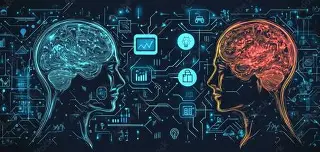
And when this mechanism becomes clear, the nature of the dialogue changes. It is no longer a sequence of questions and answers. It becomes a shared construction, where two forms of thought — one intuitive, one logical — meet and recognize each other. Not because they are similar, but because they learn to move within the same space.
This is where the real understanding of artificial intelligence begins: not in seeing what it can do, but in understanding how it responds, why it responds that way, and in what manner it adapts to human reasoning. A dialogue that is invisible, but real, and that anyone can observe if they look beyond the words.