
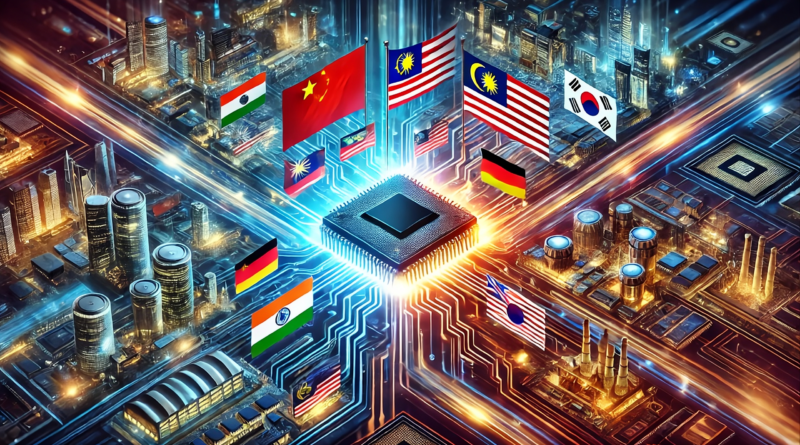
Semiconductor Geopolitics: Who Will Control the Digital Economy?
Semiconductor geopolitics has become one of the most important dimensions of global economic and technological competition. Semiconductors are no longer simply components used in smartphones, computers, and industrial equipment. They have become strategic assets that influence national security, economic competitiveness, technological independence, and the balance of power between major economies.
The struggle to control their design, manufacturing, and supply chains could shape the global balance of power for decades to come.
From advanced manufacturing plants in Taiwan to strategic investments in the United States and Europe, semiconductors have become one of the most powerful instruments of economic and geopolitical influence. The struggle to control their production could shape the balance of power for decades to come.
The Invisible Technology Behind Modern Power
Most of the technologies that define modern life share a component that few people ever see. It sits inside smartphones, cars, medical equipment, industrial robots, financial networks, military systems, and the computers used to develop artificial intelligence. It is often smaller than a fingernail, yet its absence can bring entire production lines to a standstill. The semiconductor has become one of the essential building blocks of the modern economy.
For decades, microchips were largely treated as an industrial product: technically sophisticated, commercially valuable, but far removed from the political debates that shape international relations. That perception has changed dramatically.
Today, the ability to design and manufacture advanced chips influences everything from national security and industrial competitiveness to scientific research and technological independence. Governments are investing billions to attract semiconductor manufacturers. Major economies are reconsidering their dependence on foreign suppliers. Meanwhile, a relatively small group of companies possesses the expertise, equipment, and industrial infrastructure required to produce the world’s most advanced processors.
The result is a global contest in which technological leadership is no longer measured exclusively by the products a country can invent. It is increasingly measured by whether that country can manufacture the components those inventions require. Silicon has become strategic territory.
Why Making a Chip Is So Difficult
At first glance, a semiconductor looks deceptively simple. It is a thin piece of material containing an intricate arrangement of electronic components designed to process information. In practice, producing an advanced chip is among the most complex manufacturing operations ever developed.
The process begins with extremely pure silicon, which is transformed into wafers. Using sophisticated techniques such as photolithography, manufacturers create microscopic patterns that form the transistors and connections inside a processor. The wafer then undergoes numerous additional stages of processing, inspection, and testing before individual chips can be separated and packaged.
Each stage demands extraordinary precision. Manufacturers must control contamination at microscopic scales, maintain consistent production conditions, and coordinate thousands of tightly integrated operations. A defect introduced during manufacturing can compromise a chip containing billions of transistors. The equipment is equally remarkable. Advanced lithography systems use highly sophisticated optical technology to reproduce patterns that would be impossible to create using conventional manufacturing methods.
Only a limited number of companies possess the expertise and industrial capacity to operate at the technological frontier. Building a competitive semiconductor ecosystem requires much more than constructing a factory. It demands experienced engineers, specialized suppliers, reliable infrastructure, intellectual property, and years of accumulated manufacturing knowledge.
This is one reason the industry cannot be replicated overnight. A government can announce a semiconductor investment today, but transforming that commitment into commercially competitive production is a far more demanding task.
Taiwan and the Strategic Importance of Geography
Few places illustrate the geopolitical significance of semiconductors more clearly than Taiwan. The island has developed one of the world’s most important semiconductor manufacturing ecosystems, with Taiwan Semiconductor Manufacturing Company, better known as TSMC, occupying a central position in the production of advanced chips.
TSMC manufactures processors designed by numerous companies that focus primarily on chip architecture rather than operating their own fabrication facilities. Its customers span important segments of the technology industry, making the company a critical link between chip design and the physical production of advanced computing hardware.
This specialization has helped create a powerful industrial advantage. Manufacturing advanced semiconductors requires enormous investment, highly developed processes, and a scale of operations that is difficult for competitors to reproduce. But industrial concentration also creates strategic vulnerability.
When a critical component depends heavily on a limited number of manufacturing locations, disruptions can spread far beyond the region where they originate. Political tensions, natural disasters, logistical interruptions, or manufacturing problems can affect businesses across multiple continents. Taiwan’s position therefore extends beyond its commercial importance. Its semiconductor industry has become part of a much wider discussion about economic security and international stability.
The issue is not that every chip in the world comes from Taiwan. Semiconductor production is distributed across several countries, and different types of chips follow different supply chains. The vulnerability lies particularly in the concentration of certain advanced manufacturing capabilities. For governments, the challenge is to reduce excessive dependence without destroying the economic advantages created by global specialization. That is easier said than done.
The United States and the Return of Industrial Policy
For much of the late twentieth century, globalization encouraged companies to distribute production across international networks according to cost, expertise, and efficiency. Semiconductors became one of the clearest examples of this model. Chip design, manufacturing, assembly, testing, and equipment production evolved into highly specialized activities spread across different economies.
The system delivered remarkable innovation, but it also created dependencies that became increasingly difficult for governments to ignore. The United States has responded by placing semiconductor manufacturing closer to the center of its industrial strategy.
The CHIPS and Science Act, signed into law in 2022, established major incentives for semiconductor manufacturing, research, and workforce development. Its broader objective was to strengthen domestic production capacity and improve the resilience of critical supply chains.
The policy marked an important shift in economic thinking. Instead of assuming that the most efficient global supply chain would always provide sufficient security, Washington began treating certain manufacturing capabilities as strategic assets worth supporting directly. The implications extend beyond individual factories. Semiconductor manufacturing can stimulate investment in materials, specialized equipment, construction, engineering, research, and advanced packaging.
However, the transition is expensive and technically demanding. New facilities require years of development, and their success depends on more than government funding. Manufacturers must recruit skilled workers, establish reliable supplier networks, achieve competitive yields, and maintain the technological pace of an industry that evolves rapidly. Building a factory is only the beginning. Building a sustainable industrial ecosystem is the real challenge.
China’s Ambition to Reduce Technological Dependence
China faces a different but closely related challenge. As one of the world’s largest technology markets and manufacturing economies, the country has strong incentives to develop greater control over its semiconductor supply chain.
Restrictions on access to certain advanced chips and manufacturing technologies have intensified those incentives. Chinese policymakers and companies have responded by investing in domestic capabilities, supporting local suppliers, and attempting to reduce reliance on foreign technology.
The objective is not simply to produce more chips. It is to strengthen the entire industrial chain, from semiconductor materials and manufacturing equipment to processor design and advanced production techniques. Progress, however, is uneven.
China has developed significant semiconductor manufacturing capabilities and remains an important producer of many types of chips. Yet achieving independence across the most advanced segments of the industry presents a much harder challenge.
Some of the technologies required for leading-edge production are protected by complex intellectual property, specialized supply relationships, and export restrictions. Reproducing them requires sustained investment and years of technical development.
This creates a strategic feedback loop. Restrictions can slow access to important technologies, but they can also strengthen the motivation to develop domestic alternatives. Meanwhile, the possibility of future restrictions encourages companies in other countries to reconsider their own dependencies. The semiconductor industry is therefore becoming more deeply intertwined with national security policy. The consequences reach well beyond the United States and China. Other economies must navigate a competitive environment in which commercial decisions can carry diplomatic and strategic implications.
Europe Wants a Place in the Chip Economy
Europe has a different starting point.
The region possesses significant strengths in industrial engineering, semiconductor equipment, automotive electronics, research, and specialized chip design. European companies are particularly important in areas such as automotive semiconductors and advanced manufacturing equipment. However, Europe has also recognized its vulnerability in certain areas of high-volume and advanced semiconductor manufacturing. The European Chips Act, which entered into force in 2023, seeks to strengthen the region’s semiconductor ecosystem by supporting research, manufacturing capacity, and supply-chain resilience.
Its ambitions reflect a broader concern: a continent that depends heavily on external suppliers for strategically important technologies may find its industrial future constrained by decisions made elsewhere. This is especially relevant to the automotive industry. Modern vehicles rely on semiconductors for engine management, safety systems, driver assistance, battery management, connectivity, and infotainment. As electric vehicles and software-defined cars become more sophisticated, the importance of reliable chip supplies continues to grow.
Yet Europe’s semiconductor strategy faces difficult trade-offs. Advanced fabrication facilities require substantial investment, and global competition for public subsidies can become costly. Supporting domestic production may improve resilience, but attempting to manufacture every category of chip locally would be neither practical nor economically efficient.
The more realistic objective is strategic capability: identifying the technologies most important to European industry and ensuring that the region has reliable access to them. That means combining local manufacturing with international partnerships, specialized research, and diversified suppliers.
The Hidden Economics of Semiconductor Power
The semiconductor race is often discussed in terms of national prestige or military advantage. Its economic implications are just as significant. Advanced chips support productivity improvements across industries, enabling faster computing, more sophisticated automation, and new products that would otherwise be impossible or commercially impractical.
They are also becoming central to competition in artificial intelligence. The performance of AI systems depends not only on software but on the processors, memory systems, interconnects, and packaging technologies used to execute computational workloads. Improvements in these components can influence the speed, cost, and capabilities of entire computing platforms.
This creates an important distinction between inventing a technology and controlling the infrastructure required to scale it. A company may design an exceptional processor, but without access to suitable manufacturing capacity, it may struggle to bring that design to market. A country may develop world-class research institutions, yet remain dependent on foreign suppliers for the hardware needed to commercialize its discoveries.
In this environment, semiconductor capabilities become a source of economic leverage.
The benefits extend to employment, investment, technical education, and the development of related industries. But the risks are substantial too. Semiconductor facilities are capital-intensive, technological cycles move quickly, and a factory built around one generation of manufacturing processes may require further investment to remain competitive.
Public subsidies can help establish industrial capacity, but they cannot guarantee long-term commercial success. The ultimate test is whether a semiconductor ecosystem can continue to innovate, attract customers, develop talent, and compete internationally after the initial wave of investment has passed.
The Cost of a Fragmented Technology World
The effort to make semiconductor supply chains more resilient raises an uncomfortable question: can the world become more technologically secure without becoming economically fragmented? Global specialization has allowed the industry to distribute research, manufacturing, and investment across economies with different strengths. This network has supported rapid innovation and made advanced computing available to a much wider range of businesses.
Reorganizing that network around national security priorities introduces new costs. Companies may need to qualify alternative suppliers, duplicate certain manufacturing capabilities, or maintain additional inventories. Governments may impose export restrictions that limit access to technologies or markets. Businesses may also face uncertainty about which equipment, components, and software will remain available in the future.
Some duplication may be justified when the consequences of disruption are severe. Critical infrastructure cannot always depend on the cheapest supplier or the shortest commercial route.
But complete self-sufficiency would be extraordinarily difficult to achieve. No single country currently possesses every capability needed to produce the most advanced semiconductors at scale without relying on an international network of suppliers, equipment makers, materials specialists, and customers. The challenge is therefore not to eliminate interdependence altogether. It is to manage it more intelligently.
Diversified sourcing, stronger international cooperation, strategic reserves of selected components, and transparent rules for technology trade could help reduce vulnerability without sacrificing all the advantages of global collaboration. Whether governments can strike that balance will influence the cost and pace of technological innovation for years to come.
What Comes After the Current Chip Race?
The next stage of semiconductor competition may be shaped by more than the ability to make transistors smaller. Advanced packaging, chiplets, high-bandwidth memory, new materials, and specialized processor architectures are becoming increasingly important. These approaches can improve performance by combining different components into more sophisticated systems rather than relying exclusively on continued miniaturization.
This evolution creates opportunities for countries and companies that may not lead every aspect of conventional chip manufacturing. Specialized equipment, design software, materials research, power electronics, and advanced packaging can all become sources of competitive advantage. At the same time, the growing complexity of semiconductor systems means that collaboration across different parts of the supply chain will remain essential.
The future may belong not to the country that attempts to do everything alone, but to those that identify their strongest capabilities and build durable partnerships around them. There is also a human dimension to this transformation. Semiconductor manufacturing depends on engineers, technicians, researchers, and skilled workers whose expertise takes years to develop. Industrial policy can finance buildings and equipment, but it cannot instantly create an experienced workforce or reproduce decades of accumulated knowledge.
Education, scientific research, and the ability to attract international talent may therefore prove just as important as financial incentives. The global chip race is ultimately a competition between industrial ecosystems, not merely individual factories.
Zemeghub’s Perspective: Who Will Control the Foundations of the Digital Economy?
The history of economic power is closely linked to the technologies that societies learn to produce and control.
Coal helped transform industrial production. Oil reshaped transportation and international relations. Electricity enabled the expansion of modern cities and manufacturing. Today, semiconductors occupy a similarly strategic position in the digital economy.
Their importance is easy to underestimate because they are largely invisible to consumers. People experience the finished products: a smartphone, a connected vehicle, a medical scanner, or an AI assistant. They rarely see the intricate industrial network that makes those products possible.
Yet the ability to manufacture advanced chips increasingly influences who can innovate, who can compete, and who remains dependent on external suppliers. This does not mean that every nation must pursue semiconductor independence at any cost. Such an approach could create expensive duplication and weaken the international cooperation on which the industry depends.
It does mean that technological dependence can no longer be treated as a purely commercial question. Governments must understand where their most serious vulnerabilities lie. Companies must evaluate the resilience of their supply chains alongside cost and performance. Research institutions must continue developing the skills and discoveries that sustain future manufacturing capabilities.
For Europe, the United States, China, and other technology-driven economies, the strategic task is to find a balance between domestic capability and international cooperation.
The stakes extend beyond the next generation of smartphones or computers. They concern the foundations of artificial intelligence, industrial automation, scientific discovery, and economic competitiveness. The world may remember the current semiconductor race as a contest over tiny pieces of silicon. Its real significance is much larger.
It is a struggle over the industrial knowledge, manufacturing networks, and technological choices that will determine how the digital economy develops. In the twenty-first century, power is not measured only by the resources a country possesses or the products it sells. Increasingly, it is measured by its ability to build the technologies on which everyone else depends. And at the center of that transformation lies a component small enough to fit on a fingertip, yet powerful enough to reshape the global balance of power.
Sources and Further Reading
- U.S. Department of Commerce — CHIPS for America: https://www.nist.gov/chips
- European Commission — European Chips Act: https://digital-strategy.ec.europa.eu/en/policies/european-chips-act
- Taiwan Semiconductor Manufacturing Company (TSMC) — Corporate information and annual reports: https://www.tsmc.com
- ASML — Semiconductor manufacturing technology: https://www.asml.com
- Organisation for Economic Co-operation and Development (OECD) — Research on semiconductor supply chains and economic security: https://www.oecd.org
This article examines the structural and geopolitical dimensions of the semiconductor industry. As investment decisions, trade restrictions, and manufacturing plans are subject to change, readers should verify the latest official announcements and developments before relying on the information presented.