
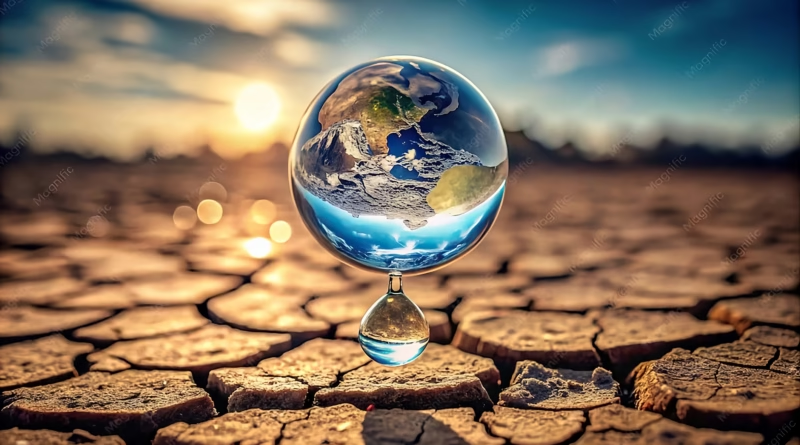
Global Water Crisis: Why Freshwater Scarcity Is Becoming One of Humanity’s Greatest Challenges
The Global Water Crisis is emerging as one of the most significant challenges of the twenty-first century. Across continents, declining freshwater supplies, climate change, and growing demand are placing unprecedented pressure on water resources
There was a time when entire civilizations were built around a simple certainty: water would always be there. Ancient cities rose along the Nile, the Tigris, the Euphrates, and countless other rivers that provided drinking water, fertile soil, transportation, and economic stability. Water was not merely a resource. It was the foundation upon which societies were constructed.
Today, that certainty is beginning to disappear. The Global Water Crisis is no longer a distant environmental warning discussed only by scientists and policymakers. It is an unfolding reality affecting billions of people across every continent. While the world focuses on energy transitions, artificial intelligence, economic instability, and geopolitical tensions, another challenge is quietly reshaping the future of human societies: the growing scarcity of freshwater.
Unlike earthquakes, hurricanes, or wildfires, water crises often develop slowly. Reservoirs shrink over years rather than days. Aquifers decline almost invisibly beneath the ground. Rivers that once appeared permanent gradually lose strength until communities begin to realize something fundamental has changed. According to UNICEF, around four billion people experience severe water scarcity for at least one month every year. More than two billion people live in countries where water supplies are insufficient to meet existing demand. [unicef.org]
Those numbers are difficult to imagine. Yet behind every statistic lies a daily reality. A farmer facing a failed harvest. A family waiting for water deliveries during a drought. A growing city struggling to satisfy the needs of millions of residents. The crisis is not defined solely by a lack of water. In many cases, the problem is access to safe water. The World Health Organization estimates that at least 1.7 billion people still rely on drinking water sources contaminated with fecal matter, exposing communities to diseases such as cholera, dysentery, typhoid, and polio. [who.int]
For many people living in developed countries, turning a faucet and receiving clean drinking water requires no thought at all. Yet this simple convenience depends on an extraordinarily complex system of infrastructure, treatment facilities, energy networks, and natural resources. When any part of that system becomes stressed, the consequences can spread rapidly through entire economies.
The Global Water Crisis and a Planet Slowly Drying Out
The modern water crisis is being shaped by a combination of forces that rarely operate in isolation. Population growth continues to increase demand. Urbanization places immense pressure on municipal water systems. Agricultural production requires enormous quantities of freshwater. Climate change is altering rainfall patterns across many regions. At the same time, groundwater reserves that accumulated over centuries are being depleted faster than they can be replenished.
According to UNESCO, approximately half of humanity experiences severe water scarcity during at least part of the year. While methodologies vary between organizations, the overall conclusion remains remarkably consistent: billions of people are already living under significant water stress. [unesco.org] Some of the clearest warnings have emerged from places that once seemed unlikely candidates for water shortages.
In 2018, Cape Town, South Africa, came dangerously close to what became known as “Day Zero,” the moment when municipal water supplies were projected to run so low that residents would need to collect water from public distribution points. Although emergency measures ultimately delayed that outcome, the episode demonstrated how rapidly even a major modern city can approach a water emergency.
Elsewhere, shrinking lakes and overexploited aquifers tell similar stories. Water shortages that were once considered temporary disruptions are increasingly becoming structural problems.
Climate change is amplifying many of these risks. However, the effects are not identical everywhere. Some regions are experiencing longer and more severe droughts, while others face increasingly intense rainfall events and flooding. Scientists emphasize that changing precipitation patterns vary considerably from one region to another, making local adaptation strategies essential.
These evolving climate dynamics are already visible across many parts of the world, including the regions influenced by powerful Pacific climate cycles discussed in El Niño 2026 Climate Impact: Understanding the Global Consequences of a Strong Pacific Event. The economic implications are enormous. According to the World Bank, water-dependent sectors such as agriculture, energy, and industry support approximately 1.7 billion jobs worldwide. When water becomes less reliable, employment, food production, and economic stability become increasingly vulnerable. [worldbank.org]
Agriculture remains the largest consumer of freshwater. UNESCO estimates that roughly 70% of global freshwater withdrawals are used for agricultural purposes, followed by industry and domestic consumption. [unesco.org] This means water scarcity is not simply an environmental issue. It is directly connected to food security, inflation, supply chains, and social stability.
The impact can even influence human migration. UNESCO reports that water deficits were associated with a 10% increase in global migration between 1970 and 2000. As conditions become more challenging in water-stressed regions, environmental migration is becoming an increasingly important global trend, explored further in The Urgent Science Behind Climate Migration: How Environmental Change Is Reshaping Humanity. [unesco.org]
Why the Global Water Crisis Matters for the Future of Civilization
One of the most important aspects of the Global Water Crisis is that demand continues to expand in unexpected ways. For decades, discussions about water consumption focused primarily on agriculture, manufacturing, and growing cities. Today, a new category of major consumers is emerging: digital infrastructure.
Artificial intelligence, cloud computing, and hyperscale data centers require substantial cooling systems, many of which depend on significant quantities of water. As digital technologies become more deeply integrated into modern life, concerns are growing about the environmental footprint of this new infrastructure. The issue is explored in greater detail in AI Overviews Environmental Impact: The Invisible Resource Crisis. The challenge, however, is not exclusively about increasing supply.
Many experts argue that improving efficiency may prove just as important. Aging infrastructure loses enormous quantities of treated water through leaks. Better irrigation systems can dramatically reduce agricultural consumption. Wastewater recycling technologies are becoming increasingly sophisticated. Smart monitoring systems can detect losses before they become critical.
Technological innovation offers genuine opportunities, but there is no single solution capable of solving the problem alone. Recent progress demonstrates that improvements are possible. According to UNICEF data, global access to safely managed drinking water services increased significantly between 2015 and 2024, allowing hundreds of millions of additional people to gain access to safer water systems. [data.unicef.org]
Yet major challenges remain. WHO and UNICEF report that approximately 2.1 billion people still lack safely managed drinking water services, while 3.4 billion lack safely managed sanitation services. [who.int], [unicef.org], [news.un.org] As pressure on freshwater resources grows, water is becoming increasingly important not only environmentally but strategically. Rivers, reservoirs, aquifers, and dams are evolving into critical assets whose management may shape regional stability and international cooperation throughout the coming decades.
This transformation is already visible in multiple regions around the world and is examined further in Global Water Geopolitics 2026: The Rising Crisis Over Rivers, Aquifers and Dams. The story of human civilization has always been closely linked to water. Cities emerged where reliable supplies existed. Economies prospered when water was plentiful. Societies struggled when it became scarce.
That reality has not changed. What has changed is the scale of the challenge. For the first time in modern history, population growth, climate pressures, economic expansion, and technological development are all increasing demand simultaneously. The Global Water Crisis is therefore about far more than water alone. It is about food, health, energy, migration, economic resilience, and the ability of societies to adapt to a rapidly changing world. The future will not be determined by whether humanity has water. The future will be determined by how wisely humanity manages it.
