
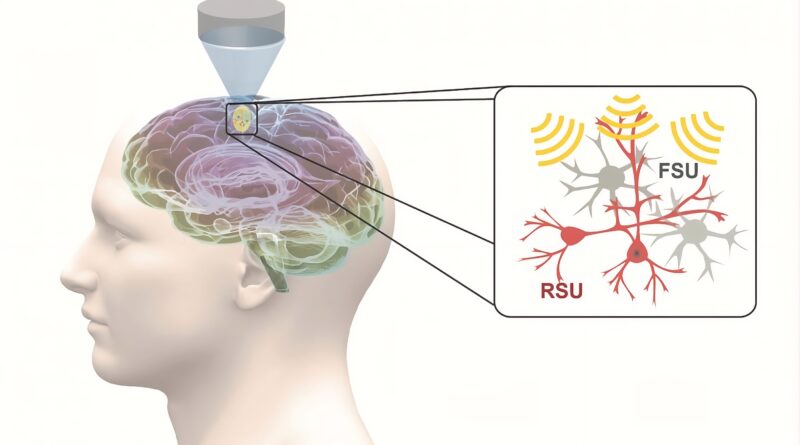
Transcranial Focused Ultrasound Stimulation: Enhancing Non-Invasive Brain-Computer Interfaces
The Human Skull Remains the Biggest Challenge for Brain-Computer Interfaces
Transcranial Focused Ultrasound Stimulation (tFUS) is emerging as one of the most intriguing technologies in modern neuroscience. As researchers continue searching for more accurate non-invasive brain-computer interfaces, this ultrasound-based approach is attracting growing scientific attention for its ability to modulate targeted neural circuits without surgery.
For decades, researchers working in neural engineering have faced a surprisingly simple obstacle: the human skull. While modern computers can process staggering amounts of information in fractions of a second, accessing the signals produced by the living brain remains far more complicated. The electrical activity generated by neurons is incredibly weak, and as those signals travel through bone, tissue and skin, much of their precision is lost before external sensors can capture them.
This challenge explains why the most accurate brain-computer interfaces (BCIs) still rely on invasive technologies. Tiny microelectrode arrays implanted directly into cortical tissue are capable of recording neural activity with exceptional detail, but they require surgery and carry obvious medical risks.
Non-invasive alternatives, particularly EEG-based headsets, avoid these risks and remain far more practical for everyday use. The trade-off, however, is reduced accuracy. The skull acts as a natural barrier, blurring the signals researchers are trying to interpret and limiting the ability of these systems to decode complex intentions.
Rather than simply attempting to read ever-fainter signals through that barrier, many laboratories are now exploring a different strategy. Instead of passively observing the brain, scientists are investigating whether carefully targeted stimulation can improve communication between humans and machines.
One of the most intriguing technologies emerging from this effort is Transcranial Focused Ultrasound Stimulation (tFUS). Unlike popular portrayals that often drift into the realm of science fiction, tFUS is not designed to read thoughts. Instead, researchers are studying its ability to gently modulate specific neural circuits, potentially reducing errors during certain non-invasive brain-computer interface tasks.
What Ultrasound Can Actually Do and What It Cannot
Public discussions about ultrasound-based neuroscience often blur together two very different technologies. The first is functional ultrasound imaging (fUS), a technique that measures changes in cerebral blood flow. Like functional MRI, it observes the physiological consequences of neural activity rather than directly recording thoughts themselves.
Historically, obtaining high-resolution functional ultrasound images in humans required an acoustically transparent cranial window or another surgical approach. Recent developments, however, suggest that the field is beginning to move beyond those limitations. A proof-of-concept study involving 13 healthy adults demonstrated that researchers could detect cerebral blood-volume changes through the intact skull during breath-holding exercises.
While notable, this achievement should not be confused with thought decoding. The technology currently remains an early-stage method for observing hemodynamic activity rather than translating human thoughts into language. The second technology, tFUS, operates in a fundamentally different way. Instead of imaging the brain, it seeks to influence neural activity in highly targeted regions.
A landmark study published in Nature Communications provided one of the clearest demonstrations of this approach. Researchers applied focused ultrasound to area V5, a region involved in visual processing, while 25 participants performed a visual brain-computer interface task designed to select letters displayed on a screen.
The results were not dramatic in the science-fiction sense, but they were scientifically meaningful. When the center of area V5 was stimulated, the average error rate dropped to 13.3%, compared with 15.5% when no stimulation was applied.
That difference may appear modest at first glance, yet it reveals something important. The ultrasound system was not extracting hidden thoughts, interpreting inner speech or reading subjective experiences. Instead, it appeared to improve the efficiency of a specific visual processing pathway, helping participants interact more accurately with an existing BCI system.
This distinction matters because it draws a clear line between verified neuroscience and popular myths. Current evidence supports ultrasound neuromodulation as a tool capable of improving performance under carefully controlled conditions. It does not support claims of effortless mind reading.
The researchers also emphasized an important safety consideration. Although the acoustic parameters used in the study remained within established limits commonly applied to diagnostic ultrasound imaging, regulatory frameworks specifically designed for ultrasound neuromodulation are still evolving, and dedicated FDA guidelines for this field do not yet exist.
The Reality Behind Thought-to-Text Decoding
The idea of transforming thoughts directly into written language remains one of the most compelling ambitions in modern neuroscience. Significant progress has been made, but the reality is considerably more demanding than many headlines suggest.
A widely discussed study published in Nature Neuroscience in 2023 demonstrated that semantic language decoding is possible under highly controlled laboratory conditions. The technology, however, relied entirely on functional Magnetic Resonance Imaging (fMRI) rather than portable consumer devices. The practical requirements alone highlight how far the technology remains from everyday use.
Participants spent approximately sixteen hours inside an fMRI scanner listening to spoken narrative stories while researchers trained machine-learning models to recognize the unique neural patterns associated with each individual brain. The resulting systems were highly personalized and depended on extensive cooperation from the participants themselves.
Researchers also found that decoding performance was not automatic. When volunteers deliberately engaged in other mental activities, such as silently inventing a different story or repeatedly naming animals, the system’s ability to reconstruct intended language declined significantly.
These findings reveal an important truth often overlooked in public discussions. Modern neuroscience is becoming increasingly capable of identifying patterns linked to meaning and language, but this process remains collaborative, resource-intensive and highly dependent on participant cooperation. It is not a passive surveillance technology capable of secretly extracting private thoughts from unsuspecting individuals.
Neuro-Rights and the Emerging Legal Protection of Brain Data
As brain technologies continue to advance, lawmakers and regulators are beginning to confront a new question: who owns neural data? Although today’s commercial neurotechnology cannot read an individual’s internal monologue, devices can already collect forms of information related to attention, cognitive engagement and motor intention. Even these limited datasets raise legitimate concerns about privacy, consent and commercial exploitation.
Several jurisdictions have decided not to wait for future breakthroughs before acting. Chile became a global pioneer in this area by incorporating neuro-rights protections directly into its constitutional framework. These measures have already influenced legal decisions, including cases involving the deletion of brainwave data obtained through consumer EEG technologies.
Across Europe, the regulatory landscape is shaped by existing privacy legislation. The French Data Protection Authority (CNIL) has clarified that personal neurodata falls under the protections of the GDPR. However, such information is not automatically classified as a special category under Article 9. Whether neural data qualifies as health or biometric information depends on the specific purpose and context in which it is processed, triggering additional safeguards when appropriate.
The situation in the United States is more fragmented. Rather than relying on a single federal framework, privacy protections are emerging through state-level legislation. States including Colorado, California, Montana and Connecticut have introduced or expanded legal definitions that explicitly encompass neural data within broader consumer privacy protections.
These initiatives are not responses to hypothetical mind-reading machines. They are practical attempts to regulate the collection, storage and commercialization of biometric and neural information before the technology becomes more deeply integrated into daily life.
Building the Future Without Abandoning Reality
As research into Transcranial Focused Ultrasound Stimulation continues to evolve, it forms part of a much broader effort to improve communication between the human brain and digital systems. Readers interested in the foundations and future of this field can explore our in-depth analysis, Brain‑Computer Interfaces: When the Brain Starts Talking to the Machine, which examines how neural signals are being transformed into practical tools for human-machine interaction.
Brain-computer interfaces continue to advance at a remarkable pace, but the most meaningful progress is happening far from the sensational claims that often dominate popular discussions. The evidence emerging from ultrasound neuromodulation research suggests that scientists are developing tools capable of improving specific forms of human-computer interaction without the need for invasive surgical implants. At the same time, studies on semantic decoding demonstrate both the promise of these technologies and the substantial limitations that still exist.
The future of neural engineering will not be built on fantasies of unrestricted mind reading. It will be built on incremental, measurable advances grounded in biology, physics and rigorous experimentation. By focusing on what has actually been demonstrated rather than what is merely imagined, researchers can continue developing safer and more effective brain-computer interfaces while preserving one of the most important values of the digital age: cognitive privacy.
Verified Scientific Sources: Nature Communications | Nature Neuroscience | CNIL Legal Framework
