
Nuclear Fusion Power Plant: An Ambitious Step Toward Clean Energy
A nuclear fusion power plant targeting 400 megawatts of electrical capacity is at the centre of Project Infinity, an ambitious initiative developed by US-based company Type One Energy in Tennessee. Backed by a $200 million funding round, the project aims to advance stellarator technology and bring fusion energy closer to commercial electricity generation by the mid-2030s. However, significant technical, regulatory and economic challenges must still be overcome before the facility can become operational.
Nuclear fusion is attracting growing investment from the energy industry as companies and researchers work to turn decades of scientific research into a reliable source of commercial electricity. Project Infinity is one of several initiatives seeking to bridge the gap between experimental reactors and future power plants.
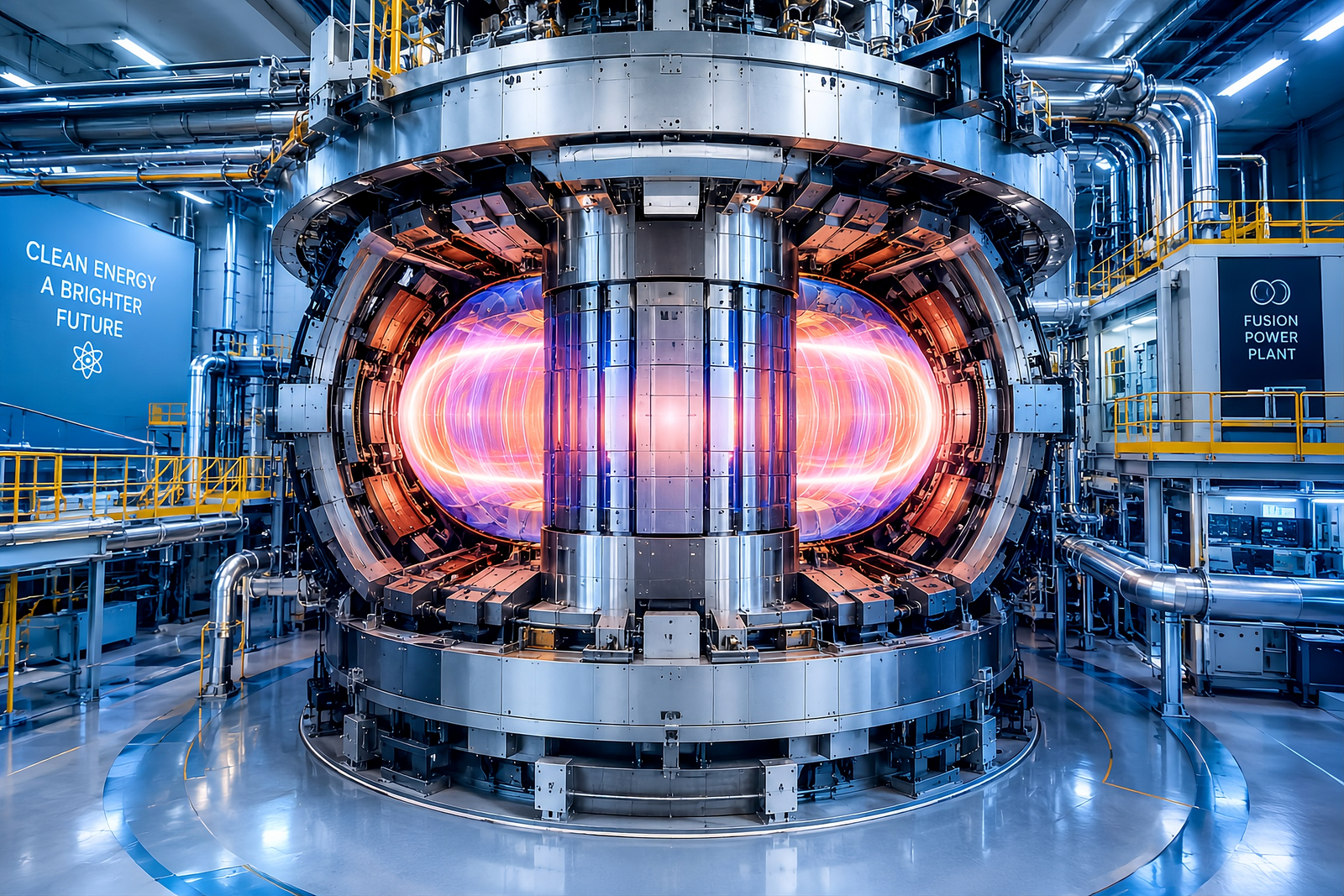
The programme includes plans for a commercial facility known as Infinity Two, designed to achieve an electrical output of 400 megawatts.
Before reaching that stage, however, the technology must undergo further engineering validation through Infinity One, a prototype intended to test components, construction methods and systems essential to the future reactor. The project took another step forward in October 2026, when Type One Energy announced the completion of a $200 million funding round. The investment represents important support for the industrial development of the technology, but it does not yet demonstrate that a fusion power plant can generate electricity continuously and at a competitive cost.
Nuclear Fusion Power Plant: A Promising $200 Million Investment
On 6 October 2026, Type One Energy announced the completion of a $200 million Series B funding round. According to the company’s official announcement, the round was led by Breakthrough Energy Ventures and Clutterbuck Capital, with participation from investors including Lowercarbon Capital, Siemens Energy Ventures and SiteGround Capital. The funding is intended to support the development of the company’s FusionDirect technology and advance Project Infinity, while strengthening its broader industrial strategy.
The involvement of investors connected to energy innovation and industry is significant because building an experimental reactor and delivering a commercial power plant are fundamentally different undertakings. A technology may show promise in a laboratory, but to become a commercial product it must be possible to manufacture it accurately, maintain it, operate it over extended periods and replicate it without prohibitive costs.
Type One Energy aims to bridge this gap by working with companies and organisations that already possess industrial expertise. The objective is to draw on existing capabilities to address challenges such as manufacturing complex components, integrating plant systems and organising future production. However, the funding should not be interpreted as a guarantee of success. Delivering a fusion power plant will require further investment, technical validation and regulatory approvals, as well as evidence that the entire system can operate under the expected conditions.
Source: Type One Energy – Official announcement on the $200 million funding round, 6 October 2026.
Infinity One and Infinity Two: Two Facilities with Different Objectives
Project Infinity is not simply the construction of a single reactor. Instead, it is a programme divided into two main stages, each designed to address different challenges. The first facility, Infinity One, is an engineering prototype intended to validate design decisions and develop the expertise required to build and operate fusion systems. It should not be confused with a commercial power plant ready to supply electricity to the grid: its primary purpose is to reduce technical and industrial uncertainties before the next stage.
Through the prototype, Type One Energy and TVA aim to gain experience in manufacturing, assembly and component management. Key questions include how to maintain equipment reliability, how to perform maintenance and how much construction and operating costs could affect the overall project. The second facility, Infinity Two, is the project intended for commercial electricity generation. Type One Energy describes it as a power plant with an electrical output of 400 megawatts, expressed as 400 MWe.
The distinction between the two facilities is essential. The prototype can help validate engineering solutions without necessarily having to demonstrate every feature required of a commercial power plant. Infinity Two, by contrast, will need to integrate plasma physics, magnetic systems, heat management, maintenance and electricity conversion into a single functioning facility.
The partnership with TVA is also important from an industrial perspective. In July 2025, the two organisations announced their first commercial contracts relating to the project, involving the utility’s manufacturing expertise in the development of specialised fabrication and welding techniques for the equipment. These activities are intended to prepare the industrial supply chain needed to manufacture complex components, an aspect of fusion research that often receives less attention than the science but is crucial to large-scale deployment.
Sources: Type One Energy – First contracts with TVA, 22 July 2025 and TVA – Official information on the fusion programme.
Why the Project Uses Stellarator Technology
One of the most interesting technological features of Infinity is its choice of the stellarator, a reactor configuration that uses three-dimensional magnetic fields to confine plasma. To understand this technology, it is useful to start with the basic principle of nuclear fusion. At extremely high temperatures, the nuclei of light elements can combine to form heavier nuclei, releasing energy in the process. The challenge is that the matter must reach extreme physical conditions for fusion reactions to occur at sufficiently high rates.
At these temperatures, the fuel becomes plasma: an ionised gas made up of electrically charged particles. No conventional material can directly contain plasma at the temperatures required for fusion, which is why powerful magnetic fields are used to keep the particles away from the walls of the confinement chamber. A stellarator has a particularly complex geometry. Its magnetic coils must be designed and manufactured with great precision to generate a three-dimensional field capable of controlling particle motion inside the reactor.
Unlike a tokamak, another of the main configurations being investigated for fusion, a stellarator does not rely in the same way on an electric current induced in the plasma to contribute to magnetic confinement. This characteristic may offer advantages when maintaining stable plasma over extended periods, although it also introduces substantial engineering challenges.
The US Department of Energy, through its Office of Science, identifies potential advantages of stellarators, including greater flexibility in magnetic-field design and the possibility of simplifying certain aspects of plasma control. At the same time, it recognises that manufacturing the magnetic coils is a significant challenge because the components are complex and require highly precise production techniques. This means that choosing a stellarator does not eliminate the difficulties of fusion. Instead, it represents a different approach to overcoming them.
Scientific source: US Department of Energy – How stellarators work.
400 Megawatts: How Much Electricity Could It Generate?
The planned output of Infinity Two is one of the features that makes the project particularly interesting. An electrical capacity of 400 megawatts would represent a substantial generating capability for a single facility. To understand the figure, it is important to distinguish power from energy. Megawatts measure the rate at which a plant can deliver power at a given moment, while megawatt-hours and gigawatt-hours measure the amount of energy generated over time.
If a 400 MW power plant operated at full output for every hour of the year, its theoretical annual generation would be approximately 3.5 terawatt-hours of electricity.
This figure is purely illustrative: it assumes 100% availability, with no maintenance shutdowns, equipment failures or other interruptions. Actual generation would depend on the capacity factor, which measures the proportion of time a plant is able to generate electricity at its intended output. For example, at an assumed capacity factor of 90%, a 400 MW plant would generate approximately 3.15 TWh annually. This is not an official forecast for Infinity Two, but an illustration of how reliability and operational continuity affect electricity production.
The same caution applies to estimates of how many homes a power plant could supply. Such calculations depend on average consumption, climate differences, heating requirements, electric vehicle use and the characteristics of the electricity network. The figure of approximately 226,000 homes cited in descriptions of the project should therefore be treated as an indicative estimate, rather than a guaranteed number of households that would actually receive electricity from the facility.
Furthermore, nominal capacity alone does not determine costs. Assessing whether Infinity Two will be competitive will require consideration of upfront investment, component costs, the electricity needed to operate the system, maintenance requirements and the overall efficiency of converting heat into electricity.
A Former Coal Plant in Bull Run Could Become a Fusion Site
The site selected for Project Infinity is the former Bull Run fossil-fuel power station in Anderson County, Tennessee. The conventional plant was retired in December 2023 after 56 years of operation. Repurposing an existing energy site may offer logistical and industrial advantages. An area previously used for electricity generation may already have infrastructure, connections and space that could prove useful for a new project, although each element must be assessed against the requirements of the chosen technology.
TVA’s involvement, as an energy operator with experience in building and managing power plants, is another important factor. Its expertise in manufacturing, maintenance and grid integration could prove valuable as the programme moves from a prototype towards a commercial facility.
However, reusing a former coal site does not mean that conversion will be automatic or that all existing infrastructure can be used without modification. A fusion reactor has technical requirements that differ substantially from those of a conventional thermal power station. According to TVA, its collaboration with Type One Energy concerns the development of a potential new electricity source for the region, alongside other activities planned for the area. The transformation of Bull Run therefore also has an industrial dimension: the site could become a testing ground for understanding how an emerging energy technology can be integrated into an existing electricity-generation environment.
Source: Tennessee Valley Authority – Fusion programme at Bull Run.
The Timeline: Commercial Deployment Remains a Mid-2030s Target
One of the most important aspects of Project Infinity is its timeline. Official communications from Type One Energy and TVA identify the mid-2030s as the target period for the potential commercial deployment of the technology. This is an industrial objective, not a guaranteed date for the plant to enter service.
Before supplying electricity to the grid, the programme will need to clear several technical and regulatory milestones. It must demonstrate that the magnetic confinement system can sustain the required conditions, that the plasma can be controlled reliably and that the components can withstand the expected stresses. The programme will also need to address long-duration operation, maintenance, heat management and the integration of different subsystems.
In January 2026, Type One Energy, TVA and the Tennessee Department of Environment and Conservation announced the submission of the initial licensing application for the commercial project. Later, in August 2026, Tennessee announced the issuance of the first licence associated with the fusion project. These developments represent progress on the administrative and regulatory fronts, but they do not demonstrate that the reactor has already generated electricity through fusion.
A licence permits activities within the scope of the relevant authorisation, whereas demonstrating energy performance requires separate technical testing. This distinction is essential when assessing the project’s progress: a power plant can advance through design, obtain permits and attract investment long before demonstrating that it can generate electricity.
Sources: Type One Energy – Initial licensing application, 29 January 2026 and Type One Energy – Official news and announcements.
The Challenges Nuclear Fusion Must Still Overcome
Despite progress in research, commercial fusion power remains a major scientific and engineering challenge. The US Department of Energy acknowledges that further advances are needed in materials, fuel management and the integration of the systems required to turn fusion energy into usable electricity. For Infinity, one of the central questions will be whether the company can manufacture components with sufficient precision and reliability to support extended operation. Stellarators use complex magnetic geometries and require coils built to demanding specifications.
Another challenge concerns the overall energy balance of the plant. Producing energy from a fusion reaction does not automatically mean that a power plant generates more electricity than it consumes. The analysis must include the energy required for magnets, auxiliary systems, plasma heating, cooling and all other equipment. It is therefore essential to distinguish the energy gain of a fusion reaction from the overall electrical performance of a power plant. Commercial success will depend on the ability to convert heat into electricity and supply the grid with enough net energy to justify the facility’s costs.
Component lifetime will also be critical. In a future reactor using deuterium-tritium fusion, the neutrons produced by the reactions can place substantial stress on internal structures and activate certain materials. Material selection, shielding and maintenance procedures will therefore require careful consideration.
Finally, economic competitiveness remains unproven. Fusion could potentially offer low-carbon electricity during operation, but this environmental advantage alone does not guarantee competitive prices. To become a commercial technology, fusion must bring construction, operating and maintenance costs under control.
Scientific source: US Department of Energy – Fusion energy challenges and prospects.
What Advantages Could It Offer Over Conventional Energy Sources?
If Infinity Two achieves its planned performance, it could help diversify the electricity-generation technologies available in the United States. One potential advantage of fusion is the ability to generate electricity without the direct carbon dioxide emissions associated with burning coal and natural gas. In addition, a plant designed for continuous operation could complement renewable sources such as wind and solar, whose output varies with weather conditions.
This does not necessarily mean that fusion will replace other technologies. The future electricity system could rely on a combination of renewables, energy storage, more flexible grids and dispatchable low-carbon generation, with fusion’s role depending on the technical and economic results it achieves.
From a fuel perspective, many of today’s leading fusion strategies rely on a combination of deuterium and tritium. Deuterium is an isotope of hydrogen that is also found in water, while tritium is radioactive and requires specialised handling. Future commercial plants will therefore need reliable systems to ensure fuel availability and manage the fuel cycle. Fusion is not without environmental and safety considerations. Although it has different characteristics from nuclear fission, it can cause some materials to become radioactive through neutron activation and may require specific procedures for handling components and waste.
Its environmental benefits must therefore be assessed across the facility’s entire life cycle. For Infinity, the real test of success will be its ability to combine electricity generation, reliability, safety and economic sustainability in a functioning industrial system.
Could Infinity Mark the Beginning of the Commercial Fusion Era?
Project Infinity is significant because it approaches fusion from an industrial perspective, rather than focusing exclusively on scientific research. The $200 million funding round, the partnership with TVA and progress in the licensing process indicate that the programme is advancing towards a potential commercial application. However, the 400 MW power plant remains a design target. Raising capital, securing a site and establishing an industrial timeline are not equivalent to demonstrating commercial electricity generation.
Over the coming years, it will be important to monitor the results achieved by Infinity One, the development of Infinity Two’s design, progress through the regulatory process and the programme’s ability to address performance, cost and maintenance challenges.
If these hurdles are overcome, the project could help make fusion a new option for large-scale electricity generation. If significant technical or economic difficulties emerge, the schedule could be extended and additional investment might be required.
The conclusion is that Infinity represents a concrete attempt to turn fusion research into an industrial project, but it is not yet proof that a 400 MW commercial fusion power plant is ready to enter service. The mid-2030s remain the stated target for this ambition. Experimental results, the ability to build a reliable facility and the actual cost of electricity generation will determine whether this promise becomes a new reality for the energy sector.
The future of nuclear fusion is closely connected to broader technological developments, from advanced computing infrastructure to the semiconductor industry. Explore these related articles to understand how emerging technologies are reshaping the global economy:
The New AI Chip War: Google Challenges Nvidia as Billions Pour Into the Infrastructure of the Future — Discover how the race for AI chips is transforming computing infrastructure and driving demand for next-generation technology.
Semiconductor Geopolitics: Who Will Control the Digital Economy? — Explore how global competition over chip manufacturing is influencing technological independence, economic security and the future of innovation.
