
Satellite Servicing: How SpaceX’s MRV‑MEP Mission Opens a New Space Infrastructure Market
Written by Zemeghub Media Creation
Satellite servicing is no longer a theoretical concept. When SpaceX launched Northrop Grumman’s MRV‑MEP repair mission…
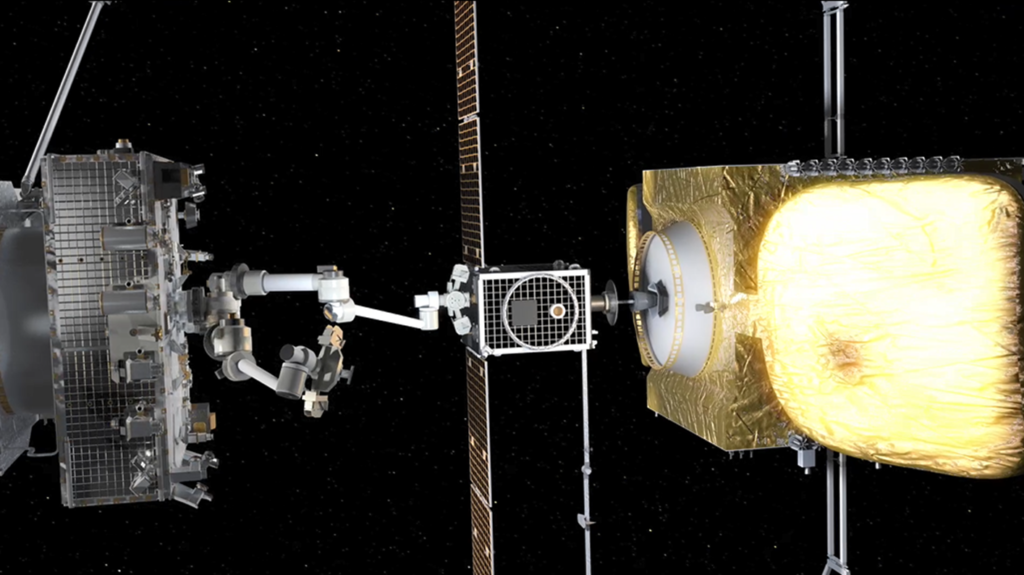
When SpaceX lifted Northrop Grumman’s MRV‑MEP satellite repair mission into orbit in July 2026, the launch looked, at first glance, like any other Falcon 9 ascent from Cape Canaveral. The rocket rose through the Florida sky with its familiar precision, shedding its first stage before the booster returned to land on the drone ship. But what happened after separation marked a turning point in the commercial space economy. For the first time, SpaceX was not delivering a communications satellite, a scientific payload, or a military asset. It was delivering a machine designed to fix other machines already in orbit — a robotic servicing vehicle built to extend the life of satellites that would otherwise be left to drift, decay, or die.
The MRV‑MEP mission, short for Mission Robotic Vehicle – Mission Extension Pod, is part of Northrop Grumman’s long‑term strategy to build an orbital servicing fleet. The concept is simple: instead of launching new satellites every time one begins to fail, operators can attach a robotic “life‑extension pod” that restores stability, corrects orbit, and adds years of operational time. The economics behind this shift are enormous. A modern geostationary communications satellite can cost between $150 million and $300 million to build and launch. Extending its life by five years with a servicing pod costing a fraction of that amount is not just efficient — it is transformative.
SpaceX’s role in this mission signals a new chapter for the company. For years, SpaceX has dominated launch contracts, Starlink deployments, and cargo missions. But satellite servicing is different. It is not about sending hardware up once; it is about maintaining the infrastructure already in orbit. This shift aligns with a broader trend in the space industry: the transition from launch‑centric revenue to infrastructure‑centric revenue. In 2026, analysts estimate that over 6,700 active satellites are operating in Earth orbit, with more than 1,200 nearing end‑of‑life conditions. The demand for servicing, repositioning, and life‑extension is growing faster than the launch market itself.
For investors watching Space Exploration Technologies through the SPCX ticker, the MRV‑MEP mission offers a glimpse into how the company may evolve. The launch was not just a technical success; it was a strategic signal. SpaceX is positioning itself as a key player in the long‑term maintenance of orbital assets, a market that could reach $4.5 billion annually by 2030, according to projections from the Satellite Industry Association. The company’s ability to support servicing missions could help secure multi‑year contracts with operators who care about lifecycle cost, uptime, and flexibility — not just headline launch pricing.
The mission also highlights the growing complexity of orbital operations. Repairing satellites in space is not trivial. The MRV‑MEP vehicle must rendezvous with aging satellites traveling at 28,000 km/h, attach itself without damaging fragile components, and stabilize the satellite’s orbit. Any failure could jeopardize not only the target satellite but also nearby spacecraft. This is why Northrop Grumman has spent years testing autonomous docking systems and robotic arms capable of operating in microgravity. The MRV‑MEP mission is the culmination of that work, and SpaceX’s involvement shows how launch providers are becoming infrastructure partners rather than simple transportation services.
This shift mirrors a broader transformation in the global technological landscape. As we explored in Artificial Intelligence Infrastructure: How AI Became the Global System of 2026, the world is moving toward systems that are not just deployed but continuously maintained, upgraded, and extended. The same logic applies to space. Satellites are no longer disposable assets; they are nodes in a planetary network that must remain operational for decades. Servicing missions like MRV‑MEP are the first step toward a future where orbital infrastructure is treated like terrestrial infrastructure — repaired, optimized, and sustained.
The financial implications are significant. SpaceX has been flagged by analysts for having less than one year of cash runway and a volatile share price. Moving into satellite servicing adds another capital‑intensive activity to its portfolio. But it also adds a new revenue stream that is less dependent on launch cadence and more tied to long‑term contracts. If SpaceX can reliably support life‑extension missions, it may strengthen relationships with major operators such as Intelsat, SES, and Viasat. These companies manage fleets worth billions, and extending the life of even a handful of satellites can dramatically improve their financial stability.
The MRV‑MEP mission also intersects with SpaceX’s other ventures. Starlink continues to expand, with recent wins such as the Cebu Pacific inflight Wi‑Fi rollout demonstrating how orbital infrastructure connects aviation, communications, and data services. The ability to service satellites in orbit complements these achievements, creating a unified ecosystem where launch, connectivity, and maintenance reinforce each other.
Yet the risks remain. On‑orbit repair is technically demanding, and any failure could damage SpaceX’s reputation across its entire portfolio. Investors must consider both sides: the promise of a new market and the challenge of mastering a field where mistakes are costly. As of July 2026, SPCX shares have shown volatility, dropping 2.68% on the day of the mission’s announcement. Market reactions reflect uncertainty, but also curiosity. The space economy is changing, and SpaceX is positioning itself at the center of that change.
The MRV‑MEP mission marks a milestone. It is the moment when satellite servicing moved from concept to commercial reality. It is the moment when SpaceX expanded beyond launch dominance into infrastructure stewardship. And it is the moment when investors began to see the space economy not as a series of launches, but as a network of assets that must be maintained, repaired, and extended.
In the years ahead, more missions like MRV‑MEP will follow. The orbital environment is becoming crowded, complex, and indispensable. Companies that can keep satellites alive will shape the future of communications, navigation, climate monitoring, and defense. SpaceX has taken its first step into that future — and the market is watching closely.
If you’re exploring how new technologies reshape global industries, you may also like our analysis on frontier AI systems: A New AI Race Begins: Startup in Stealth Mode Claims Breakthrough in Faster, Cheaper, Energy‑Efficient LLM Architecture