
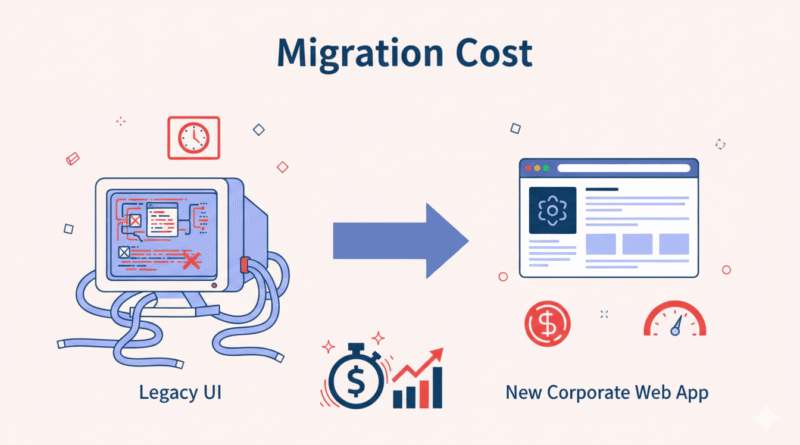
The Unfair Cost of Content Migration: How Google Erases Authors
The web is full of stories that rarely get told. One of the most important concerns what happens to an author when they decide to leave the platform on which they built their digital identity. This issue affects especially those who began publishing when the Internet was simpler, less fragmented, and more direct. People who wrote for years, accumulated content, earned loyal readers, and transformed a personal project into a stable editorial presence. Many of these journeys began on Blogger, a platform that for a long time served as the easiest gateway for anyone wanting to publish without technical skills.
The Content Migration Paradox
The problem emerges the moment the author decides to move elsewhere. The content remains the same, the person remains the same, the project continues. The topics do not change, and often the audience is still interested. Yet visibility can collapse overnight. This is where a deep contradiction appears: the system that should recognize the continuity of a project seems instead to focus almost exclusively on its current structure, ignoring the history behind it.
For the author, a migration is a technical evolution. For search systems, it becomes an event that is difficult to interpret. What is obvious to a human becomes an incomplete puzzle to a machine. The result is paradoxical: a project that has worked for years suddenly loses a substantial portion of its traffic, as if it had become irrelevant from one day to the next.
This does not happen because the author stopped working, nor because the content deteriorated or the audience lost interest. It happens because the new site is interpreted as something different from what it truly is. And this is where the system deserves serious criticism.
When Algorithm Signals Ignore Human Value
An author who has been publishing for many years accumulates signals that cannot be reduced to the pages currently online. There is an editorial trajectory, articles that gained traction, external references, returning readers, discussions, and citations. All of this forms a recognizable identity. For those familiar with the project, switching platforms does not change its essence. For the search engine, however, the transition can be interpreted as a break in domain reputation.
From a technical standpoint, the difficulty is understandable. A system that analyzes billions of pages cannot rely solely on an author’s declaration that they are continuing a previous project, even if redirects are correctly implemented. But complexity does not justify neglect. This should be one of the areas where a modern search engine invests the most.
The web is not made only of sites that appear and disappear. There are projects that change structure, domain, platform, and technology while remaining the same editorial reality. This continuity deserves far better recognition.
The Closed Ecosystem Trap
For many years, Blogger allowed anyone to publish online with ease. Creating a blog, choosing a template, and writing was enough to start building an archive. Many personal projects were born this way. Some remained small, others grew into full editorial ventures. This creates a unique bond between the author and the platform. As long as the site remains on Blogger, the project continues to live within the environment where it was born. Once the author moves away, they face technical challenges and, above all, the risk of losing part of the visibility accumulated over time.
Here lies a clear contradiction. An author may leave Blogger to gain more control over their work, yet the choice to become more independent can result in a loss of audience. Stepping outside the ecosystem carries a cost that affects not only technology but also discoverability.
A change of platform does not equal the birth of a new project. Publishing technology does not define editorial identity. The same applies to the domain: a new address may be necessary for technical, commercial, or organizational reasons. It may be part of a restructuring or a branding decision. But the person writing remains the same. The problem arises when this continuity is not recognized.
At that point, the author must rebuild a digital reputation that, from their perspective, already exists. This should not be a normal scenario. Current traffic does not reflect the full history of a project. A site may have gone through growth, stagnation, editorial shifts, and technical migrations. It may have had hundreds of thousands of readers in the past and now receive fewer visits. This does not erase its past.
When the Loss of Visibility Becomes an Economic Sentence
For the author, the history is obvious. For an automated system, history must be reconstructed through signals. When those signals become less clear after a migration, the project enters a weaker position. And this is precisely what needs improvement.
A project can lose visibility without losing value. It is crucial to distinguish between a site that declines and one that continues to function but becomes harder to find. These are entirely different phenomena, yet from the outside they appear identical. A reader sees fewer results and assumes the site is no longer relevant. The author sees years of work that still exist but no longer reach the same audience.
Loss of visibility becomes loss of perceived value. For independent authors, this is particularly damaging, because much of their credibility depends on being discoverable. Google’s power is not limited to search; it shapes content distribution. If a page is found, it gets readers. If it is harder to find, the audience shrinks. If many pages lose visibility simultaneously, the entire project enters crisis.
This directly affects revenue, the ability to attract clients, audience growth, and the capacity to keep investing in the site. Ranking is not a technical detail; it has economic consequences. And this is why the inner workings of classification systems deserve far more scrutiny.
Large companies can compensate for traffic drops through advertising or alternative channels. Independent authors often cannot. Many sites are run by a single person who writes, updates, manages technical aspects, interacts with readers, and tries to keep the project sustainable. When visibility decreases, revenue decreases. And when revenue decreases, resources for producing content shrink.
Breaking the Silence of Independent Authors
There is also a psychological dimension. Many site owners avoid speaking publicly about problems with Google. The fear of drawing negative attention or triggering penalties is enough to create silence. As a result, many experiences remain isolated. One person notices a drop, another faces a difficult migration, another sees their site lose positions after years of growth. Each searches for an individual explanation, without realizing these cases may be part of a broader issue.
Transparency does not mean revealing the algorithm. It means explaining how certain changes are interpreted. It means providing clearer tools to understand why a migration produced such drastic consequences. It means developing systems capable of recognizing the human continuity of a project beyond the server hosting it.
Until machines learn to read the history and identity of a project—not just its current structure—the digital independence of creators will continue to carry a cost that is far too high, and profoundly unfair.
