
Smartphone Security 2026: How to Keep Your Device Safe in a Digital World
Written by Julian Reyes
Smartphone Security 2026 is no longer just a technical concern; it has become a form of personal protection. Your smartphone holds your identity, your financial life, your memories, and your daily routines, and keeping it secure is now an essential part of living in a digital world.
Your smartphone has become the most intimate object you own. It knows where you go, who you talk to, what you search for, what you fear, what you desire, and what you try to forget. In 2026, it is no longer just a device; it is the core of your digital identity, the gateway to your financial life, the archive of your memories, and the silent witness of your routines. Protecting it is not a technical task — it is an act of self‑preservation.
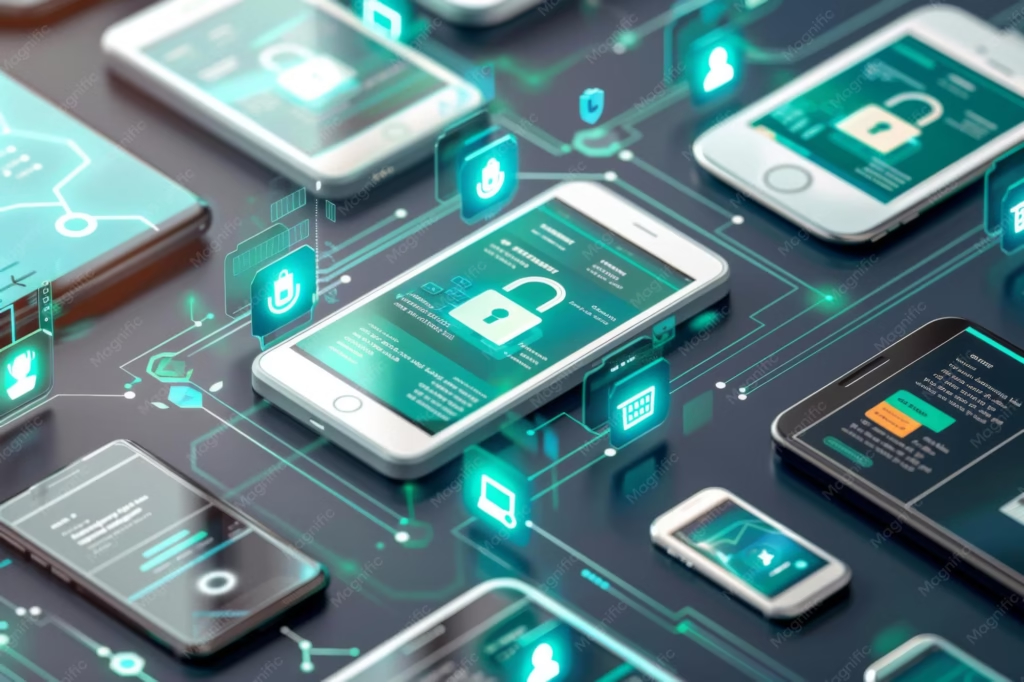
The threats that surround smartphones today are not the same ones we faced a decade ago. Malware is no longer the main enemy. The real danger comes from precision‑engineered attacks powered by artificial intelligence, capable of mimicking legitimate interfaces, cloning trusted contacts, and predicting user behavior with unsettling accuracy. A phishing message in 2026 does not look suspicious; it looks familiar. It looks like something you would click without thinking. And that is exactly why attackers design it that way.
The first layer of smartphone security is identity protection. Your device is the vault that holds your passkeys, your biometrics, your authentication tokens, your encrypted conversations, and your access to every account that matters. If your smartphone is compromised, your entire digital life becomes vulnerable. Modern operating systems have evolved to protect users with secure enclaves, hardware‑level encryption, and isolated environments for sensitive data. But these protections only work if the user understands them. A secure device in the hands of an unaware user is still a fragile device.
The second layer is behavioral awareness. Most breaches do not happen because a phone is technically weak; they happen because a user is distracted. People tap notifications without reading, install apps without checking permissions, connect to public Wi‑Fi networks without considering the consequences, and approve login requests they did not initiate. In 2026, attackers rely on speed — not on sophistication. They know that a rushed user is an exposed user. The strongest smartphone security begins with slowing down, even for a second, before tapping.
The third layer is environmental integrity. A smartphone is only as secure as the ecosystem around it. If your cloud storage is unprotected, your phone is unprotected. If your email is compromised, your phone is compromised. If your social media accounts are vulnerable, your phone becomes a gateway for impersonation. Security is not a feature; it is a network of habits. And every weak link in that network becomes a door.
The fourth layer is physical control. In 2026, a stolen smartphone is not just a lost object — it is a potential identity breach. Modern devices integrate biometric locks, encrypted storage, and remote‑wipe capabilities, but these tools are only effective when configured correctly. A phone without a secure lock screen is a phone without a future. A phone without remote‑wipe enabled is a phone that can betray you. Physical security is digital security.
The final layer is sovereignty. Your smartphone is the interface through which companies, apps, and services interact with your data. Every permission you grant, every app you install, every sync you enable is a negotiation of trust. Sovereignty means understanding that your data is not a commodity — it is a part of you. It means choosing services that respect your autonomy, minimizing unnecessary data collection, and revoking permissions that no longer serve a purpose. A sovereign smartphone user is not paranoid; they are aware.
Keeping your smartphone secure in 2026 is not about fear. It is about clarity. It is about recognizing that your device is the anchor of your digital life and that protecting it protects everything connected to it. Security is not a setting you toggle; it is a mindset you cultivate. And in a world where threats evolve faster than habits, the people who stay safe are not the ones who know everything — but the ones who pay attention.
Your smartphone is your identity. Guard it with intention.
Read also: When Identity Becomes an Illusion: The 2026 Biometric Spoofing Crisis No One Saw Coming
