
El Niño 2026 Climate Impact: Understanding the Global Consequences of a Strong Pacific Event
El Niño 2026 climate impact is already visible across the Pacific, where exceptional warming is reshaping atmospheric circulation and amplifying global climate risks.
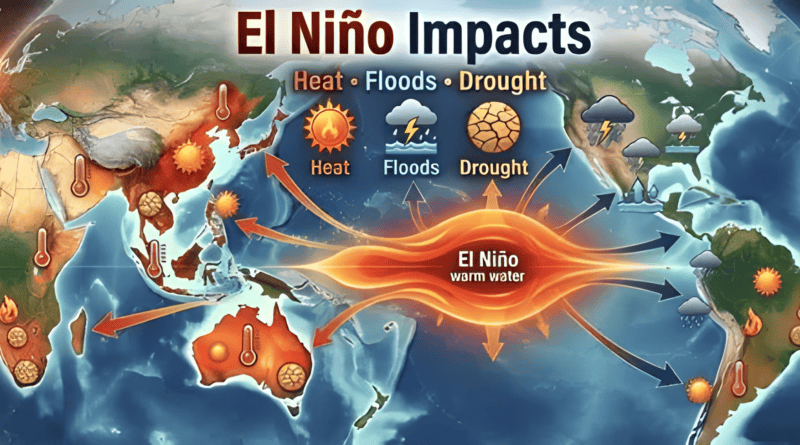
When we talk about El Niño, we are not simply talking about a heatwave. It is a natural climate phenomenon that begins in the tropical Pacific Ocean but can alter atmospheric conditions and influence the climate thousands of kilometres away. According to the NOAA, the United States’ National Oceanic and Atmospheric Administration, El Niño is the warm phase of a climate cycle known as ENSO (El Niño–Southern Oscillation). It occurs periodically when surface waters in the central and eastern tropical Pacific become unusually warm, altering winds, rainfall and temperatures across many parts of the world.
The name has an origin that goes back much further than modern climate science. Fishermen along the coast of Peru had observed for centuries that, at certain times, seawater became unusually warm around Christmas. They therefore began calling the phenomenon “El Niño,” meaning “the little boy,” in reference to the Christ Child. Under normal conditions, trade winds push warm surface water towards Indonesia and Australia, while colder, nutrient-rich water rises from the deep ocean along the coast of South America. During El Niño, this balance weakens: warm water moves towards the central and eastern Pacific, changing the distribution of rainfall and atmospheric systems.
The consequences can be very different from one region to another. Some areas may experience exceptionally heavy rainfall and flooding, while others may face drought, wildfires and unusually high temperatures. It is precisely this ability to alter atmospheric circulation on a global scale that makes El Niño a phenomenon closely monitored by meteorologists.
The new El Niño of 2026
In 2026, the phenomenon has taken on particularly important characteristics. In its update of September 10, 2026, NOAA’s Climate Prediction Center reported that El Niño was strengthening, with sea-surface temperatures more than 3°C above average in some parts of the eastern equatorial Pacific. NOAA also estimated a greater than 90% probability that the event would remain very strong during the autumn and winter of 2026–2027, and a 75% probability that between October and December it would reach an intensity greater than that of previous events recorded since 1950.
It is in this context that the figure of 450,000 deaths has appeared in the news. The number does not come from a prediction that scientists already know how many people will die. Instead, it is a statistical projection produced by the Climate Impact Lab, a research collaboration involving scientists from the University of Chicago and other institutions. A report published on September 22, 2026, estimates that the strong El Niño could be associated with approximately 451,000 additional deaths caused by heat.
The distinction is crucial. The 451,000 are not people who have already died, nor does the figure represent a certain number of future deaths. It is an estimate of the number of excess deaths that the model projects compared with what would have occurred under normal climate conditions. According to the same research, rising land temperatures could reach approximately 1.2°C, while extremely hot days could become about 44% more frequent than in an average year.
The figure also mainly concerns heat-related mortality. El Niño can produce other effects, including drought, wildfires, extreme rainfall and problems affecting water and agricultural resources. These phenomena can have consequences for health and the economy, but they should not automatically be added to the 451,000 deaths: the estimate specifically concerns additional mortality associated with heat.
How seriously should we take the figure of 450,000 deaths?
The most accurate answer is that the research is real, but the number should be understood as a projection rather than a prophecy. NOAA independently confirms that the current El Niño is very strong and that ocean conditions are exceptional; the Climate Impact Lab then uses statistical models to estimate how rising temperatures could translate into mortality. These are therefore two different questions: the climate phenomenon itself is being observed in reality, while the number of deaths is a model-based estimate of what could happen in the future.
This does not mean that the risk is invented or purely theoretical. Extreme heat is already recognised as an important factor in mortality, and El Niño can increase temperatures in certain parts of the world. The research attempts to translate these established relationships into a quantitative estimate, while also identifying the regions where the consequences could be greatest. The Climate Impact Lab report also stresses that timely measures, such as heat-warning systems and measures to protect people who are particularly vulnerable to extreme heat, could reduce the number of deaths.
For this reason, a headline such as “El Niño will kill 450,000 people” is too categorical. A scientifically more accurate formulation would be: “A new study estimates that the strong 2026 El Niño could be associated with approximately 451,000 additional heat-related deaths in the following months.” The difference is important: the first sentence presents the figure as a certainty, while the second makes clear that it is a model-based estimate subject to uncertainty.
Main sources: NOAA/National Weather Service for the current El Niño situation and its definition; Climate Impact Lab/University of Chicago for the estimate of 451,000 deaths; Associated Press/Al Jazeera for independent reporting on the research.
1. Global Environmental Instability: The Hidden Forces That Shape Our Daily Lives
environment and social issues 23 September 2026 Aria Lorne In this exploration of global instability, Aria Lorne reveals how environmental pressures quietly shape human behavior and social systems. A powerful visual metaphor contrasts planetary collapse with the possibility of recovery, offering a deeper understanding of the forces that influence our daily lives. Read More
2. Global Water Geopolitics 2026: The Rising Crisis Over Rivers, Aquifers and Dams
environment and social issues 20 September 2026 Aria Lorne A striking aerial river landscape introduces a detailed analysis of the growing tensions surrounding water resources. From transboundary rivers to fragile aquifers, this article shows how environmental pressure is reshaping geopolitics and exposing vulnerabilities in global water systems. Read More
3. Extreme Heat 2026: A Dangerous New Era of Global Warming
environment and social issues 14 September 2026 Aria Lorne A global anomaly map reveals how 2026 has entered a new era of extreme heat. This article examines the regions most affected, the atmospheric mechanisms behind the temperature spike, and the broader implications for human health and environmental stability. Read More
