AI Mathematical Intuition: When Machines Seem to Find Unexpected Paths in Mathematics
AI mathematical intuition has become a serious scientific question, especially now that modern systems appear capable of finding solutions that humans did not explicitly teach them.
22 August 2026 — Not long ago, the idea that a machine could show something resembling mathematical intuition sounded like a playful question for science‑fiction fans. Today it has become a serious topic inside universities, research labs, and the broader scientific community trying to understand how far artificial intelligence can go.
The discussion was reignited by Angelo Mingarelli, a mathematician at Carleton University in Canada, who has spent decades studying the strange borderland where mathematics, creativity, and computation meet. In an interview reported by RaiNews, he explored a possibility that many researchers have quietly wondered about: can an AI system find a path to a solution that no human explicitly taught it? And if it does, what does that actually mean?
Before jumping to conclusions, it helps to understand what mathematicians mean when they talk about intuition. In mathematics, intuition is not magic. It is the moment when a researcher sees a pattern before being able to prove it, when a structure becomes visible even though the formal demonstration is still far away. A mathematician might stare at a problem for hours, then suddenly feel that a certain direction “smells right.” Only later comes the proof.
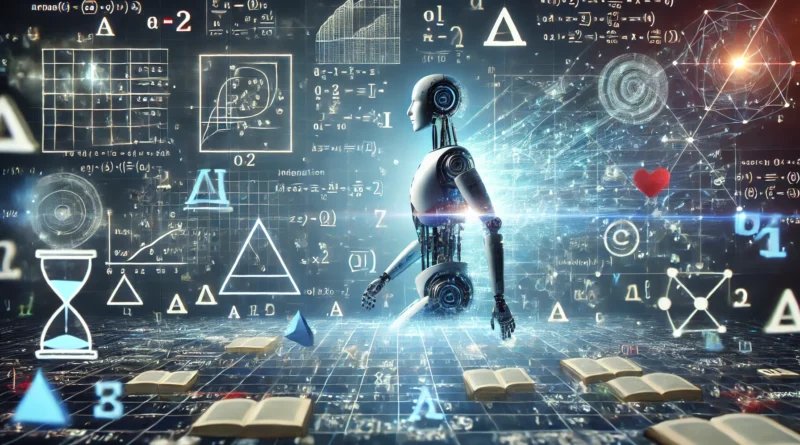
Modern AI systems sometimes behave in a way that resembles this process. They sift through enormous spaces of possibilities, notice patterns that were not explicitly pointed out, and propose strategies that surprise even the experts. It is tempting to call this intuition, but the word carries meanings that machines do not possess. An AI does not have subjective experience, nor does it “feel” a solution. What it does is explore, evaluate, and recombine information at a scale humans cannot match.
Mingarelli himself is an interesting figure in this debate. A professor in the School of Mathematics and Statistics at Carleton University, he has worked on celestial mechanics, spectral theory of differential operators, fuzzy cellular automata, and number theory. His academic profile lists more than a hundred scientific papers and several books. He has spent a lifetime thinking about how mathematical ideas emerge, how creativity works in a field that many imagine as rigid and mechanical. That background makes his reflections on AI particularly relevant.
One of the most striking aspects of today’s AI systems is their ability to explore vast landscapes of possibilities. A human mathematician can test a handful of strategies in a reasonable amount of time. A machine can test millions. It does not need to know the correct answer from the start. It simply moves through the space of options, identifies promising directions, and pushes further. Sometimes the result is something no one expected.
But calling this intuition is risky. When an AI produces a clever solution, it does not prove that the machine has an inner life or a human‑like understanding of the problem. It only shows that the system can behave in ways that appear intuitive to us. The appearance is not the experience. The machine does not “realize” anything; it does not have awareness or comprehension in the human sense. It is performing a kind of accelerated exploration that, from the outside, looks surprisingly close to creativity.
This blurring of boundaries is one of the most fascinating shifts of the last decade. For years, computers were seen as tools that executed instructions. Today they generate text, images, code, mathematical expressions, and even research strategies. They combine ideas in ways that the user did not specify. This does not make them creative in the human sense, but it does make the old distinction — the computer executes, the human thinks — far too simple to describe what is happening now.
Mathematics is one of the fields where this transformation is easiest to observe. A mathematical result is not just a number. It is often a structure, a relationship, a strategy for proving something that was previously invisible. AI systems are beginning to assist researchers by proposing new directions, new conjectures, new ways of approaching a problem. The human mathematician still decides what is meaningful, still builds the proof, still interprets the result. But the machine becomes a partner capable of exploring regions of the problem that would take a human months or years to examine.
This leads to a deeper question. Perhaps the real issue is not whether AI has intuition. Perhaps the more interesting question is whether humans can use non‑human systems to discover ideas they would never have found alone. If the answer continues to be yes, the impact on scientific research could be enormous. A scientist could pose a problem, let the AI explore millions of possibilities, and then examine the most promising ones with traditional mathematical rigor. In this scenario, the machine does not replace the researcher. It expands the researcher’s reach.
There is a crucial difference between a system that answers a known question and a system that proposes a solution no one asked for. In the second case, the line between statistical calculation and genuine discovery becomes harder to draw. This is one of the great scientific questions of the AI era: when a machine reveals something new, what exactly has happened?
For now, the evidence does not support the idea that AI systems possess consciousness or human‑like intuition. But the evidence does show something real and increasingly common: machines can produce solutions, connections, and strategies that feel new to us. They can surprise us. They can reveal paths we did not see. And that alone is enough to reshape the way science works.
Researchers like Mingarelli help shift the conversation away from science fiction and toward a more grounded question: how far can a machine participate in the process of discovery? The revolution may not come when a machine becomes identical to a human. It may come earlier, when humans learn to collaborate with systems capable of seeing possibilities they had not yet imagined.
A natural extension of the discussion on AI mathematical intuition is the growing ability of artificial intelligence to operate in fields where human creativity and scientific reasoning once seemed irreplaceable. One of the most striking examples is the emergence of AI‑designed viruses, where machine‑generated biological structures have begun to reshape synthetic biology and genome engineering. It is a story that shows how AI can move beyond simple prediction and enter the territory of invention, raising profound questions about the future of science and the limits of machine‑driven discovery. Read More
Another perspective comes from the evolution of World Models AI, systems built to simulate reality and anticipate complex scenarios. These models do not merely compute outcomes; they attempt to understand the underlying structure of a situation, much like a mathematician searching for the right path through a problem. Their ability to generate predictions and strategies that were not explicitly programmed echoes the same debate surrounding AI mathematical intuition — whether machines are beginning to reveal patterns that humans have not yet learned to see. Read More
