
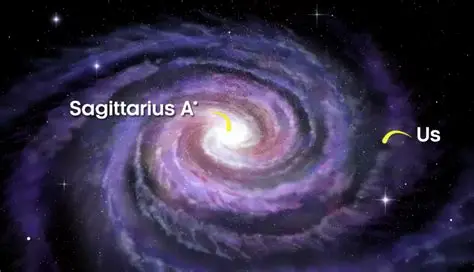
Fastest Star in the Milky Way: S301 Reaches 25,000 km/s Near Sagittarius A
The fastest star in the Milky Way has just been discovered, and its name is S301 — a remarkable object racing at 25,000 km/s near the supermassive black hole Sagittarius A
For decades astronomers have stared into the darkest heart of our galaxy, searching for clues about the supermassive black hole that anchors the Milky Way. Now, hidden in that gravitational chaos, they have found something extraordinary: the fastest star ever observed in our galaxy. It is called S301, and it races through space at 25,000 kilometers per second, roughly 100,000 times faster than a commercial airplane. Its discovery, published in Nature, comes from the ultra‑precise observations of the Very Large Telescope Interferometer (VLTI) of the European Southern Observatory.
S301 is not just fast. It is also the closest star ever seen orbiting Sagittarius A\*, the supermassive black hole at the center of the Milky Way. At its nearest point, it approaches the black hole at a distance comparable to the space between Saturn and the Sun. No other known star has ever ventured so close. And because of that proximity, S301 may become the first star capable of revealing the rotation of a black hole — a measurement astronomers have been chasing for decades.
A star moving at eight percent the speed of light
The numbers behind S301 are almost impossible to imagine. At its closest approach, the star reaches 25,000 km/s, about 8% of the speed of light. That velocity earns it the title of the fastest star in the Milky Way. The reason for such extreme speed is its incredibly tight orbit around Sagittarius A\*. S301 completes one full revolution in just 8.7 years, a remarkably short period for an object so close to a supermassive black hole.
Despite its dramatic behavior, S301 is a fairly ordinary star in terms of physical properties: a main‑sequence star with a mass roughly 1.5 times that of the Sun and a radius between 1.4 and 1.6 solar radii. What makes it unusual is its faintness. From Earth, S301 appears two billion times dimmer than Betelgeuse, the bright orange giant in Orion. Astronomers suspect that S301 was once part of a binary system torn apart by the tidal forces of Sagittarius A\*. One star remained trapped in the black hole’s gravitational grip; the other was flung away at such speed that it likely escaped the galaxy entirely.
Why S301 matters: a chance to measure the spin of Sagittarius A\*
The true importance of S301 lies not in its speed, but in what it may allow scientists to measure. According to Einstein’s general relativity, a rotating black hole drags spacetime around with it — a phenomenon known as frame dragging. This effect subtly alters the orbits of nearby stars. But to detect it, astronomers need a star that passes extremely close to the black hole. S301 is the first star ever found that meets this requirement.
If its orbit can be tracked with enough precision over the next decade, S301 may allow astronomers to directly measure the rotation of Sagittarius A\*. This would be a breakthrough in black‑hole physics, offering new constraints on models that describe how these exotic objects form, evolve and interact with their surroundings.
How astronomers found S301
Detecting a star as faint as S301 — especially one located right next to a black hole — is an extraordinary challenge. The discovery was made possible by the VLTI at ESO’s Paranal Observatory in Chile, equipped with the Gravity+ instrument. The VLTI combines the light of four eight‑meter telescopes to create a virtual telescope with a resolution fifteen times higher than any single telescope of the same size. As Frank Eisenhauer, principal investigator of Gravity+, explains, this is the only place on Earth capable of making such observations.
Astronomers first spotted S301 in the spring of 2023. Since then, they have tracked its motion and reconstructed its orbital history back to 2017. The star’s most recent close passage near Sagittarius A\* occurred in early 2023. Future observations with Gravity+ and with MICADO, a next‑generation instrument that will be mounted on ESO’s Extremely Large Telescope, will be crucial. S301 is expected to make another close approach in 2031, and observing at least two full orbits will give scientists the precision needed to measure the black hole’s spin for the first time.
A new window into the physics of black holes
The discovery of S301 marks a turning point in the study of the Milky Way’s central black hole. For years, astronomers have relied on stars like S2 — bright, massive, and relatively close to Sagittarius A\* — to test general relativity. But S301 is different. It is smaller, fainter, faster, and far closer to the black hole than any star previously observed. It is the first star that brings us within reach of measuring the rotation of a supermassive black hole directly.
In the coming decade, S301 may become one of the most important objects in astrophysics. Its orbit is a natural laboratory for extreme gravity, a place where Einstein’s equations are pushed to their limits. And as instruments grow more powerful, the faint light of this extraordinary star may reveal secrets that have remained hidden at the center of our galaxy for billions of years.
