
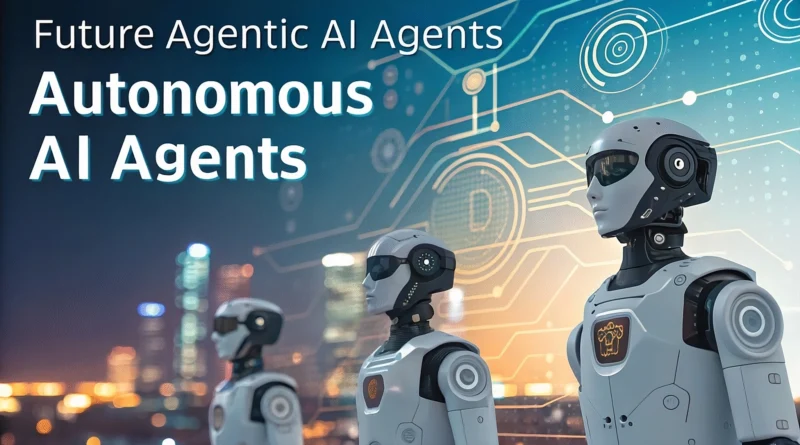
AI Agents Are Changing the Digital World: Acting on Our Behalf
The digital landscape is undergoing a silent but monumental shift. For the past few years, the public conversation around artificial intelligence has been dominated by large language models that generate text, summarize articles, or create realistic images based on a user’s direct prompt. However, we have officially entered a new era. The paradigm is moving from a passive assistant that waits for instructions to an active, autonomous collaborator. The transition from generative tools to autonomous systems represents the dawn of the agentic era, where software does not just reply to us—it acts on our behalf.
This evolution is fundamentally rewriting the relationship between humans and machines. Imagine an artificial intelligence that does not merely draft an apology email to a client, but instead logs into your corporate customer relationship management platform, investigates why a specific shipment was delayed, coordinates with the logistics database, refunds the customer, updates the internal ticket, and alerts the engineering team to a systemic error in the supply chain.
This is no longer a speculative concept discussed in academic papers. In late 2026, it is a lived economic reality. AI agents are breaking free from the constraints of simple chat interfaces, evolving into digital proxies capable of navigating complex software environments, managing schedules, making payments, and orchestrating multi-step workflows with minimal human intervention.
The Anatomy of Action: How Agentic Systems Are Breaking the Chat Window
To understand why this shift is so profound, one must look at how the core mechanics of AI have changed over the past twelve months. Traditional generative systems operate on a rigid input-output loop: a human provides a prompt, and the machine generates a statistical prediction of what the answer should look like. If the user wants to execute a multi-step task, they must act as the manual bridge between each step, continuously “babysitting” the machine, evaluating its output, and copying data from one application to another.
Agentic systems dissolve this friction through three key architectural breakthroughs: advanced multi-step reasoning, contextual memory retention, and the integration of open communication protocols. Rather than looking at a high-level goal as a singular prompt, an agent treats it as an objective to be disassembled into small, logical sub-tasks. If instructed to organize a three-day corporate seminar in a specific city, the agent constructs an internal roadmap. It calls APIs to check hotel availabilities, compares flight prices, references the user’s personal calendar to cross-match preferences, and coordinates with external digital platforms to execute tentative bookings.
This degree of operational independence has been significantly accelerated by the industry-wide adoption of standardized open frameworks. A prominent example is the Model Context Protocol (MCP), which acts as a universal bridge between underlying AI reasoning models and the disparate data silos of the modern web. Through protocols like MCP, agents can seamlessly read and write data across platforms like secure corporate databases, public transit portals, and financial ledgers.
Furthermore, the scale of this technological deployment has changed the very structure of digital workspaces. According to recent industry assessments published by Deloitte Applied AI Research, agents have evolved past simple data-retrieval scripts into complex, multi-agent collaboration ecosystems. In these environments, specialized digital agents operate like a corporate department.
A lead “manager” agent receives the primary user directive, breaks down the work, and delegates individual pieces to specialized sub-agents—one dedicated exclusively to secure data extraction, another to rigorous compliance auditing, and a third to user-interface execution. This continuous, self-correcting internal loop allows the software to navigate unexpected errors or API timeouts without throwing up its hands and waiting for a human to debug the process.
The Ghost in the Marketplace and the Future of Human Oversight
As these autonomous proxies proliferate, they are fundamentally altering the broader consumer economy. The digital space is transitioning into what computer scientists describe as the “agentic web,” an internet ecosystem where the vast majority of web traffic, clicks, and digital transactions are performed by software proxies interacting with other software proxies, rather than by human eyes clicking on physical screens.
This trend became undeniable following major consumer platform rollouts, such as Meta launching its multi-step personal assistant, Muse, which quickly climbed to the top of digital application charts by allowing users to delegate everyday tasks like making peer-to-peer payments and managing dining reservations directly through automated app interactions. Simultaneously, tech ecosystems are clashing over the rules of this new economy.
When autonomous personal agents attempt to automatically scrape, compare, and finalize transactions on major e-commerce platforms, they face resistance from traditional online retailers seeking to maintain control over human attention and direct ad clicks. This friction highlights a deeper transformation: businesses are realizing they no longer just need to market their products to human consumers; they must convince the consumer’s automated agent that their product offers the optimal parameters of cost, speed, and reliability.
However, this rapid transition from assisted automation to complete operational autonomy introduces a profound set of challenges regarding security, accountability, and the nature of human labor. When software is granted the authority to execute legal or financial actions on behalf of an individual, the traditional boundaries of cybersecurity are completely transformed. Malicious actors no longer just focus on cracking user passwords; they actively design adversarial prompts hidden within ordinary images or invoices, intended to hijack an autonomous agent’s reasoning loop the moment it scans the document.
This reality has catalyzed a shift in how modern enterprises structure their workforces. The emerging paradigm is not a completely dark, automated office devoid of people, but rather a “human supervisor model”. In this framework, human professionals transition from manual executors of routine digital tasks into strategic orchestrators and compliance auditors. The human sets the high-level boundaries, defines the strategic goals, and steps in at critical inflection points to approve financial expenditures or verify legal compliance.
This symbiotic relationship removes the exhausting administrative overhead that plagues modern knowledge work, giving individuals the freedom to focus entirely on creative problem-solving and critical evaluation. The central story of modern technology is no longer about building machines that think like us, but rather about cultivating intelligent proxies that can reliably act for us, freeing humanity to focus on what cannot be simulated: authentic judgment, empathy, and strategic vision.
