CoreWeave rises while Bitcoin stalls: The New Fault Line Between AI and Crypto
By Julian Reyes, Zemeghub
CoreWeave rises while Bitcoin stalls in one of the most revealing weeks of the summer, a moment where the acceleration of the AI industry collides with the hesitation of the crypto market. While CoreWeave’s stock climbed more than nine percent, Bitcoin slipped below sixty‑four thousand dollars, entering a fragile corridor of macro uncertainty ahead of the U.S. CPI release. The contrast between these two forces—one expanding through industrial momentum, the other bracing for macro pressure—has become one of the defining narratives of 2026.
CoreWeave’s stock surged more than 9% this week, a sharp and confident ascent that unfolded in the very same hours when Bitcoin slipped below $64,000 and the broader crypto market entered a phase of hesitation. The contrast was impossible to ignore. On one side, a company powering the global AI boom was accelerating with the momentum of a sector that refuses to slow down. On the other, the world’s largest digital asset was bracing for macroeconomic turbulence, waiting for the U.S. CPI data like a ship waiting for the next tide.
The divergence between these two worlds—AI infrastructure and decentralized finance—has become one of the defining stories of 2026. CoreWeave, once a niche GPU‑rendering startup, has transformed into a heavyweight of the AI era. Its valuation has climbed past $19 billion, supported by massive demand for compute from companies building frontier models. The firm’s latest earnings report showed a 54% increase in revenue year‑over‑year, driven primarily by long‑term contracts with AI labs and cloud providers. Investors see CoreWeave not as a speculative bet but as a backbone of the new digital economy.
Bitcoin, meanwhile, is navigating a different kind of pressure. Its price decline this week was not catastrophic, but it was symbolic. The asset fell below a psychological threshold at the exact moment when traders were repositioning ahead of the inflation report. The market’s sensitivity to macro signals has grown sharper, and Bitcoin’s volatility has become a mirror reflecting the anxieties of global finance. While CoreWeave benefits from structural demand, Bitcoin remains tied to liquidity cycles, interest‑rate expectations, and the shifting moods of institutional capital.
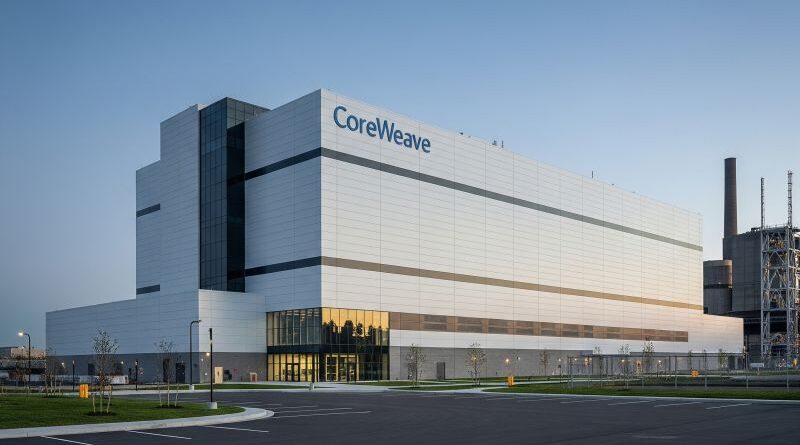
What makes this moment particularly revealing is how investors are allocating their attention. AI has become the gravitational center of technological optimism. Every major fund—from BlackRock to Sequoia—is expanding exposure to AI infrastructure, compute, and model‑training ecosystems. CoreWeave sits at the heart of that movement. Its data centers, filled with NVIDIA H100 and H200 clusters, are the engine rooms of the new industrial revolution. When the company announced the expansion of its New Jersey and Texas facilities, analysts described it as “the most important infrastructure build‑out since the early cloud era.”
Crypto, by contrast, is experiencing a quieter summer. Trading volumes on Coinbase and Binance have contracted by nearly 12% compared to June. DeFi activity has slowed, with total value locked hovering around $92 billion, down from the spring peak. Even Ethereum’s gas fees have dropped, a sign that speculative activity has cooled. This is not a collapse—it is a pause. But pauses in crypto are loud. They create narratives, doubts, and questions about whether the next wave of innovation will come from blockchain or from AI.
And yet, the story is not as simple as “AI up, crypto down.” Under the surface, the two sectors are beginning to intersect in unexpected ways. CoreWeave itself has quietly become a provider of compute for several blockchain projects experimenting with AI‑enhanced smart contracts and decentralized inference. The company’s GPU clusters are being used to train models that will eventually run on-chain or in hybrid architectures. In other words, the same infrastructure powering the AI boom is also becoming a foundation for the next generation of crypto applications.
This convergence is still in its infancy, but it hints at a future where the boundary between AI and crypto becomes porous. Bitcoin may be struggling this week, but its long‑term narrative remains intact. The number of addresses holding more than one BTC reached 1.1 million, an all‑time high. BlackRock’s Bitcoin ETF continues to attract inflows even during downturns. And institutional adoption is no longer a question—it is a fact.
CoreWeave’s rise does not diminish Bitcoin’s relevance. It simply reveals where capital is flowing right now: toward infrastructure, toward compute, toward the machinery that makes intelligence scalable. Bitcoin represents a store of value, a macro hedge, a digital commodity. CoreWeave represents the engine of creation, the factory where models are born. The market is choosing both, but at different speeds, for different reasons.
As August unfolds, the contrast between these two giants—one decentralized, one industrial—will continue to shape the narrative of digital finance. Bitcoin waits for CPI. CoreWeave builds data centers. One reacts to macro forces; the other creates technological momentum. And in that contrast lies the story of 2026: a world where AI accelerates even when crypto hesitates, and where the future is being built not in a single sector but in the space between them.
As the market braces for the next macro signal, you can explore how this tension extends beyond crypto and into the accelerating world of artificial intelligence in our in‑depth analysis: CoreWeave rises while Bitcoin stalls.
