
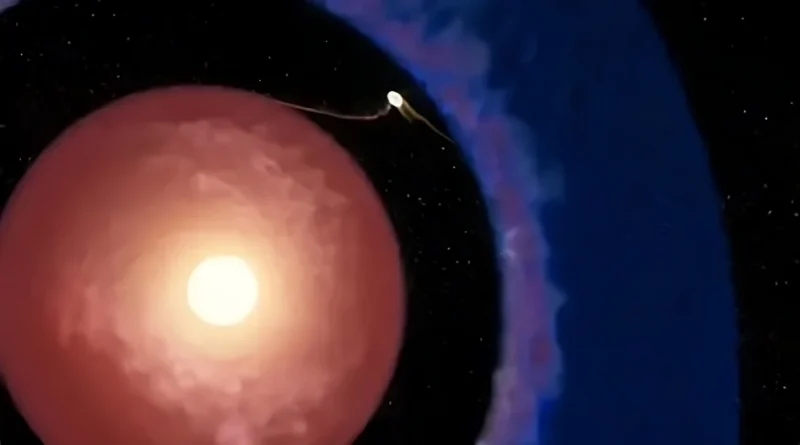
Elias 2-24 b: The Astonishing Youngest Planet Ever Discovered
Some discoveries in astronomy feel important because of their size. Others capture our attention because of their distance or because they reveal something beautiful about the Universe. And then there are discoveries that seem to bend our understanding of time itself. Elias 2-24 b belongs to that rare category. Located roughly 450 light-years from Earth, this newly confirmed exoplanet is forcing astronomers to look again at one of the most fundamental questions in planetary science: how quickly can a giant planet form?
At first glance, the discovery does not sound particularly extraordinary. Astronomers have identified thousands of exoplanets over the past few decades. Many are larger than Jupiter. Many are farther away than Elias 2-24 b. Distances measured in hundreds or thousands of light-years have become almost routine in modern astronomy. Yet the detail that makes this planet exceptional has nothing to do with its size or its location. What makes astronomers pause is its age.
According to the observations, Elias 2-24 b is less than one million years old.
That number is surprisingly difficult to appreciate. In human terms, one million years represents an almost unimaginable span of time. Entire species have appeared and disappeared within periods shorter than that. Landscapes have transformed. Ice ages have come and gone. Human civilization itself occupies only a tiny fraction of such a timeline. Yet in the life of a planetary system, one million years is barely the beginning. It is the cosmic equivalent of infancy.
And somehow, despite being so young, Elias 2-24 b already appears to be a giant world with a mass several times that of Jupiter.
The more I thought about the discovery, the more fascinating it became. We are accustomed to imagining planets as ancient objects. When we look at Jupiter, Saturn, Earth, or Mars, we are looking at worlds that have existed for billions of years. Their violent beginnings are buried deep in the past, preserved only in subtle clues left behind in rocks, crater patterns, and computer simulations. We know that planets must form somehow, but we almost never get to witness the process itself.
Elias 2-24 b offers something different.
Rather than observing a mature planet long after its birth, astronomers may be looking at a world that is still emerging from the environment that created it. The planet remains embedded within the gas and dust surrounding its young star. Instead of seeing the finished result, we may be witnessing one chapter of the construction process itself.
That is what makes this discovery feel so remarkable. It is not simply another planet added to a growing catalog. It is a glimpse into an extraordinarily brief stage of planetary evolution that astronomers have been trying to understand for decades.
The young star at the center of this story, Elias 2-24, resides within the Ophiuchus star-forming region, an active stellar nursery where new stars continue to emerge from collapsing clouds of gas and dust. Around the star extends a broad protoplanetary disk, a rotating structure containing the raw materials from which planets are expected to form. Such disks are common around young stars, but they are anything but orderly places.
Popular illustrations often show planetary systems as elegant arrangements of planets orbiting quietly around a star. The reality is far messier. During the earliest stages of planetary formation, enormous amounts of gas, dust, ice, and rocky material are constantly interacting. Particles collide and merge. Gravity pulls matter into larger concentrations. Some structures grow while others disappear entirely. It is a dynamic environment filled with chaos, motion, and transformation.
Eventually, from that chaos, planets emerge.
The challenge is that observing those early moments is incredibly difficult. Young planets tend to hide inside the very material from which they are forming. The surrounding disk can obscure them. Their host stars are usually far brighter than the planets themselves. Distinguishing a genuine planetary signal from dust structures, observational noise, or instrumental artifacts often requires years of careful analysis.
This is precisely why Elias 2-24 b has attracted so much scientific attention.
Researchers were able to identify the planet within a narrow gap inside the surrounding protoplanetary disk. At first glance, a gap might seem insignificant. After all, astronomers spend most of their time searching for things that exist rather than places where material appears to be missing. Yet in planetary science, an empty region can sometimes be the most revealing clue of all.
Over the past decade, increasingly detailed images of protoplanetary disks have revealed an astonishing variety of structures. Many disks contain rings, spirals, arcs, and dark gaps. These features often hint at invisible processes occurring within the disk itself. One possible explanation is that forming planets exert gravitational forces on their surroundings, redistributing material and carving out regions where the density becomes lower than elsewhere.
In simple terms, a planet may leave fingerprints on the disk long before astronomers can see the planet directly. That appears to be exactly what happened in the Elias 2-24 system.
Using observations obtained with the NIRC2 instrument and vortex coronagraph at the Keck Observatory, researchers examined archival observations dating from 2018 and 2020. Recovering the same signal from different datasets was crucial. A faint point of light near a young star can be deceptive. It might represent a background object, random noise, or an observational artifact. Scientists therefore needed strong evidence before concluding they had identified a genuine planetary companion.
The repeated detections strengthened the case considerably. Eventually, the evidence pointed to the same conclusion. A planetary source existed within the narrow gap observed in the disk. That confirmation transformed what had previously been a suggestive hint into one of the most exciting planetary discoveries of recent years.
What came next was perhaps even more surprising.
Based on evolutionary models, Elias 2-24 b is estimated to possess between roughly two and four times the mass of Jupiter. Estimates for planets this young inevitably involve uncertainties because astronomers cannot place these distant worlds on a scale and measure their weight directly. Instead, they compare observations with theoretical models that describe how young planets evolve over time.
Even accounting for these uncertainties, however, the broad picture remains astonishing. This is not a tiny rocky object taking its first tentative steps toward becoming a planet. This is already a giant world. And it apparently achieved that status in less than one million years.
That simple fact raises profound questions about planetary formation. Traditional core-accretion models describe giant planets forming through a gradual process. A solid core accumulates material from the surrounding disk until it becomes massive enough to attract enormous quantities of gas. The process works well for explaining many observed planetary systems, including much of what astronomers understand about Jupiter and Saturn.
The difficulty is that such growth typically requires time. Lots of time. Yet Elias 2-24 b appears to have become a giant planet extraordinarily quickly.
Its location makes the puzzle even more intriguing. The planet orbits approximately 55 astronomical units from its host star. One astronomical unit represents the average distance between Earth and the Sun. This means Elias 2-24 b is orbiting fifty-five times farther from its star than Earth does from ours.
To understand how distant that is, consider Neptune, the outermost major planet in our Solar System. Neptune orbits at roughly 30 astronomical units. Elias 2-24 b lies substantially farther out than Neptune while possessing a mass comparable to a giant gas planet. For theorists who study planetary formation, this combination is fascinating.
Building a massive planet becomes increasingly difficult farther from a star because material is spread over larger regions of space and orbital timescales grow longer. The farther away a planet forms, the more challenging it becomes to gather enough material quickly. Yet Elias 2-24 b seems to have accomplished precisely that.
Importantly, astronomers are not claiming that the planet violates the laws of physics. The discovery has not broken science, overturned gravity, or destroyed decades of research. Reality is usually more nuanced and far more interesting than sensational headlines suggest.
Scientific models are tools for understanding nature, not rigid laws that nature must obey.
When observations fail to fit comfortably inside an existing model, scientists examine their assumptions. Perhaps giant planets can grow faster under certain conditions. Perhaps young disks contain more mass than previously estimated. Perhaps multiple formation pathways operate simultaneously. Or perhaps there are aspects of early planetary evolution that remain poorly understood.
These possibilities are exactly what make discoveries like Elias 2-24 b valuable. The Universe is effectively telling astronomers that there is still something important left to learn.
One of the most fascinating aspects of this discovery involves the way astronomy allows us to experience multiple layers of time at once. Elias 2-24 lies approximately 450 light-years away. That means the light detected by our telescopes today actually left the system roughly 450 years ago. In a very real sense, every observation is historical.
The version of Elias 2-24 we see tonight no longer exists exactly as we observe it. The system has continued evolving during the centuries required for its light to cross interstellar space. If a dramatic event occurred around the star today, scientists on Earth would remain completely unaware of it for another four and a half centuries.
That fact alone feels extraordinary. Yet there is another clock operating simultaneously. The planet itself is less than one million years old. So astronomers are observing ancient light originating from an object that is itself extraordinarily young. The age of the planet, the age of the star, the travel time of the light, and our own position in history all overlap in a complicated tapestry of cosmic timescales.
Astronomy constantly reminds us that time is not experienced uniformly throughout the Universe. Every observation represents a conversation between different clocks. Another aspect of the discovery deserves special attention because it highlights how far astronomical technology has progressed. Detecting a faint planet near a bright star is an immense technical challenge. The star’s light overwhelms almost everything around it, making nearby planets exceptionally difficult to identify.
This is where specialized instruments become essential. Coronagraphs are designed specifically to suppress the overwhelming glare of a star so that much fainter objects become visible. In combination with advanced image-processing techniques, these tools allow astronomers to search for planets that would otherwise remain hidden.
The process is not unlike trying to spot a firefly hovering beside a powerful searchlight. Except the searchlight is hundreds of light-years away. And the firefly may be buried inside a vast cloud of cosmic dust. The fact that astronomers can recover such signals at all is a remarkable achievement of modern observational science.
Perhaps the most beautiful aspect of Elias 2-24 b, however, is that it may not yet be finished forming. The planet appears to remain embedded within its natal disk. It may still be interacting with surrounding material. It could still be gaining mass. The environment around it continues to evolve. In other words, astronomers may be observing a planet during construction rather than after construction.
That possibility transforms the way we think about our own origins. Earth formed approximately 4.5 billion years ago. Jupiter emerged during the earliest history of the Solar System. The original disk from which our planets formed disappeared long ago, leaving only indirect evidence of what those ancient conditions may have been like.
We cannot travel backward through time to witness those events. But we can observe other systems experiencing similar stages today.
Every young planetary system becomes a natural laboratory where astronomers can investigate questions that would otherwise be impossible to answer. How quickly do giant planets form? How much material exists within young disks? What role does migration play? How do planets reshape their environments? Which processes are universal, and which depend on local circumstances?
The beauty of astronomy is that the Universe continuously performs these experiments for us. Across the galaxy, countless stars are surrounded by disks. Countless planets are forming right now. Some systems will resemble our own. Others will follow completely different evolutionary paths. Each one adds another piece to the broader puzzle of planetary formation.
Elias 2-24 b may ultimately prove to be an extraordinary outlier. Or it may turn out to be the first clearly observed member of a population that astronomers have only recently gained the ability to detect. At present, nobody knows. And that uncertainty is part of what makes the discovery so compelling.
Future telescopes, more sophisticated coronagraphs, and improved imaging techniques will almost certainly reveal additional young planets hidden inside protoplanetary disks. As those discoveries accumulate, astronomers will be able to compare systems, test models, and develop a clearer picture of how planetary systems emerge from clouds of gas and dust.
The story of Elias 2-24 b therefore extends beyond a single planet. It represents a new window into planetary childhood itself.
For generations, astronomers have studied mature worlds long after their formative years had passed. Now, for perhaps the first time, we are beginning to catch planets during the earliest chapters of their lives. We are moving beyond asking whether planets exist and toward understanding how they become what they are. That shift may prove just as important as the discovery itself.
When people describe Elias 2-24 b as a baby planet, the phrase sounds poetic. Yet it may also be scientifically accurate. This world appears to remain surrounded by the material from which it was born. Its environment is changing. Its growth may not be complete. Its planetary system is still taking shape.
In cosmic terms, it has barely begun its journey. And yet it is already massive enough to challenge assumptions, inspire new research, and force astronomers to reconsider how quickly giant worlds can emerge.
Perhaps that is why discoveries like this resonate so deeply. They remind us that the Universe is not a finished place. Stars continue to form. Galaxies continue to evolve. Planets continue to grow. Entire solar systems are still being assembled in the darkness beyond our skies.
Elias 2-24 b is more than the youngest confirmed planet currently known. It is a reminder that planetary systems have childhoods. And for the first time in human history, we are becoming capable of watching them grow.
Scientific Sources
NASA Science
Newfound “Baby” Planet Smashes Record for Youngest Known World
September 16, 2026
The relationship between distance, cosmic time, and the journey of light remains one of the most fascinating concepts in modern astronomy. A deeper exploration can be found in The Expanding Universe: How Cosmic Expansion Shapes Space, Time, and Dark Energy.
Discoveries like Elias 2-24 b are reshaping our understanding of planetary evolution and the broader history of the cosmos. Readers interested in the larger picture can explore Cosmology 2026: The New Frontiers of the Universe Revealed by JWST.
Modern astronomy is moving beyond simply detecting planets and toward understanding their physical properties and environments. This evolution is evident in studies such as Exoplanet Atmospheres: Stunning JWST Discoveries Reveal the Chemistry of Distant Worlds.
