
U.S. Debt 40 Trillion: What America’s New Record Really Means
The U.S. debt 40 trillion milestone didn’t arrive with fireworks or dramatic speeches. It simply appeared in the Treasury’s daily numbers on August 18, 2026, when the federal debt quietly crossed $40.047 trillion and pushed the United States into a financial territory it had never entered before.
Washington, August 21, 2026 — At some point, the numbers stop feeling real. They become too large, too abstract, too distant from everyday life. But this one, unfortunately, is very real: the United States has crossed $40 trillion in gross federal debt. It happened quietly, almost without ceremony, on August 18. The Treasury’s daily report showed the total debt at $40.047 trillion, and just like that, America stepped into a new chapter of its financial history.
It’s a strange moment. Nobody celebrates it, nobody wants to own it, yet everyone knew it was coming. The debt had been climbing fast for years. Back in July 2025, it was around $36.2 trillion. Then Congress raised the legal debt limit by $5 trillion, pushing the ceiling to $41.1 trillion. And here we are, barely a year later, already brushing against that ceiling.
The speed is what shocks most economists. The U.S. didn’t drift into $40 trillion — it rushed into it.
A Trillion Here, a Trillion There
The federal government has been running deficits at a pace that feels almost surreal. In the first ten months of fiscal year 2026, Washington added $1.8 trillion in new deficit spending. July alone contributed $432 billion. One month. Nearly half a trillion dollars.
It’s not complicated: when the government spends more than it collects, it borrows. And lately, it has been borrowing a lot.
But here’s where people often misunderstand the situation. When Americans hear “$40 trillion in debt,” many imagine the country owes $40 trillion to foreign governments. That’s not how it works.
The Debt America Owes to Itself
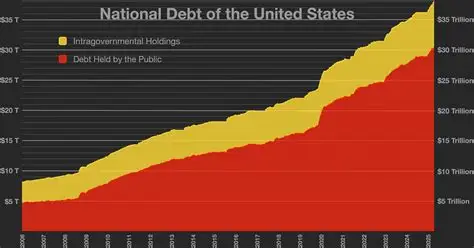
The gross federal debt includes two big pieces:
- Debt held by the public — investors, banks, pension funds, foreign governments, anyone who buys Treasuries.
- Intragovernmental debt — money the government owes to its own agencies, like Social Security and other federal trust funds.
As of August 5, 2026, the Congressional Joint Economic Committee reported:
- $32.10 trillion held by the public
- $7.73 trillion in intragovernmental holdings
This distinction matters. The $40 trillion headline is dramatic, but it doesn’t tell you how much of that debt is actually held by outside creditors. Economists tend to focus more on the public portion, because that’s the part the government must repay to real investors.
Still, even with that nuance, the number is enormous.
The Interest Bill Keeps Growing
There’s another problem lurking behind the debt: interest costs. When debt grows, interest payments grow with it. And when interest rates rise, those payments explode.
In August 2026, a Treasury auction for 30‑year bonds produced a yield of 5.216% — the highest since 2001. That’s not a small detail. Higher yields mean the government must pay more to borrow money, and with a debt this large, even a small rate increase can add tens or hundreds of billions to the annual budget.
This doesn’t mean the U.S. is close to default. The country still has strong access to global markets, and the dollar remains the world’s reserve currency. Investors still trust the United States. But trust doesn’t erase math. The long‑term cost of carrying this debt is becoming heavier.
The Real Issue: A Deficit That Won’t Slow Down
Crossing $40 trillion is dramatic, but the real story is the persistent deficit. The U.S. isn’t just sitting on a mountain of old debt — it’s adding new layers to it every year.
According to the Committee for a Responsible Federal Budget, the government borrowed more in the first ten months of FY 2026 than in the entire FY 2025. That’s the kind of trend that keeps economists awake at night.
Debt rises because deficits rise. And deficits rise because spending keeps outpacing revenue. Unless that changes, the debt will keep climbing, no matter what Congress sets as the legal limit.
Is This Dangerous?
It depends on how you measure danger. The raw number — $40 trillion — is shocking, but it doesn’t automatically mean the economy is collapsing. A more meaningful metric is the debt‑to‑GDP ratio, which compares the size of the debt to the size of the economy.
The Conference Board estimates the U.S. debt‑to‑GDP ratio is now around 123%. That’s high. Not unprecedented globally, but high for a country that plays such a central role in the world economy.
The real question is whether economic growth can keep up. If the economy expands fast enough, the debt becomes more manageable. If growth slows while interest costs rise, the situation becomes harder.
Right now, the U.S. is still growing — but not fast enough to make the debt feel comfortable.
A Historic Number, but Not the Final One
Passing $40 trillion is a milestone, but it’s not the end of the road. The debt ceiling is $41.1 trillion, which means the U.S. is already close to the next political showdown. Analysts don’t expect the limit to be hit immediately, but the margin is thin.
The real question isn’t whether the U.S. can exceed $40 trillion. It already has. The question is how long the country can continue increasing its debt without making major changes to spending, taxes, or economic strategy.
For now, the U.S. remains stable, influential, and capable of borrowing. But the numbers are getting louder, and the long‑term path is becoming harder to ignore.