
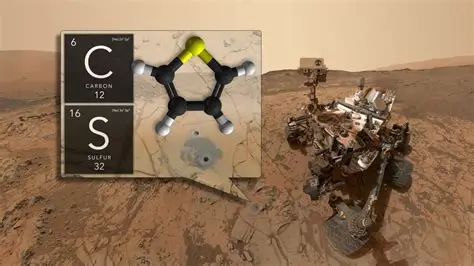
Organic Molecules on Mars: The Molecules That Shouldn’t Be There
Organic molecules on Mars were never supposed to be found in such fragile and ancient form, yet in 2026 the Curiosity rover uncovered more than twenty of them inside clay-rich rocks. Some resemble the early chemical precursors of DNA and RNA, forcing scientists to reconsider what Mars might have been billions of years ago.
When the Curiosity rover landed on Mars back in 2012, nobody imagined that fourteen years later it would still have enough life left in its circuits to surprise the scientific community. And yet, in 2026, while slowly climbing the slopes of Mount Sharp, it sent a batch of data that forced researchers to stop, recheck the readings, and wonder if something had gone wrong. But nothing was wrong. What Curiosity had found was more than twenty organic molecules trapped inside ancient clay-rich rocks, some of them resembling the precursors of nucleotides, the basic building blocks of DNA and RNA.
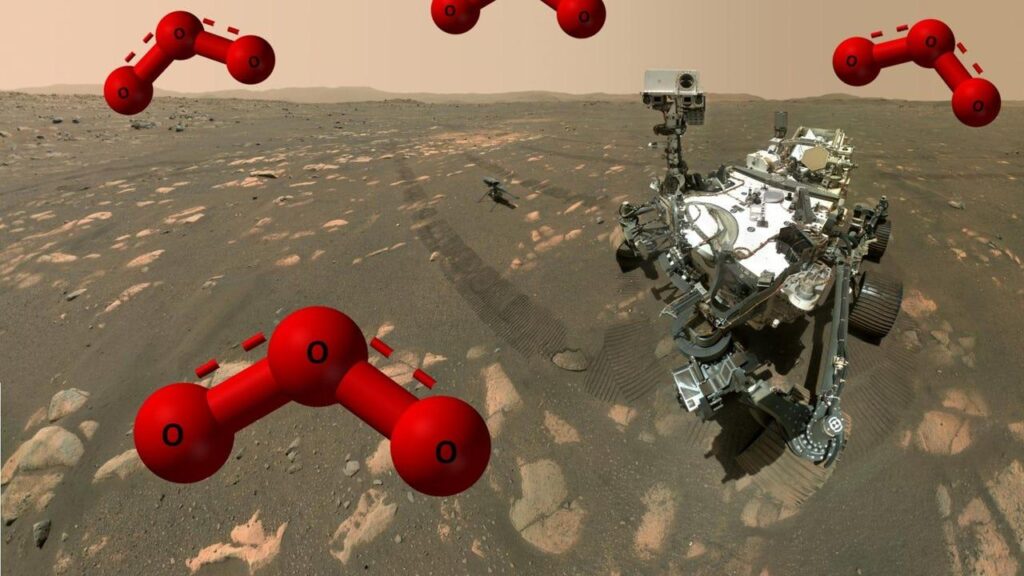
It wasn’t the first time Curiosity detected organic compounds. In 2018 it had already identified thiophenes and aromatic compounds, and in 2021 it confirmed unusually high concentrations of organic carbon. But this time the story was different. These molecules weren’t just generic carbon fragments: they were more complex, more delicate, more similar to the structures that, on Earth, participate in the chemical processes that come before life. And the fact that they were found in rocks 3.5 billion years old adds enormous weight to the discovery.
The analyses come from SAM (Sample Analysis at Mars), a small engineering marvel tucked inside Curiosity’s body. SAM heats samples up to 900 degrees, separates them, and analyzes them using mass spectrometry and chromatography. It’s a slow, almost ritualistic process that takes days. But when the team saw the chemical signals emerging from the graphs, they realized something didn’t fit. The molecules were too stable to be modern contamination, too complex to be simple geological leftovers, too similar to the compounds that, on Earth, form in environments rich in water and energy.
The question everyone asked was inevitable: how did they survive? Mars is a hostile planet. Its atmosphere is thin, the soil is bombarded by cosmic radiation, and temperatures swing violently. And yet, those molecules were there, preserved like in a natural archive, protected by layers of clay that formed billions of years ago in the presence of liquid water. That’s the key: water. The clays in Gale Crater are the result of ancient lakes that formed and retreated multiple times, leaving behind sediments that eventually trapped everything passing through that environment.
Scientists aren’t talking about life. They’re cautious, as always. But they’re talking about potential, about ingredients, about favorable conditions. They’re talking about a Mars that, in a remote past, wasn’t the red desert we see today but a dynamic world with complex climate cycles, water that flowed and pooled, minerals reacting with each other. A world that, at least for a certain period, could have hosted chemical processes similar to those that, on Earth, led to the emergence of life.
The discovery of these organic molecules isn’t an isolated announcement. It fits into a series of clues Curiosity has gathered over the years: layered sulfates indicating repeated evaporation cycles, carbon isotopes suggesting processes not fully explained, and even seasonal variations in atmospheric methane—still a mystery today. Each of these elements, taken alone, doesn’t say much. But together, they start forming a picture that looks like a larger, more intricate, more fascinating story.
And yet, there’s a limit no rover can overcome. Curiosity can analyze, photograph, drill, but it cannot bring anything back to Earth. And to truly understand the nature of these molecules—whether they’re the result of complex geological processes or somehow connected to a biological past—we need something Curiosity cannot do: we need to bring those samples home.
The Mars Sample Return program, which is supposed to retrieve samples collected by Perseverance, has been delayed, redesigned, and scaled down multiple times. But Curiosity’s discovery adds a new level of urgency. It’s no longer just about analyzing sedimentary rocks from Jezero Crater’s delta. It’s about understanding whether Mars, billions of years ago, really began a chemical path similar to Earth’s. And whether that path stopped abruptly or left traces we can still find today.
The truth is that nobody knows what we’ll discover. We might find that the molecules are the result of purely geological processes. Or we might find something that changes forever our understanding of life in the universe. It’s a risk, sure. But it’s also a promise. A promise that Curiosity, with its patient mechanical persistence, keeps reminding us of every time it sends a new batch of data.
Mars doesn’t speak. It has no voice. But it preserves. It preserves everything. And those molecules—those structures that shouldn’t be there—are a message. A message waiting to be decoded.
Read also: Black Hole Star: The Astonishing JWST Discovery Behind MoM‑BH*-1 — A deep look at how early black holes may hide inside dense gas envelopes, revealed through gravitational lensing.
Read next: Curiosity Rover Wheel Damage: What 14 Years on Mars Reveal About the Rover’s Survival — New MAHLI imagery shows severe wheel damage after years of navigating the harsh Martian terrain.
