
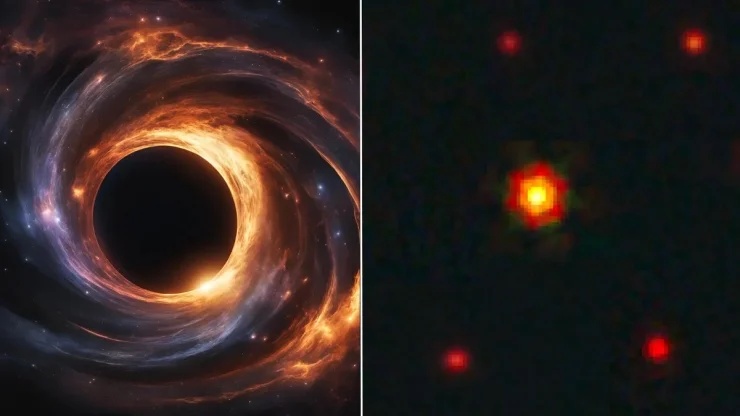
Black Hole Star: The Astonishing JWST Discovery Behind MoM‑BH*-1
Black hole star candidates like MoM‑BH*-1 challenge everything astronomers thought they understood about the early Universe.
There are periods in the history of the Universe that remain difficult to picture, even for astronomers who spend their entire careers trying to reconstruct them. The first galaxies were only beginning to assemble, stars were still young and chemically simple, and the enormous black holes we see today at the centers of galaxies should have had very little time to grow. Everything about that era feels compressed, rushed, almost unreasonable. And yet, the James Webb Space Telescope keeps finding objects that make the puzzle even harder.
One of the strangest is an object now labeled MoM‑BH*-1. The name is not memorable, but the object itself is becoming impossible to ignore.
JWST detected it as it existed roughly 660 million years after the Big Bang, at a spectroscopic redshift of z = 7.7569. The light we see today began its journey more than 13 billion years ago, from a time when the Universe was still in its infancy. The discovery and interpretation were published in Nature in 2026 by Rohan Naidu, Jorryt Matthee and collaborators, and since then the object has become one of the most debated sources in early‑Universe studies.
MoM‑BH*-1 does not behave like a normal star. It does not behave like a young galaxy either. It sits somewhere in between, or perhaps outside both categories entirely.
The researchers argue that it may be what they call a “black hole star”, a term that sounds misleading until you understand what it describes. This is not a giant version of the Sun. It is a system in which a rapidly growing black hole is buried inside an enormous envelope of dense gas. The black hole produces the energy, but the surrounding gas reshapes that energy, absorbs part of it, re‑emits it, and ultimately makes the entire object look surprisingly star‑like from such a huge distance.
The observations were made with JWST’s Near‑Infrared Spectrograph (NIRSpec), using the prism mode for about 4.5 hours. Earlier imaging from the PRIMER and EXCELS programs provided additional constraints. Together, these data gave astronomers something far more useful than a simple picture: a spectrum showing how the object’s light changes with wavelength.
And it is the spectrum that makes MoM‑BH*-1 so unusual.
The source shows an exceptionally strong Balmer break, far stronger than what ordinary stellar populations can produce. This matters because the Balmer break is one of the classic signatures of starlight. When it becomes extreme, the simple explanation — “it’s just stars” — starts to fall apart.
MoM‑BH*-1 also shows a dramatic drop in brightness across the infrared spectrum. Its flux falls by more than a factor of 20 between roughly 3 and 4 microns, giving the object an extremely red appearance in JWST images. Nothing about that slope looks like a normal star.
And then there is the broad hydrogen emission. Astronomers detect broad Hβ, a sign of gas moving at very high velocities. Broad hydrogen lines are commonly associated with material located close to an actively accreting black hole. The interpretation is complicated, but the presence of broad emission is another reason why a powerful central engine is favored over a simple cluster of stars.
The picture that emerges is strange, but coherent.
At the center, according to the proposed model, there is a rapidly growing black hole. Around it sits a thick envelope of gas. The black hole feeds on the surrounding material, releasing enormous amounts of energy as matter falls inward. But that radiation does not escape freely. It must pass through the dense gas surrounding the central engine. The gas absorbs and reprocesses part of the radiation, changing the spectrum that eventually reaches us.
From Earth, more than 13 billion years later, the result can look almost like a giant red star. But the engine underneath is completely different.
A normal star shines because nuclear fusion is taking place in its interior. A black hole star, in this interpretation, would be powered primarily by accretion onto the black hole. The surrounding gas acts as a giant envelope, hiding the central engine and making the entire system appear much more star‑like than a typical quasar.
This is why the term “black hole star” has attracted so much attention. It describes a phase that might help explain how early black holes grew so quickly.
Still, astronomers are cautious. MoM‑BH*-1 is an exceptionally strong candidate, but the interpretation is not yet a certainty. Researchers are still testing whether black hole stars represent a genuine and common stage in early black‑hole growth. Recent work has already identified hundreds of possible black‑hole‑star‑dominated objects in JWST data, with candidates spanning redshifts from z ≈ 1.7 to z ≈ 9.3. If the interpretation is correct, the phenomenon may not have been restricted to the very first few hundred million years of cosmic history.
This connects MoM‑BH*-1 to another JWST mystery: the “little red dots.” Since JWST began observing, astronomers have found large numbers of compact, extremely red objects in the early Universe. Their nature has been debated. Some may be galaxies, some may contain active black holes, and some may be heavily obscured systems in which the central engine is almost completely hidden by gas and dust.
MoM‑BH*-1 provides an intriguing possibility. Perhaps at least some of those little red dots are not simply unusual young galaxies. Perhaps their central regions are powered by black holes surrounded by dense gas, with the surrounding material producing the strange red appearance seen by Webb. The European Research Council notes that the new observations strengthen the idea that black hole stars could be connected to the population of little red dots.
There is another interesting detail about MoM‑BH-1 itself. Unlike many of the mysterious red objects discovered by Webb, MoM‑BH-1 appears to be overwhelmingly brighter than its host galaxy. This gives astronomers an unusually clean opportunity to study the light coming from the proposed black‑hole‑star system itself, without having the signal heavily mixed with light from a normal galaxy. MIT researchers describe this as one of the reasons why the object is so useful for testing the model.
MoM‑BH-1 is also located close to a young galaxy. According to the researchers’ modeling, the two systems could eventually merge on a timescale of around 100 million years. That possibility is particularly interesting because simulations suggest that after such a merger, the resulting system could resemble the kind of little red dot already seen in JWST observations. In that scenario, MoM‑BH-1 would not simply be an isolated oddity. It could represent an earlier stage in the evolution of an object that later becomes part of a galaxy and eventually looks very different.
Of course, we cannot watch that evolution unfold. The Universe does not give us a movie. It gives us snapshots.
When astronomers look at MoM‑BH*-1, they are seeing one moment from more than 13 billion years ago. When they look at a different galaxy at another distance, they are seeing a different moment in cosmic history. By comparing thousands of these snapshots, they try to reconstruct how the Universe changed over time.
This is why an object like MoM‑BH*-1 can be so valuable.
The problem of early black holes has been around for years. We know that today’s galaxies can contain black holes with millions or even billions of solar masses. We also know that quasars powered by enormous black holes existed when the Universe was less than a billion years old. The difficult part is explaining how they became so massive so quickly.
A black hole needs matter to grow. But there are limits to how rapidly ordinary accretion can proceed. If the initial black hole seed was too small, simply feeding it at conventional rates may not provide enough time to reach billions of solar masses by such an early epoch.
This is where a dense, gas‑rich environment could become important. If black holes were born early and then spent part of their lives buried inside enormous reservoirs of gas, their growth could potentially proceed very rapidly. The black‑hole‑star phase could therefore be part of a pathway connecting early black‑hole seeds with the massive quasars that appear surprisingly soon after the Big Bang.
That does not mean MoM‑BH*-1 has solved the mystery. Far from it.
There are still questions about the exact physical structure of the gas, how the envelope forms, how long such a phase can survive, and how efficiently the central black hole can grow. Different models also have to reproduce the observed spectrum across several wavelengths, not just one unusual feature.
This is where future JWST observations will become important. Astronomers need more objects like MoM‑BH*-1. One spectacular discovery can show that something is possible. A larger population is needed to understand how often it happens.
The recent survey work is already moving in that direction. A 2026 study identified 241 black‑hole‑star‑dominated candidates in roughly 1,000 square arcminutes of JWST imaging. The candidates extend across a surprisingly broad redshift range, from z ≈ 1.7 to 9.3, and the estimated bolometric luminosities span roughly 10^42 to 10^45 erg/s. If interpreted as Eddington‑limited accretion, these luminosities correspond to black‑hole masses between 10^4 and 10^7 solar masses.
Those numbers are still model‑dependent, and candidate samples are not the same thing as confirmed black hole stars. But they show why the subject is moving so quickly.
The discovery of MoM‑BH*-1 is therefore more than another strange image from JWST. It could represent a missing stage in the story of how the first massive black holes grew.
And there is something almost ironic about the object. The black hole itself is invisible. What astronomers actually see is the material around it. The gas is glowing. The gas is absorbing light. The gas is changing the spectrum. And that enormous envelope may be hiding the very thing that is powering the whole object.
So when JWST sees MoM‑BH*-1 as a tiny red source in the distant Universe, it may not be looking at a star in the traditional sense at all. It may be seeing a black hole buried so deeply inside its own environment that the surrounding gas has effectively become its visible surface.
That could explain why the object looks so wrong when compared with ordinary stars. It also gives the little red dots a potentially much more interesting story.
They may not simply be strange galaxies that happened to look red in the first JWST images. Some could be growing black holes, hidden inside dense clouds of gas, caught during a short and violent stage of their development.
And if that turns out to be correct, MoM‑BH*-1 may eventually be remembered not because it was the first object given the name “black hole star,” but because it offered astronomers a rare look at what could be happening before a young black hole grows into something much more familiar: a quasar at the center of a galaxy.
For now, the safest conclusion is also the most exciting one. MoM‑BH*-1 is an exceptionally distant and unusual source, seen when the Universe was only about 660 million years old. Its spectrum and extreme red appearance are difficult to explain with ordinary starlight alone. The observations are consistent with a black hole surrounded by a dense envelope of gas, making it one of the strongest examples yet of the proposed black‑hole‑star phase.
Whether every little red dot hides a similar engine is still an open question. But JWST has now given astronomers something they did not have before: a remarkably clear example with which to compare the others.
Somewhere inside that tiny red point, more than 13 billion years away, there may be a black hole in the process of becoming the kind of monster that will eventually dominate the center of a galaxy.
Even in our own Solar System, long‑term survival in extreme environments leaves visible scars — something clearly seen in the Curiosity rover wheel damage after fourteen years of driving across the harsh Martian terrain.
And while MoM‑BH*-1 pushes our understanding of cosmic dawn, JWST continues to reveal even earlier structures, as shown in James Webb earliest galaxies — a discovery that reshapes how we imagine the Universe’s first billion years.
