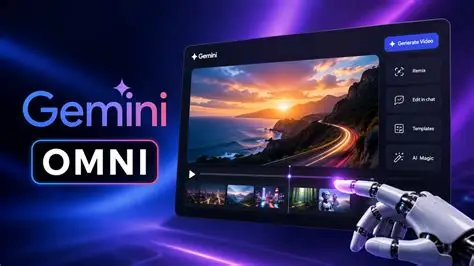
Google Gemini Omni 1.1 Flash video AI: the truth behind the 40‑second clips and the fake 4K
Google Gemini Omni 1.1 Flash video AI arrives at a moment when every announcement in AI video generation seems designed to reshape the industry. Google DeepMind presents it as a step forward in narrative continuity and extended clip creation, but behind the promise of 40 seconds and 4K output, several technical details radically change how this product should be understood.
In the fast‑moving world of AI video generation, every announcement arrives dressed as a revolution. With Gemini Omni 1.1 Flash, Google DeepMind chose to tell a story of continuity, control, and extended creative reach—a narrative meant to reassure developers and enterprises that generative video is finally entering a more mature phase. But once you look beneath the surface of the official launch post, the tone shifts. What appears to be a bold leap forward becomes, in truth, a measured step, full of technical constraints that Google prefers not to spotlight.
The most celebrated feature is the so‑called “scene extension,” a mechanism that allows the model to analyze ten seconds of an existing clip and append another ten seconds at the end. Repeating the process four times yields the headline number: forty seconds. Yet the magic stops there. The extension works only at the end of the clip—never in the middle.
You cannot insert new scenes, you cannot make a character who is already speaking deliver new lines, you cannot restructure the narrative. It is a progressive elongation of the ending, not an editable timeline. Anyone imagining a commercial with a central scene to be re‑shot will quickly discover that this feature simply doesn’t allow it. For enterprise workflows, this limitation matters. A produced video and an edited video are not the same thing: the former is what the model decides to add; the latter is what the team decides to build.
The resolution issue is even more delicate. Google advertises output “up to 4K,” but the native resolution remains 720p. Both 1080p and 4K are achieved through upscaling, not native generation. This detail does not appear clearly in the official announcement; it was highlighted only by independent technical coverage. A truly native 4K video carries spatial coherence, micro‑details, and stability that originate directly from the model. Upscaling, instead, starts from a lower‑quality frame and invents missing pixels.
Edges, hair, text inside scenes—all become more fragile. Google blends native resolution and upscaled resolution in the same specification list, a choice that complicates life for anyone evaluating the model for real production needs. For teams working at scale, the difference also affects budget: upscaling is an additional computational step, with a cost that is not always clearly separated in pricing. Comparing two video models based solely on their maximum declared resolution, without understanding how that resolution is achieved, leads to flawed estimates and risky decisions.
Then there is the “draft” mode at 360p, the only part of the announcement that hides nothing. Lower resolution, lower cost, lower time. Up to 60% faster and one‑third the price of 720p. It is a promise that matches what is delivered, without tricks. A rarity in a launch post that tends to emphasize aspiration more than reality.
Google also introduces new control tools: the ability to specify the first and last frame to guide transitions and camera movement, and the use of a reference video up to three seconds long to maintain visual consistency. These are useful features, especially for teams working with repeatable assets, but they are not original inventions.
Runway and models like Sora had already introduced similar logic. The real question, however, remains unanswered: how well does narrative coherence hold across the full forty‑second extended sequence? Google provides no comparisons on character drift, lighting continuity, or object stability between one block and the next.
Anyone evaluating the product must test it themselves, because the announcement offers no basis for judging it beforehand. It is a silence that weighs heavily, especially because the launch emphasizes the ability to extend clips further. The longer the promised sequence, the more important it becomes to know how well that sequence actually holds.
Google’s positioning is clearly enterprise‑oriented. The partners mentioned—Figma with Weave, Adobe Firefly, Runway, GMI Cloud—paint a picture of an ecosystem designed for professional workflows, not for a consumer app meant to generate viral clips. Official language support remains English only, a significant limitation for teams producing localized content in Italian or other European languages. It is a clear signal: this model is not aimed at the general public, but at those who integrate generative video into complex pipelines.
The most surprising part of the announcement, however, is not the technology but the communication. The launch post speaks of broad, almost global availability on Google AI Studio, the Gemini Enterprise Agent Platform via API, Google Flow, and the Gemini app for Plus, Pro, and Ultra subscribers. Yet Google Cloud’s technical documentation, published the same day, tells a different story: the model is still classified as “Preview.” Two different registers describing the same product.
One is meant for the press and customers; the other for developers who must decide whether to build something stable on top of it. And the second, by definition, almost never lies. The distinction has concrete consequences: a Preview model carries different clauses regarding SLA, availability, and the possibility of changes without notice. Building a critical workflow on an unstable foundation is a choice that must be made with full awareness. Procurement teams should read the technical documentation before the press release, not after. That is where the real classification lives, along with usage limits and contractual details the launch post does not mention.
The competitive context helps interpret Google’s move. OpenAI shut down Sora as a consumer app in March, after a brief wave of curiosity that never turned into sustained use. Google chooses the opposite direction: less spectacle, more granular control for those integrating the model into production processes.
It is a strategy consistent with Gemini’s pricing policy, where some Flash models have costs halved until 2027 to encourage developer adoption. A cheaper video model to test—even in draft mode—fits perfectly into this logic. Google wants to lower the barrier to entry and let developers discover the limits in production. It is a strategy aimed at building loyalty, not at dazzling the public.
This move also fits into Google’s broader generative chain: an ecosystem that allows users to generate images, extend them into video, and integrate everything into enterprise tools without ever leaving the vendor’s environment. Keeping a customer inside a single ecosystem—from image generation to forty‑second video extension—is a commercial advantage far greater than any single announced feature.
In the short term, the winners are enterprise developers who already needed precise control over keyframes and visual continuity, and who now have one more tool without switching providers. The ones paying the price are the teams who take the launch post literally and discover only in production that the promised 4K is upscaled, that the forty seconds are four stitched blocks without guaranteed coherence, and that the product they are building on is, according to Google itself, still in Preview. It is a story that repeats often in the world of generative AI: the distance between what is announced and what is delivered is the real news.
At the end of your exploration of Google Gemini Omni 1.1 Flash video AI, readers can continue their journey through the broader landscape of artificial intelligence with two in‑depth articles that expand the conversation:
Future of Artificial Intelligence: the invention that could change all the others A forward‑looking analysis that imagines how human insight may merge with next‑generation machine intelligence, shaping an era where one invention could transform all the others. Continue reading: Future of Artificial Intelligence
AI poisoned by online propaganda: the invisible risk hidden in the modern web A critical investigation into how modern AI systems absorb distorted signals from the web, revealing the hidden dangers of propaganda infiltrating digital intelligence. Continue reading: AI poisoned by online propaganda
