

The Dangerous Geopolitics of Semiconductors: Inside the Global Power Struggle
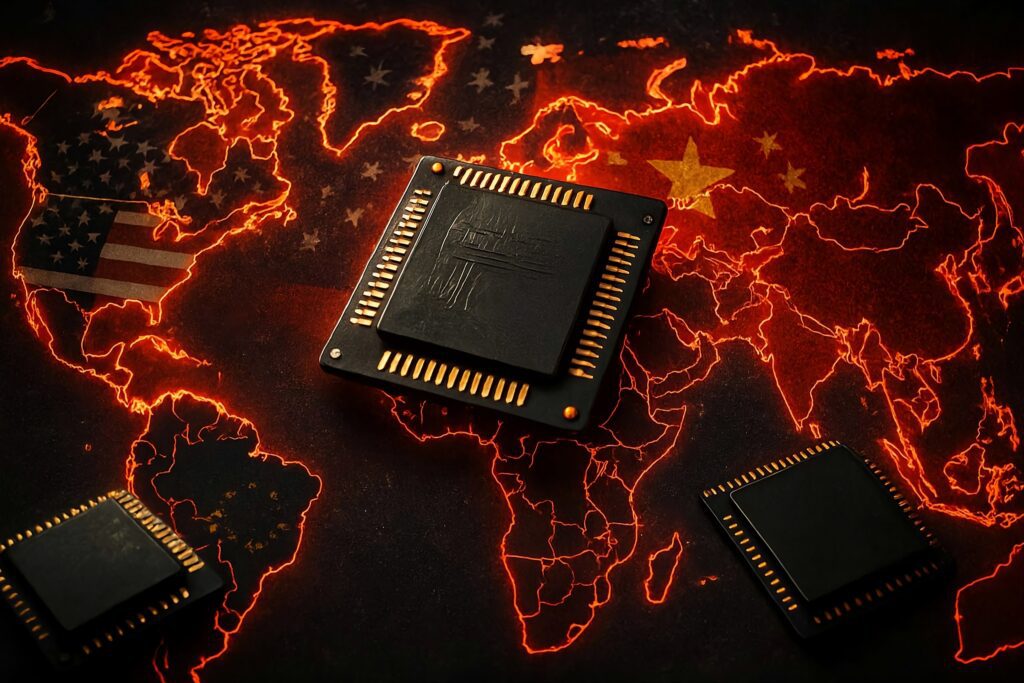
The geopolitics of semiconductors has rapidly become the defining arena of modern global power. For generations, the weight of nations was measured in acreage, standing armies, and the barrels of crude flowing through vital sea lanes. Today, the balance of international power hinges on something almost invisible to the naked eye: microscopic circuits etched onto ultra-thin wafers of silicon.
Microchips have quietly surpassed oil as the most critical resource on the planet, serving as the foundational infrastructure for everything from modern telecommunications and autonomous transport to advanced defense networks and artificial intelligence. What appears to be a purely technological industry has transformed into a high-stakes diplomatic struggle, where a handful of global choke points dictate the economic and sovereign fate of nations.
The Island at the Epicenter of the World
At the heart of this confrontation sits a narrow island in the East China Sea. Taiwan, through its manufacturing prowess, has become the undisputed nerve center of the global digital economy. The concentration of advanced semiconductor manufacturing within a small geographic footprint represents one of the most remarkable—and precarious—realities of modern history. A single facility in Hsinchu or Tainan manufactures the vast majority of the world’s most sophisticated processing units. This technological density has created what local leaders call a silicon shield: an industry so irreplaceable to both Western economies and Asian markets that any disruption to its supply chain would trigger immediate, catastrophic shocks across global trade and industry.
The Bottlenecks of Human Ingenuity
The vulnerability of the semiconductor ecosystem lies not just in where chips are made, but in how impossibly complex the production process has become. No single country holds a complete monopoly over every stage of manufacturing. The equipment required to print the smallest transistors relies on specialized optics, precision engineering, and chemical expertise scattered across highly specialized firms in Europe, East Asia, and North America.
A single advanced chip must cross international borders dozens of times in various stages of refinement before reaching a consumer device. Within the broader geopolitics of semiconductors, these extreme specialization points create massive strategic leverage, allowing governments to use trade controls and export restrictions as diplomatic weapons.
The Industrial Re-Shoring and the Race for Technological Autonomy
Faced with the stark reality of supply chain fragility, world powers have embarked on a massive, state-sponsored push to bring manufacturing back within their own borders. Washington, Brussels, and Beijing are deploying hundreds of billions of dollars in subsidies and incentives to construct new fabrication plants on domestic soil. Yet, rebuilding this ecosystem is proving to be a formidable challenge.
Building a modern semiconductor foundry requires far more than vast capital investments; it demands a dedicated, highly trained workforce of specialized engineers, reliable access to clean water and stable power grids, and an intricate web of chemical and equipment suppliers that cannot be replicated overnight. The transition from off-shored efficiency to sovereign resilience is exposing the deep cultural and economic hurdles that Western nations face as they attempt to revitalize their industrial foundations.
The Dragon’s Pursuit of Digital Sovereignty
Across the Pacific, export controls on advanced machinery and cutting-edge design tools have forced a dramatic acceleration in domestic innovation. Cut off from Western supply chains for high-end microprocessors, state-backed entities and domestic tech giants are pouring unprecedented resources into reverse-engineering equipment and building alternative software frameworks. While the gap in manufacturing ultra-thin chips remains a significant hurdle, this technological isolation is catalyzing an independent ecosystem focused on mature node production, specialized domain architecture, and new materials. What was intended as a strategy to slow technological advancement has instead triggered a fierce, parallel race for self-reliance, permanently fragmenting the once unified, global tech landscape into distinct, competing ideological blocks.
The AI Epoch and the Redefinition of National Security
As artificial intelligence transitions from software experiments to the primary engine of economic activity, computing power has officially become a strategic measure of national strength. Training next-generation neural networks requires clusters of tens of thousands of specialized accelerators, turning semiconductor design into a zero-sum game of strategic dominance. A nation’s capacity to innovate, run advanced simulations, and secure its critical infrastructure is now directly bound to the density of transistors it can deploy. In this new era, military superiority is defined less by physical tonnage and more by algorithmic speed, elevating chip designers and foundry engineers to the front line of national defense strategy.
The Cost of Fragmentation and the Road Ahead
The unwinding of decades of globalized efficiency carries an inevitable price. As the world transitions toward duplicate supply chains, regionalized manufacturing hubs, and strictly guarded technical standards, the era of cheap, abundant hardware is giving way to a more costly and fragmented landscape. Yet, this friction is also spurring a renaissance in hardware architecture, driving researchers to explore novel materials beyond silicon and alternative computing paradigms like photonics and quantum processing. The quest for digital sovereignty is reshaping not only global alliances and trade agreements, but the very nature of human innovation itself.
The New Frontier of Global Power
We are standing at a historic inflection point where geography, diplomacy, and physics converge. The struggle for control over the microscopic world of semiconductors is no longer a niche dispute among tech executives or trade regulators; it is the central narrative defining the geopolitical architecture of the twenty-first century. As nations construct digital fortresses and race to secure their technological destiny, the outcome of this invisible battle will determine which societies lead the global economy, set the standards for emerging technology, and safeguard their independence in an increasingly interconnected world.
Read Next on ZEMEG Hub:
If you enjoyed this analysis, explore the energy side of this global transformation: Nuclear Energy Geopolitics: The Critical Global Race for Power, Security and Industrial Sovereignty.