
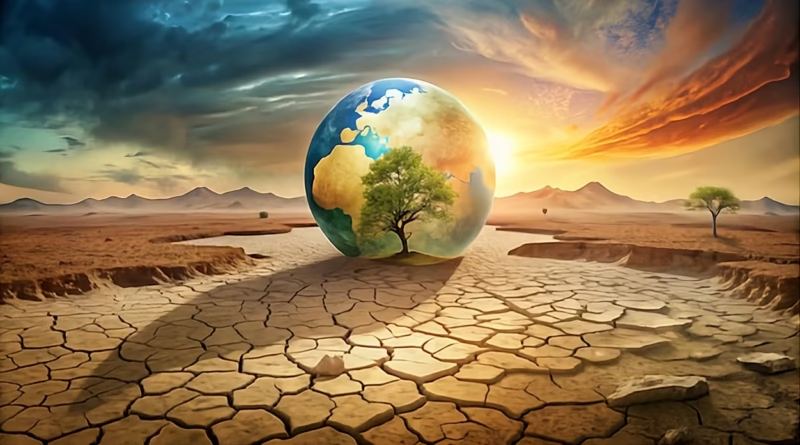
Global Environmental Instability: The Hidden Forces That Shape Our Daily Lives
By Aria Lorne
Global environmental instability is not just a planetary condition — it is a subtle force that shapes the way we think, behave, and make decisions every single day.
We wake up each morning believing that our choices belong to us. We decide what to eat, what to read, what to buy, what to believe. We move through the world with the quiet conviction that our preferences are personal and our decisions autonomous. Yet beneath the surface of everyday life, there are forces that shape us far more than we realize. They are not conspiracies, not invisible powers pulling strings, not secret entities directing our steps. They are real, measurable dynamics — environmental pressures, psychological mechanisms, technological architectures, social expectations, and economic conditions — that quietly sculpt our behavior.
The first of these forces is the environment itself. Climate change is not a distant abstraction; it is a lived reality that touches our routines in ways we rarely notice. Seasons shift, temperatures rise, rainfall patterns change, and ecosystems transform. The IPCC has shown how environmental stressors influence human behavior, affecting everything from migration patterns to mental well‑being. When the world around us becomes unstable, our routines adapt. We sleep differently, move differently, plan differently. We seek cooler spaces, safer environments, more predictable rhythms. The planet’s instability becomes our own, shaping our daily lives even when we believe we are acting freely.
The second force is digital architecture — the invisible systems that mediate our interactions with information. Algorithms do not control us, but they shape the landscape in which our choices are made. Every pause, every scroll, every click becomes a signal interpreted by platforms that learn what captures our attention. The OECD has shown how digital platforms shape information exposure, influencing what content becomes visible and how users navigate online environments. This subtle architecture of recommendations and curated feeds does not dictate our choices, but it frames the terrain in which those choices unfold. We believe we discover content on our own, yet much of what we “find” has been placed before us by systems optimized to keep us engaged.
How Global Environmental Instability Shapes Human Behavior
The third force is social influence. Human beings are profoundly shaped by the presence of others — a fact well‑established in decades of research by the American Psychological Association. Even when we act alone, we act with an imagined audience in mind. In the digital age, that audience is constant. Every post, every photo, every opinion is filtered through the awareness of being seen. This creates a subtle pressure to conform, to present, to curate. We adjust our behavior not because someone tells us to, but because we anticipate how others might react. Social influence becomes a quiet companion, guiding our steps without ever speaking aloud.
The fourth force is economic pressure. The cost of living, the price of energy, the availability of resources — these shape our decisions more than personal preference. The World Bank tracks how inflation and resource scarcity alter consumption patterns, shifting priorities and reshaping daily life. When energy becomes expensive, we heat differently. When food prices rise, we eat differently. When uncertainty grows, we plan differently. Economic conditions do not dictate our choices, but they define the boundaries within which our autonomy operates. We adapt to constraints we did not choose, often without realizing it.
The fifth force is health — not just personal health, but environmental health. The WHO has shown how climate stressors, pollution, and extreme weather events affect physical and psychological well‑being. Heat waves alter mood and cognition. Air quality influences energy levels. Environmental instability affects stress, sleep, and emotional resilience. We often attribute these changes to personal factors, unaware that the planet’s condition is quietly shaping our own.
These forces do not operate separately. They intertwine, forming a web of influences that surrounds us. Climate instability affects the economy. Economic pressure affects mental health. Mental health affects digital behavior. Digital behavior affects social dynamics. Social dynamics affect political choices. And political choices affect the environment. We live inside a loop — a system of reciprocal influences that shapes our daily lives in ways we rarely notice.
Yet acknowledging these forces does not mean surrendering our autonomy. It means understanding that autonomy is not a solitary act, but a negotiation with the world around us. We are not puppets, but we are not islands either. We are participants in a complex ecosystem of influences, pressures, and signals. The hidden forces that shape our lives are not enemies; they are part of the reality we inhabit. And by seeing them clearly, we gain the ability to navigate them with intention.
The challenge of our time is not to escape these forces, but to recognize them. To understand how climate shapes mood, how technology shapes perception, how society shapes identity, how economics shapes opportunity. To see the invisible architecture of daily life and learn to move within it consciously. The more clearly we see the forces that shape us, the more capable we become of shaping our own future.
The hidden forces are always there. But once we learn to see them, they are hidden no longer.
Sources
IPCC · OECD · APA · World_Bank · WHO
As we explore how global environmental instability shapes human behavior, it becomes impossible not to recall the patterns described in Global Environmental Instability: The Day Everything Changed, where the first signs of systemic fragility became visible.
These pressures echo what we see in Global Water Geopolitics 2026, where rivers and aquifers reveal how environmental forces quietly reshape societies.
Even subtle climate shifts, like those described in The Hidden Signals of a Warming Autumn, influence mood, perception, and daily decision‑making.
