Artificial Intelligence Explained: How AI Is Born, Learns, and Reshapes the Modern World
Artificial Intelligence Explained is not just a technical phrase or a trending keyword. It is the story of a new invisible architecture that now shapes medicine, creativity, global politics, economics, and the very structure of modern society. To understand what artificial intelligence truly is, we must go far beyond the surface-level idea of “smart machines” and step inside the mechanisms that allow a system to transform raw data into predictions, patterns, and decisions. In 2026, AI has become the silent engine of the digital world, a force that operates behind every screen, every platform, every automated process, and every strategic decision made by governments and corporations.
AI does not appear fully formed. It begins as a question, a limitation, a human desire to overcome the boundaries of our own cognition. Researchers start with a blank neural architecture, a mathematical skeleton capable of processing information in ways that resemble the abstraction of the human brain, but without consciousness, emotion, or intention. Every piece of data becomes a number, every number becomes a signal, and those signals travel through layers that interpret, transform, and recombine them. This is the foundation of Artificial Intelligence Explained, a system that does not imitate the human mind but reconstructs its logic through probability, optimization, and scale.
The training phase is where the transformation becomes visible. A machine does not think in the human sense; it optimizes. It predicts, fails, corrects itself, and tries again. Every incorrect prediction becomes a mathematical adjustment, every adjustment becomes a refinement, and billions of refinements turn a blank structure into a model capable of recognizing language, images, anomalies, or behaviors. When a system like ChatGPT generates a coherent paragraph, or when a medical AI detects a subtle irregularity in a scan, we are witnessing the practical side of Artificial Intelligence Explained in action. It is not magic. It is the result of a relentless cycle of error and correction, repeated at a scale no human mind could ever match.
But raw intelligence is not enough. A model trained on vast datasets can also inherit errors, biases, and distortions. This is why alignment exists — a continuous effort to teach AI how to behave responsibly, safely, and ethically. Alignment is not a technical detail; it is a negotiation between human values and machine logic. It evolves as models become more capable, more autonomous, and more embedded in critical systems. In this sense, Artificial Intelligence Explained is also a story about control, boundaries, and the human responsibility to shape the tools we create.
Behind every AI system lies an enormous physical infrastructure. Data centers filled with thousands of GPUs process requests in milliseconds, consuming energy on the scale of small cities. This hidden machinery is the beating heart of modern AI, the part that users never see but that makes everything possible. If you want to understand how this invisible machinery has become the backbone of the digital world, the article Artificial Intelligence Infrastructure: How AI Became the Global System of 2026 offers a deep look into the global architecture powering today’s intelligent systems. It is within this infrastructure that the true meaning of Artificial Intelligence Explained becomes visible: intelligence does not float in the cloud — it lives in hardware, heat, electricity, and global networks.
When an AI responds to a question, it does not understand the world as we do. It calculates the most probable next word, the most likely pattern, the most coherent continuation. Yet within this statistical process emerge behaviors that resemble reasoning. It is partly an illusion and partly a sign that complexity can generate unexpected capabilities. This duality — mechanical yet creative, limited yet powerful — is central to Artificial Intelligence Explained, and it is what makes AI both fascinating and challenging. The more we scale these systems, the more they surprise us, revealing abilities that were never explicitly programmed but emerge from the depth of their architecture.
The future of AI is moving toward systems that help build other systems, models that optimize architectures, and agents capable of planning and acting autonomously in controlled environments. This evolution does not replace humans; it amplifies them. It forces us to rethink our role, our skills, and our relationship with technology. It challenges our assumptions about intelligence, creativity, and decision-making. And it reinforces the idea that Artificial Intelligence Explained is not the end of something, but the beginning of a new intellectual era.
Artificial intelligence is not magic, nor is it an inevitable threat. It is a tool — powerful, complex, imperfect. An extension of our ability to analyze, create, and imagine. Its strength lies not in replacing us, but in revealing how much more we can build when we expand the boundaries of our own intelligence. And in this sense, Artificial Intelligence Explained becomes the story of a world learning to think differently, a world where human intuition and machine computation merge into a new form of cognitive collaboration.
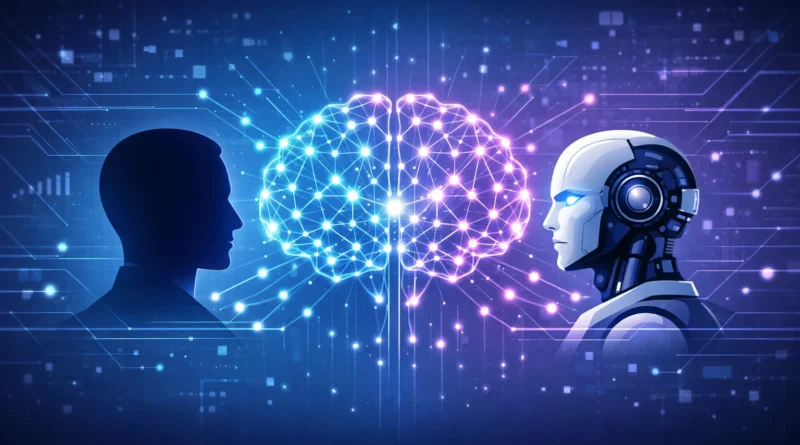
The real revolution is not that machines are becoming intelligent. The real revolution is that humans are learning to work alongside a new kind of intelligence — one that does not sleep, does not forget, and does not think like us, yet expands what we can achieve. This is the essence of Artificial Intelligence Explained: a partnership between biological and digital minds, a fusion of creativity and computation, a new chapter in the long history of human innovation.