
USA Leaving NATO: The Dangerous Scenario That Could Shake the Western World
USA Leaving NATO is a scenario that many experts once considered impossible. For more than seventy years, NATO has been the cornerstone of Western security, connecting North America and Europe through a shared commitment to collective defense. But what would happen if the United States suddenly decided to leave the alliance?
The possibility has gained attention in recent years as political debates over NATO spending, burden-sharing, and America’s global role have intensified. While a U.S. withdrawal remains hypothetical, the consequences could be enormous, affecting military strategy, international relations, and global stability.
For more than seven decades, NATO has been far more than a military alliance. It has served as the foundation of Western security, a symbol of transatlantic cooperation, and one of the key pillars supporting global stability since the end of World War II. But what would happen if the United States, the alliance’s most powerful member, decided to walk away?
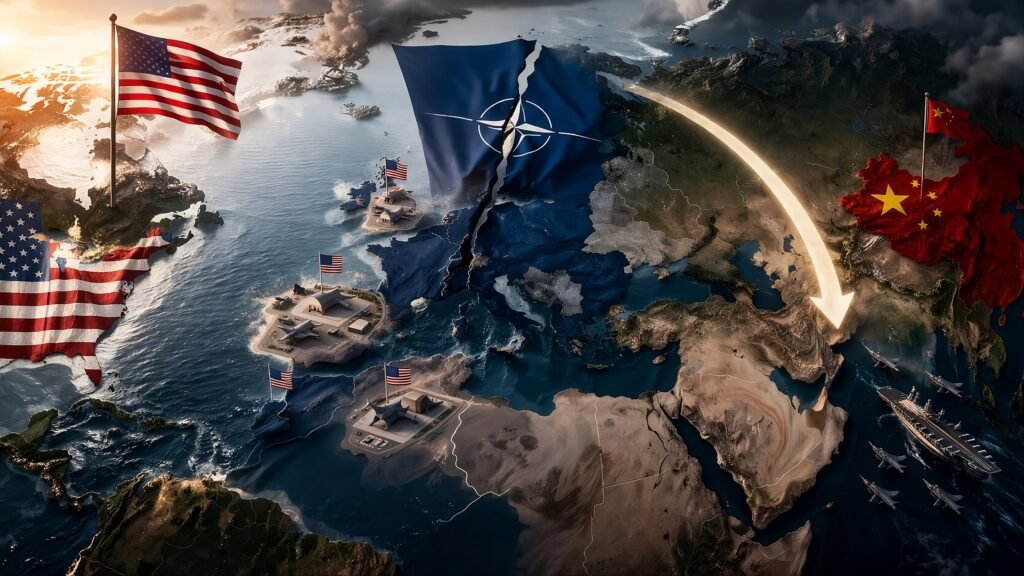
USA Leaving NATO could trigger a major shift in global security.
A scenario that once seemed unimaginable has increasingly entered geopolitical discussions following debates about America’s role within the alliance and growing tensions between Washington and some European partners. While a U.S. withdrawal from NATO remains hypothetical, the possibility alone is enough to raise concerns among governments, military strategists, and security experts worldwide.
Founded in 1949, NATO was built on a simple but revolutionary principle: an attack against one member would be considered an attack against all. This commitment, known as Article 5, became one of the strongest deterrents in modern history. At the center of this security framework stands the United States, which provides a significant share of the alliance’s military capabilities, intelligence resources, advanced technology, and strategic leadership.
If Washington were to leave NATO, the first impact would be psychological. European nations would suddenly face a dramatically different security reality. The American presence in Europe extends far beyond soldiers and military bases. It includes intelligence-sharing networks, missile defense systems, satellite surveillance, logistical support, and strategic capabilities that no single European country can currently replicate on its own.
The immediate consequence would likely be a major increase in defense spending across Europe. Although many European nations have already begun strengthening their military budgets in response to recent geopolitical challenges, a U.S. exit would accelerate this process significantly. Countries such as Germany, France, Poland, and Italy would face immense pressure to invest heavily in defense infrastructure, equipment, and personnel to fill the void left by America.
France would likely emerge as a central player in this new security landscape. As the only European Union member possessing an independent nuclear arsenal, Paris could assume a leading role in shaping a future European defense structure. However, creating a truly unified and effective European military capability would require years, if not decades, of political coordination and financial commitment.
The geopolitical consequences could be even more profound. Russia might perceive an American withdrawal as a sign of weakened Western unity, potentially increasing its influence in strategically important regions. Meanwhile, China would closely monitor any cracks within the transatlantic partnership, as a less cohesive Western bloc could reshape global economic and diplomatic power balances.
Another critical factor would involve the extensive network of American military bases spread across Europe. From Germany to Italy, these installations play a vital role in NATO operations and rapid-response capabilities. A reduction or withdrawal of U.S. forces would force European militaries to assume greater responsibilities while also impacting local economies that benefit from the American military presence.
Financial markets could also feel the effects. Investors generally view geopolitical stability as a cornerstone of long-term economic growth. A historic split between the United States and its European allies could trigger market volatility, affect investor confidence, and create uncertainty across international trade and investment networks.
Yet not all consequences would necessarily be negative for Europe. Some analysts argue that the end of Europe’s long-standing dependence on American military protection could accelerate the development of a stronger and more autonomous European defense policy. For years, leaders have discussed the idea of a common European army. In such a scenario, what has long been considered an aspiration could become a necessity.
A key question remains: would the United States truly benefit from leaving NATO? The alliance does not only protect Europe. It also serves as one of Washington’s most valuable instruments for projecting power, maintaining influence across the Atlantic, and supporting its broader strategic interests around the world. Abandoning NATO would mean giving up a significant geopolitical advantage while entering a far more unpredictable international environment.
For now, the idea of the United States leaving NATO remains a theoretical possibility. However, recent debates have highlighted an important reality: the Western alliance is not immune to political change. In a world increasingly shaped by great-power competition, regional conflicts, and shifting strategic priorities, even institutions that have defined global security for generations can no longer be taken for granted.
If the United States were ever to leave NATO, the world would witness far more than a diplomatic crisis. It would mark the beginning of a new geopolitical era, one capable of reshaping international security, altering global alliances, and influencing the balance of power for decades to come.
Continue Reading
The future of NATO cannot be separated from the broader economic transformations that are reshaping international power. As geopolitical competition intensifies, financial influence is increasingly becoming as important as military strength. Read our analysis: The Future of the Dollar: Can the World Move Beyond American Financial Dominance?
Military capabilities are also evolving rapidly through technological innovation. To understand how emerging defense technologies could shape future conflicts and strategic competition, explore: Military Drones and Modern Warfare: How Unmanned Warfare Is Changing Global Conflicts
For more international analysis, visit our Geopolitics section.