
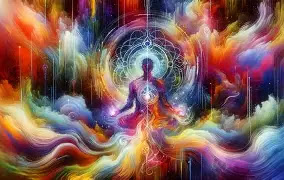
🌌 Exploring the Concept of Oneness: A Journey into Spiritual Unity
In the heart of nearly every spiritual tradition lies a profound and often elusive idea: oneness. It’s the notion that beneath the surface of separation—between people, nature, and even the divine—there exists a fundamental unity. This concept has inspired mystics, philosophers, and seekers for centuries, offering a lens through which to view life not as fragmented, but as deeply interconnected.
🌿 What Is Oneness?
Oneness is the spiritual understanding that all things are part of a single, unified whole. It transcends the boundaries of race, religion, species, and even time. To experience oneness is to feel that you are not merely in the universe—you are the universe, expressing itself in a unique form.
This idea challenges the ego’s tendency to divide and categorize. Instead of “me” and “you,” “us” and “them,” oneness invites the realization that all distinctions are temporary illusions.
🧘♂️ Oneness in Spiritual Traditions
Though expressed differently across cultures, the essence of oneness is universal:
-
Hinduism teaches Advaita, or non-duality, which asserts that the soul (Atman) and the ultimate reality (Brahman) are one and the same.
-
Buddhism emphasizes interdependence, where all phenomena arise in relation to others—nothing exists in isolation.
-
Christian mysticism speaks of union with God, where the soul dissolves into divine love.
-
Sufism describes the journey of the lover merging with the Beloved, losing the self in divine unity.
-
Indigenous wisdom often views the Earth and all its beings as part of a sacred web of life.
Despite doctrinal differences, these traditions point toward a shared truth: separation is an illusion, and unity is our deepest reality.
🔍 Why Oneness Matters
In a world marked by division—political, social, environmental—the concept of oneness offers a radical shift in perspective. It’s not just a spiritual idea; it’s a call to action.
1. Healing Relationships
When we see others as extensions of ourselves, compassion becomes natural. Conflicts soften. Forgiveness becomes possible. Oneness dissolves the barriers that keep us from truly connecting.
2. Environmental Stewardship
If the Earth is not “other” but part of us, then caring for it becomes a sacred duty. Oneness inspires ecological responsibility rooted in reverence, not obligation.
3. Inner Peace
The ego thrives on comparison and competition. Oneness quiets the mind by reminding us that we are already whole. There’s nothing to prove, nothing to chase—only to remember.
4. Spiritual Awakening
Many spiritual paths describe enlightenment as the realization of oneness. It’s not something gained, but something uncovered—a truth that was always there.
🌠 Experiencing Oneness
You don’t need to be a monk or mystic to touch the experience of oneness. It can arise in ordinary moments:
-
Watching a sunset and feeling part of the sky
-
Holding a loved one and sensing no boundary between you
-
Sitting in silence and noticing the breath as a shared rhythm with life
-
Walking in nature and feeling the pulse of the Earth beneath your feet
These glimpses remind us that oneness is not a theory—it’s a lived reality, accessible to anyone willing to be present.
🌀 The Paradox of Unity and Diversity
Oneness doesn’t erase individuality. In fact, it celebrates it. Just as every wave is part of the ocean, each person is a unique expression of the whole. Diversity is not a threat to unity—it’s its most beautiful manifestation.
The spiritual journey is not about becoming the same, but about recognizing the same essence in all things.
🌟 Conclusion
To explore the concept of oneness is to embark on a journey of remembrance. It’s a return to the truth that we are not separate, not alone, not divided. We are threads in a vast tapestry, notes in a cosmic symphony, sparks of the same eternal flame.
In embracing oneness, we don’t lose ourselves—we find ourselves in everything.