
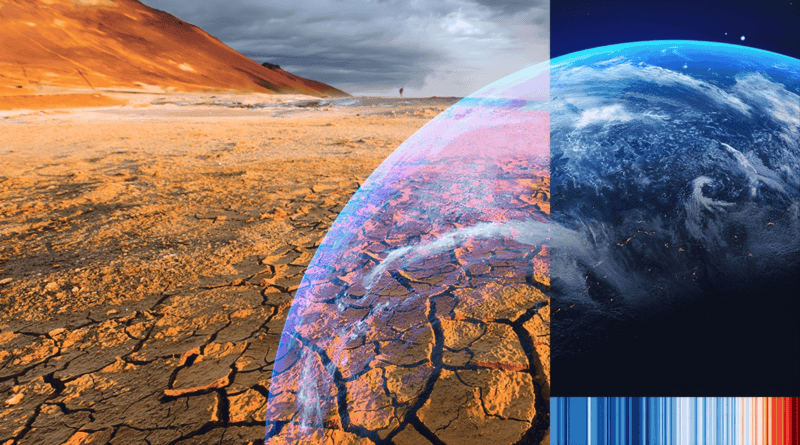
The Hidden Signals of a Warming Autumn
A Season That No Longer Starts Where It Used To
Warming autumn is no longer just a seasonal shift; it has become a quiet but powerful indicator of how deeply the planet is changing.
I’ve always thought of autumn as a kind of gentle pause between two extremes, a moment when the world exhales after the intensity of summer. But lately, when I look at how the season unfolds, I feel something different, something slightly off, like a familiar melody played in a new key. And I think the reason is simple: autumn no longer begins from the same baseline it once did. When I saw the Copernicus data showing that 2015–2025 were the eleven warmest years ever recorded, I had one of those moments where you stop scrolling and just stare. The numbers are not abstract anymore.
They shape the season itself. Global temperatures have been rising at about 0.21°C per decade since 1979, and even faster—around 0.27°C per decade—between 1996 and 2025. According to me, that acceleration is exactly what makes autumn feel different now. September, October, and November inherit the leftover heat of the preceding months, especially from land surfaces and oceans that have been warming relentlessly. So the season starts already warm, already charged, already tilted toward outcomes that used to be rare.
When I read that 2025 ended up being the third‑warmest year ever measured—just 0.01°C cooler than 2023 and 0.13°C cooler than 2024—I felt a strange mix of déjà vu and disbelief. The average temperature for 2023–2025 exceeded 1.5°C above the pre‑industrial reference for the first time over a three‑year period. The WMO places 2025 at about +1.43°C depending on the dataset.
And even though the datasets differ slightly, the conclusion is the same: the planet is still extremely warm. I think this is the part people underestimate. Autumn cooling doesn’t mean the climate resets. It means the season is trying to descend from a much higher platform than before. And sometimes it doesn’t descend very far.
The ocean plays a quiet but decisive role in this. When I saw the WMO statement that ocean heat content reached a record high in 2025, with warming rates more than double those of 1960–2005, I realized how much of the story is happening out of sight. Oceans absorb enormous amounts of excess energy, and they release it slowly. Land cools quickly after sunset or after a cold front.
The ocean doesn’t. Warm seas keep feeding warmth back into the atmosphere well into autumn, influencing humidity, rainfall, storm development, and circulation patterns. I’ve noticed it myself: those strange October days that feel like late summer, the nights that refuse to cool, the storms that seem to carry more moisture than they should. According to me, these are not coincidences. They are symptoms of a system that is storing more heat than it used to.
And then there is the Arctic, which has become, in my mind, one of the clearest dashboards of seasonal change. Copernicus reported that 2025 was the second‑warmest year ever recorded in the Arctic, while Antarctica reached its warmest annual temperature in the dataset.
The Arctic Report Card keeps documenting the loss of older, thicker ice—ice that used to act like a reflective shield and a stabilizing force. When I saw those satellite images of late‑season open water where ice should already be forming, I felt something close to unease. Autumn is the period when the Arctic transitions from its summer minimum toward winter refreezing. But a warmer ocean and atmosphere can delay that process, distort it, or weaken it. And when the Arctic changes, it’s not just a regional story. It’s a global one.
Warmth That Stays, Cold That Still Appears, and a Planet That Rolls Loaded Dice
One thing I always remind myself is that climate change doesn’t erase cold weather. It shifts probabilities. The document used a metaphor I really liked: rolling a six‑sided die that has been subtly altered so higher numbers appear more often. You can still roll a one. But the odds have changed. I think autumn is exactly like that now. A cold October is still possible. A sudden frost can still arrive early. But persistent warmth, record heat, and delayed cooling have become more likely.
And 2026 adds another twist. The WMO warned that the current El Niño could become one of the strongest ever recorded, with nearly a 100% chance of persisting through February 2027. El Niño is natural, but when it sits on top of a warming baseline, it amplifies everything. When I saw that August 2026 tied with July 2023 as the hottest August ever recorded—16.96°C globally, or +1.65°C above the pre‑industrial average—I felt that familiar mix of shock and resignation.
One month doesn’t redefine the Paris Agreement targets, but it does show how high the system’s temperature range has shifted. And according to me, this shift is exactly what autumn is now revealing: the heat doesn’t disappear when summer ends. It lingers, it pulses, it resurfaces.
The WMO describes Earth’s energy imbalance as the highest in its 65‑year observational record. That sentence stayed with me. It means the planet is absorbing more energy than it releases, and that energy moves through the atmosphere, oceans, and cryosphere in ways that reshape seasonal rhythms. I’ve seen it in small things: trees that hold their leaves longer, nights that feel strangely warm, the first frost arriving later than expected. These details seem trivial, but together they form a pattern. The calendar says autumn. The climate says something else.
Scientists are watching multiple indicators at once: global and regional temperatures, ocean heat content, sea‑surface temperatures, Arctic ice extent and thickness, snow‑cover timing, growing‑season length, late‑season heatwaves, rainfall patterns, atmospheric moisture, greenhouse‑gas concentrations, and Earth’s energy imbalance. When I read that the ocean has been absorbing energy equivalent to roughly eighteen times annual human energy use each year over the past two decades, I had to pause. It’s such a staggering number that it almost feels unreal. But it’s not a forecast. It’s a measurement.
Autumn as a Mirror of a Warming World
I think autumn deserves more attention than it gets. We often focus on dramatic images—wildfires, floods, heatwaves—but some of the most important evidence is quieter. It’s in the temperature of the sea after summer. It’s in the date of the first frost. It’s in how long Arctic ice takes to return. It’s in the persistence of warm nights. It’s in the length of the growing season. It’s in the heat stored beneath the ocean’s surface. These signals may look disconnected, but they are not. They are different expressions of the same physical reality: the Earth is accumulating additional energy because greenhouse‑gas concentrations have risen sharply since the pre‑industrial era.
A warming autumn doesn’t mean a future without cold snaps or storms. It means the entire seasonal system is operating from a warmer starting point. Some regions will experience longer summers. Others may see shifts in rainfall, earlier or later freezes, or sharper swings between warm and cold.
And in many places, the most important change may not be the average temperature but the growing frequency of extremes. According to me, this is why autumn has become such a revealing chapter in the story of a warming planet. It sits between the intense heat of summer and the cold of winter, making it the perfect moment to observe how quickly—or how slowly—the climate system releases the heat accumulated during the year.
The leaves will still change color. The days will still shorten. Winter will still arrive. But the conditions surrounding that transition are changing. And when I look at the subtle signals of this new autumn, I feel both curiosity and concern. Because the season I grew up with is still here, but it’s carrying a different kind of energy now—one that tells us, quietly but unmistakably, that the planet is warming in ways we can no longer ignore.
As I was writing about how autumn is now carrying the leftover heat of summer, I kept thinking about how 2026 pushed global temperatures into territory that once seemed impossible. When I saw the anomaly map from that year, I remember feeling almost disoriented by how much red covered the planet. It wasn’t just a warm season; it was a warning. If you want to understand how that extreme warmth set the stage for today’s shifting autumn patterns, Aria Lorne’s report Extreme heat 2026: a dangerous new era of global warming offers one of the clearest windows into what happens when the climate system is pushed beyond its historical limits.
While exploring how the Arctic has become a kind of climate dashboard for the entire planet, I couldn’t help thinking about how fragile that region has become. The ice that once defined its identity is thinning, retreating, reshaping everything from ecosystems to human stories. And sometimes, those stories are not just scientific—they’re cultural, historical, even mysterious. Lost Arctic Civilization: The People Who Vanished Into the Ice, captures that intersection beautifully. It reminds readers that the Arctic is not only a place of data and measurements, but a landscape where human history and climate change collide in ways we’re only beginning to understand.
