
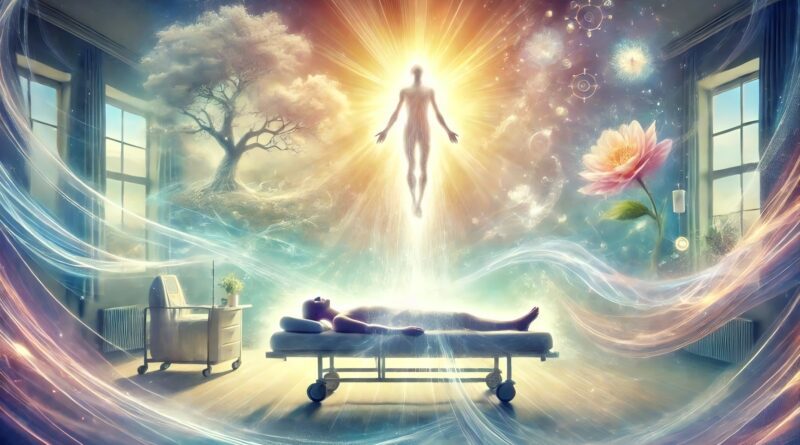
Near-Death Experiences: Can Consciousness Survive Cardiac Arrest?
Near-death experiences have fascinated people for decades. Some describe seeing a bright light, feeling an overwhelming sense of peace, meeting someone they believe has died, or experiencing themselves from outside their body. For a long time, these accounts were treated mainly as spiritual stories. Today, however, researchers are studying them in hospitals, during cardiac arrest and resuscitation, using EEG recordings, oxygen measurements and carefully designed interviews.
There is a moment in medicine that is difficult to imagine from the outside. The heart stops beating, circulation collapses, the brain is suddenly deprived of its normal supply of oxygen, and a team of doctors begins working against the clock to bring the person back. From a purely biological perspective, this is a crisis in which the systems that sustain ordinary conscious experience are breaking down.
And yet, some people who survive cardiac arrest later describe experiences that seem to have taken place during precisely that period.
They speak of a profound sense of awareness, unusual perceptions, encounters, memories, or experiences that they struggle to put into ordinary language. Some describe peace, others describe a feeling of separation from the body, and some report something they interpret as transcendent. For decades, stories like these belonged largely to the worlds of spirituality, philosophy, and personal testimony. Today, however, researchers are trying to study them under controlled medical conditions.
The results do not prove that consciousness survives death. That conclusion would go far beyond the evidence. But they do reveal something genuinely intriguing about what can happen to the brain during cardiac arrest and resuscitation.
And the more closely researchers look, the less convincing the simple idea of consciousness as an ordinary on-off switch begins to seem.
What Happens to the Brain When the Heart Stops?
One of the most important modern studies in this field is AWARE II, published in Resuscitation in 2023. The study was designed to investigate awareness and consciousness during cardiac arrest and resuscitation using physiological monitoring as well as interviews with survivors.
Researchers followed 567 patients who experienced in-hospital cardiac arrest across 25 hospitals. During resuscitation, some patients were monitored with electroencephalography, or EEG, while researchers also measured cerebral oxygenation. This allowed the investigators to examine what was happening physiologically while doctors were attempting to restore circulation.
The numbers tell an important story. Of the 567 patients included in the study, 213 achieved sustained return of circulation. Only 53 survived to hospital discharge, and 28 of those survivors completed the interviews required by the research protocol.
Among those 28 interviewed survivors, 11 people, or 39.3%, reported memories or perceptions associated with the period of cardiac arrest that were classified within the study’s framework as experiences of consciousness.
That number is striking, but it needs to be understood correctly. It does not mean that 39.3% of the 567 patients experienced a near-death experience. It refers specifically to 11 of the 28 survivors who completed the interviews. The distinction matters, especially when statistics from studies of near-death experiences are discussed online.
Still, what those 11 people reported is scientifically interesting because their experiences occurred in connection with one of the most extreme physiological conditions a human being can survive.
Four Different Types of Experiences
The researchers did not treat every reported experience as the same phenomenon. Instead, they identified four broad categories within the interviewed group.
Two people, or 7.1%, described a form of consciousness associated with the period of CPR itself, classified by the researchers as CPR-induced consciousness, or CPRIC. Another two people, also 7.1%, described experiences associated with consciousness after resuscitation. Three people, or 10.7%, reported dream-like experiences.
The fourth category was particularly unusual. Six people, representing 21.4% of those interviewed, reported what the researchers classified as a Recalled Experience of Death, or RED. These experiences were described as transcendent experiences associated with death.
It is tempting to read that finding as evidence that people were consciously observing another realm while their bodies were clinically unresponsive. But the study does not establish that. The researchers were careful to distinguish between the existence of reported experiences and the interpretation of their ultimate origin.
That distinction is essential. A person can have a profound experience without science yet knowing exactly how that experience was generated.
What Was Happening Inside the Brain?
This is where AWARE II becomes particularly interesting. During cardiac arrest and resuscitation, the brain is exposed to severe physiological stress. Blood flow is disrupted, oxygen availability falls, and the normal conditions required for brain function are profoundly altered.
The researchers measured cerebral oxygenation and reported a median cerebral oxygen saturation level of approximately 43% during the period studied. Despite this severe reduction, some patients showed EEG activity in delta, theta, and alpha frequency ranges that the investigators considered consistent with organized brain activity.
Even more surprisingly, such EEG patterns were observed in some patients between 35 and 60 minutes after the beginning of CPR. This does not mean that the patients’ brains were functioning normally. It does not mean that they were awake in the ordinary sense, and it certainly does not demonstrate that consciousness can exist without brain activity.
What it does suggest is that the dying and resuscitating brain may be considerably more dynamic than the familiar image of a simple switch being turned off.
The brain may move through different physiological states during cardiac arrest and recovery, and some of those states may involve forms of organized electrical activity that researchers are only beginning to understand.
For me, this is one of the most fascinating parts of the entire subject. The mystery does not necessarily begin when the brain becomes completely silent. It may begin with the fact that the transition itself appears to be more complicated than we once assumed.
Did Patients Actually Perceive Their Surroundings?
This question has become central to the debate around near-death experiences. If a person reports being conscious during cardiac arrest, could they have actually perceived events taking place around them? Could they have heard conversations or seen something happening in the room?
AWARE II attempted to investigate this possibility experimentally. Researchers used hidden visual and auditory targets during resuscitation. The idea was simple: if patients were consciously perceiving their surroundings during a period when ordinary awareness should have been severely impaired, perhaps they would later be able to identify information that had been presented.
The results were limited. None of the 28 interviewed patients correctly identified the visual target. One person, representing 3.5% of the interviewed group, correctly identified the auditory stimulus.
That finding is important because it prevents us from turning the study into something it was not.
AWARE II did not demonstrate that people can routinely watch their own resuscitation from outside their bodies. The visual test produced no correct identifications, and only one participant correctly identified the auditory stimulus.
At the same time, the absence of widespread correct identification does not explain every reported experience either. It simply means that the experimental evidence for veridical perception during cardiac arrest remains limited. This is exactly where the difference between a fascinating possibility and a scientific conclusion becomes important.
How Common Are Near-Death Experiences?
Another question is whether these experiences are rare or relatively common among people who survive cardiac arrest.
The answer is surprisingly difficult to establish.
A 2024 scoping review examined prospective studies investigating near-death experiences following cardiac arrest. The researchers identified 60 records and included 11 interview studies in their analysis. The individual study populations ranged from 28 to 344 participants.
The reported incidence of NDEs varied considerably, from 6.3% to 39.3%. In studies involving in-hospital cardiac arrest, the reported range was 6.3% to 39.3%, while studies involving out-of-hospital cardiac arrest reported rates between 18.9% and 21.2%.
At first glance, such a wide range may look confusing. But it is actually a reminder of how difficult this phenomenon is to measure.
Different studies use different questionnaires, different definitions, different patient populations, different interview methods, and different time intervals between the event and the interview. The review also noted that the content of reported experiences can be influenced by the wording of the questions used to investigate them.
That point deserves more attention than it usually receives.
When someone is asked to describe an experience that may have occurred during an extreme physiological event, the language available to that person inevitably matters. A questionnaire can help researchers collect comparable information, but it can also influence how an experience is remembered and described.
For that reason, there is no scientifically reliable single percentage that can be applied to every person who survives cardiac arrest.
The Experience May Matter Even After the Hospital
There is another side of the phenomenon that is sometimes overlooked. The scientific question is not only what people experience during or around cardiac arrest. Researchers are also interested in what happens to them afterward.
A systematic review published in 2025 examined the long-term effects associated with near-death experiences, looking at research published between 2014 and 2024.
The review found that positive NDEs are frequently associated with changes such as increased spirituality, a reduced fear of death, a greater appreciation for life, and increased compassion. Negative experiences can be associated with emotional distress, confusion, and difficulties integrating what happened.
This is significant regardless of how the experience is ultimately interpreted. Suppose, for a moment, that every near-death experience eventually receives a completely neurological explanation. That would not make the experience meaningless to the person who lived through it.
A profound psychological event can change someone’s relationship with mortality, relationships, priorities, and the meaning they attach to their own existence. The question of whether an NDE comes from the brain or represents something beyond the brain is therefore only part of the story.
The other part is what happens to a person after they return.
For readers interested in the broader question of whether consciousness might extend beyond the boundaries we normally understand, our article Beyond the Threshold: What Science Cannot See and What Consciousness Continues to Feel explores that question from a wider spiritual and scientific perspective.
Is the Brain Creating the Experience?
The most straightforward scientific interpretation is that near-death experiences are generated by the brain. That possibility should not be dismissed simply because the experiences feel extraordinary.
A brain under extreme physiological stress can produce unusual perceptions, altered states of consciousness, memory distortions, changes in sensory processing, and profound emotional experiences. Changes in oxygenation, blood flow, neurotransmitter systems, and neural connectivity may all contribute.
A 2024 review examining consciousness and the dying brain discussed emerging evidence concerning neurophysiological changes around cardiac arrest, including alterations in brain oscillations and cortical connectivity.
Some researchers have also focused on gamma-band activity observed around the time of death. Such findings have attracted considerable public attention because gamma oscillations are associated with several forms of cognitive processing.
But there is an important scientific caveat.
Gamma activity does not automatically equal conscious experience, and certainly does not demonstrate consciousness continuing after death. A 2024 publication challenged interpretations that treat patterns of gamma activity around death as a sufficient explanation for near-death experiences.
This is an area where headlines can easily move faster than the evidence. The brain is capable of producing remarkable activity during extreme physiological conditions. But observing that activity does not by itself tell us exactly what a person subjectively experienced at that moment.
What If There Is No Single Explanation?
One possibility that deserves consideration is that there may not be one universal explanation for every NDE. Some experiences could be related to physiological changes occurring while the brain is deprived of oxygen. Others might emerge during the gradual restoration of brain function. Some could involve memory reconstruction after the event, while others may reflect combinations of neurological, psychological, and environmental factors.
It is also possible that different people experience fundamentally different phenomena that happen to be grouped together under the same label. This may partly explain why researchers have struggled to identify one mechanism that accounts for every reported NDE. A large body of research exists, but the field remains interdisciplinary and methodologically diverse.
And that brings us to another remarkable figure.
775 publications.
A 2025 systematic and bibliometric review examined 775 publications concerning near-death experiences, covering research from 1977 through April 2025.
After decades of investigation, however, the literature still does not provide a universally accepted explanation for the origin or nature of NDEs. Researchers continue to approach the subject through neuroscience, medicine, psychology, philosophy, and other disciplines.
Seven hundred and seventy-five publications do not mean that science has proved the existence of an afterlife.They mean that the phenomenon has generated a substantial scientific literature while many fundamental questions remain unresolved.
That distinction is important.
What About the Soul?
This is where the scientific evidence reaches its current boundary. There is no established scientific evidence demonstrating that near-death experiences prove the existence of a soul that can exist independently of the brain. At the same time, the available research has not produced a complete explanation for every aspect of the experiences reported by survivors.
Those two statements can exist together. Someone approaching the subject from a spiritual perspective may see NDEs as possible evidence that consciousness is more than biological activity. Someone approaching it from neuroscience may interpret the same experiences as products of a brain undergoing extreme physiological stress and recovery.
Neither interpretation should be presented as a scientific certainty when the evidence does not justify that certainty. And perhaps that is where the subject becomes most interesting. The mystery is not that science has proved something supernatural. The mystery is that we still do not fully understand consciousness itself.
The Consciousness Problem
We know an extraordinary amount about the brain.
We know that particular neural networks are involved in memory, perception, attention, emotion, language, and decision-making. We know that injuries and diseases affecting the brain can profoundly alter personality and conscious experience. We know that drugs, anesthesia, electrical stimulation, and changes in oxygenation can alter what a person perceives and remembers.
But there is a question underneath all of this knowledge. Why does any of it feel like something from the inside? Why is there an experience of being “me”?
Why isn’t the brain simply processing information without producing a subjective point of view? This is sometimes described as the hard problem of consciousness, and it existed long before anyone began studying near-death experiences. NDEs do not solve this problem. But they place it in an unusually dramatic setting.
They allow researchers to investigate consciousness at a moment when the ordinary physiological conditions associated with conscious experience are profoundly disrupted. That is scientifically valuable even if the final answer turns out to be entirely neurological.
A Famous Case That Still Raises Questions
The scientific discussion also inevitably brings us back to some of the famous individual cases that helped make NDEs part of modern culture.
One of the best known is the case of Pam Reynolds, whose experience during a highly unusual neurosurgical procedure became one of the most frequently discussed examples in the history of NDE research.
Her story has been interpreted in radically different ways over the years, and it remains controversial.
If you want to explore that case separately, you can read The Extraordinary Story of Pam Reynolds and examine what was actually reported, what has been claimed about it, and where the scientific debate remains unresolved.
Looking at individual cases can be fascinating, but they also demonstrate why controlled research matters. A single story can be emotionally powerful while still leaving unanswered questions about timing, memory, perception, and physiology.
The Boundary We Still Cannot See Clearly
Perhaps one day researchers will be able to explain every major feature of near-death experiences.
We may discover that the sensation of leaving the body, the perception of light, encounters with other beings, intense memories, and the feeling of transcendence all emerge from identifiable neurological processes.
That would not make the experiences any less profound.
Or perhaps future research will lead to a much more complicated understanding of the relationship between the brain and consciousness.
There is also the possibility that some of today’s assumptions about consciousness will eventually have to be revised.
But we are not there yet. And this is where I think we should resist the temptation to turn uncertainty into certainty.
Saying “we do not yet have a complete explanation” is not the same thing as saying “therefore, the explanation must be supernatural.”
The first is an observation about the current state of knowledge. The second is a philosophical or spiritual interpretation. The distinction matters.
Because perhaps the most fascinating thing about near-death experiences is not that they give us a definitive answer about what happens after death. Maybe their real importance is that they force us to confront how little we still understand about the nature of conscious experience itself.
A heart can stop. The body can become critically unstable. The brain can enter a state unlike ordinary waking consciousness. And sometimes, against all expectations, the person survives and remembers something. What that memory ultimately means remains an open question.
Science can measure electrical activity. It can measure oxygen levels. It can record circulation, monitor resuscitation, compare hundreds of cases, and examine the brain at the edge of life. But there is still something that cannot simply be placed on a monitor:
the experience of being conscious.
Perhaps that is why near-death experiences continue to fascinate us. Not because they have proven what lies beyond death, but because they bring us face to face with one of the oldest and deepest mysteries of being human.
When the heart stops, where does the body end — and where does the person end? We do not have the final answer. But after decades of research, one thing has become increasingly clear:
the boundary between the brain, consciousness, and the experience we call “self” is far more complicated than we once believed.