
Modern Life Overwhelm: Why Modern Life Feels Overwhelming and the Psychology Behind It
Modern life overwhelm has become one of the defining psychological experiences of the twenty‑first century. People across the world describe the same sensation: days that move too fast, minds that feel constantly full, and a level of cognitive pressure that seems to rise year after year.
This isn’t a personal weakness or a generational complaint. It is a pattern documented by the American Psychological Association, the World Health Organization, and multiple systematic reviews published on PubMed, all pointing toward a shared conclusion: the digital and professional environments of modern life expose the human mind to continuous stimulation, fragmented attention, and emotional strain.
Modern life has become a landscape where everything happens too fast, too often, and too close. This isn’t a personal illusion or a generational complaint. It is a phenomenon observed across psychology, neuroscience, sociology, and public health. Research from the American Psychological Association, the World Health Organization, and multiple systematic reviews published on PubMed has begun to outline a clear picture: the digital and professional environments of the twenty‑first century expose people to a level of stimulation and cognitive demand that can be difficult to manage without boundaries, pauses, or moments of genuine recovery.
This does not mean that the human brain is “unfit” for modernity. It means that modernity, as we have constructed it, no longer offers the natural spaces the mind once relied on. Days are no longer divided into predictable rhythms. Work is no longer confined to a physical place. Communication is no longer limited to a handful of people. Decisions are no longer few and meaningful. We live in a world where everything is accessible, everything is urgent, everything is potentially relevant. And the mind—extraordinary, adaptive, resilient—reacts to this environment in ways that often feel like pressure, fatigue, or overwhelm.
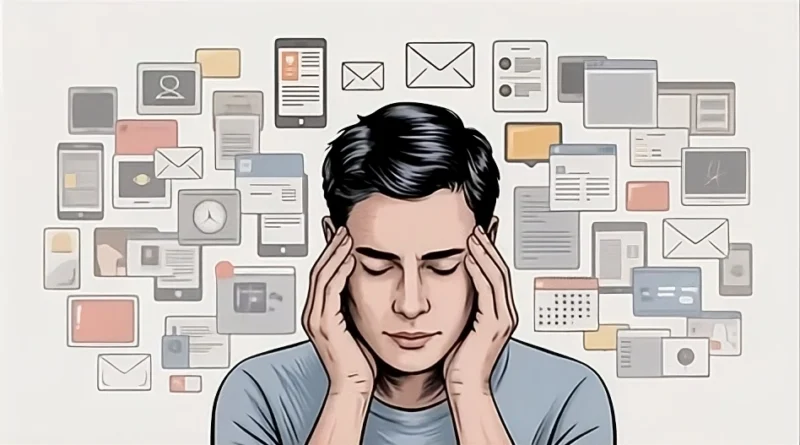
One of the first sources of this weight is constant connectivity. Research from the American Psychological Association shows that frequent notifications, compulsive email checking, and the ever‑present smartphone can increase distraction and reduce psychological well‑being. It is not merely the technology itself, but the way technology fragments attention. Every notification is a micro‑interruption. Every interruption breaks a mental thread. Every broken thread requires energy to repair. Over time, this fragmentation creates a sense of permanent urgency, as if the mind is always on alert, always ready to respond, always engaged—even when nothing truly demands its attention.
The modern workplace amplifies this pressure. Systematic reviews published on PubMed describe the phenomenon of technostress: a cluster of psychological reactions linked to the pervasive use of digital technologies in both professional and personal life.
“Techno‑overload,” in particular, refers to the feeling of being overwhelmed by digital demands that multiply faster than one can manage. The World Health Organization, in its reports on mental health at work, highlights how excessive workloads, limited autonomy, and blurred boundaries between work and private life can become significant risk factors. Teleworking, often celebrated as a convenience, can transform into an environment where work never truly ends because the physical boundary that once separated professional time from personal time has dissolved.
To this pressure, another element is added: the sheer number of decisions people face each day. The American Psychological Association has published several analyses showing that a high volume of choices can increase mental load and make it harder to maintain focus. This is not a universal law, but a pattern observed in many contexts: when decisions multiply, psychological energy diminishes. The mind becomes fatigued not because the choices are complex, but because they are numerous. This is why, at the end of the day, even a trivial decision can feel heavy. It is not physical exhaustion—it is cognitive exhaustion.
Modern loneliness adds yet another layer. The WHO Commission on Social Connection has identified loneliness and social isolation as global issues with significant consequences for mental health. We live in a world where we are always “connected,” yet rarely present. Digital interactions replace physical ones. Messages replace conversations. Social comparison replaces authentic relationships. The mind senses this distance. Humans need emotional grounding—shared pauses, real presence, unfiltered connection. When this is missing, everything else becomes heavier. Loneliness is not merely an emotion; it is a stressor.
Another component of overwhelm is the presence of unfinished thoughts. Historical research on the so‑called Zeigarnik effect, summarized by RRI, suggests that interrupted tasks can continue to draw attention, especially when no concrete plan exists to resume them.
This is not an automatic or universal mechanism, but a phenomenon observed in many situations: what remains unfinished tends to occupy mental space. In modern life, almost everything remains unfinished. Emails waiting for replies. Messages waiting to be read. Projects waiting to be started. Decisions waiting to be made. The mind accumulates these fragments like objects scattered across a room. We do not see them, but we feel them.
The result is a diffuse sense of overload. Not because people are weak, but because they live in an environment that demands the mind to be constantly active, constantly reactive, constantly present. Modernity does not ask us only to work. It asks us to decide, to respond, to compare, to update, to be available, to be informed, to perform. It is a continuous request that never fully stops.
And yet, understanding the psychological roots of this weight is not meant to justify fatigue—it is meant to recognize it. Modern life is complex, but not invincible. Balance can be reclaimed by protecting mental space, reducing interruptions, choosing less, completing what can be completed, and rebuilding genuine human connection. Modernity is not an enemy; it is an environment that requires awareness. And when we understand the weight, we can finally begin to carry it differently.
The overwhelming nature of modern life is not a failure of the human mind. It is a reflection of a world that has accelerated beyond the rhythms that once shaped human experience. But awareness is a form of power. When we see the forces that shape our days—the constant connectivity, the digital fragmentation, the invisible workload of decisions, the erosion of boundaries, the quiet ache of loneliness, the accumulation of unfinished thoughts—we begin to understand that overwhelm is not a personal flaw. It is a cultural condition.
And cultural conditions can be changed.
Not by slowing the world, but by slowing ourselves within it. Not by eliminating technology, but by reclaiming control over how it enters our lives. Not by escaping modernity, but by learning to navigate it with intention. Not by seeking silence everywhere, but by creating pockets of silence where the mind can breathe.
Modern life feels overwhelming because it asks the mind to operate at a speed it was never meant to sustain continuously. But once we understand the architecture of this overwhelm, we can begin to redesign our relationship with the world. We can choose what enters our attention. We can choose what deserves our energy. We can choose which threads to follow and which to let go.
Overwhelm is not destiny. It is a signal. And signals, once understood, can guide us toward a different way of living.
If you want to explore how the mind shapes the world we experience, read next: The Mind’s Canvas — How Thought Shapes Reality and Something Beyond
