
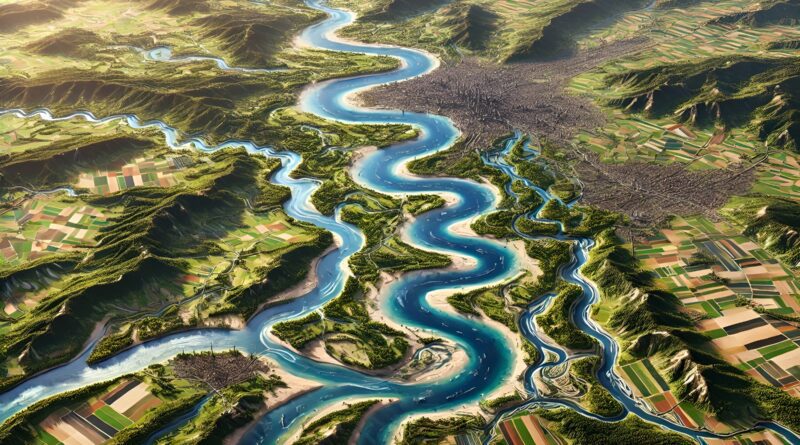
Global Water Geopolitics 2026: The Rising Crisis Over Rivers, Aquifers and Dams
Global water geopolitics 2026 is not a theoretical concept or a distant future scenario. It is already unfolding in real time, reshaping the way nations think about security, development and international cooperation. For decades, global power dynamics were defined by oil, gas, minerals and strategic trade routes. Today, however, fresh water — something so ordinary and so essential — is emerging as one of the most critical resources of the twenty‑first century.
Water has no substitute. It is indispensable for agriculture, electricity generation, industrial production, public health and basic human survival. Unlike fossil fuels, it cannot be replaced by another resource, and it cannot be imported indefinitely without enormous economic and logistical consequences. This is why rivers, lakes, aquifers and dams are becoming strategic assets, and why water scarcity is increasingly intertwined with political, economic and social tensions.
One of the most revealing facts is that 60% of the world’s freshwater flows through transboundary systems, shared by 153 countries. Hundreds of aquifers cross borders as well. This creates a level of interdependence that is both unavoidable and politically sensitive. Decisions made upstream — the construction of a dam, the expansion of irrigation, the extraction of groundwater — can directly affect downstream populations and economies. Climate change adds instability, making previously predictable water‑sharing arrangements more fragile. The challenge is not only scarcity; it is interdependence without coordination.
Agriculture, Food Security and the Fragile Chain of Stability
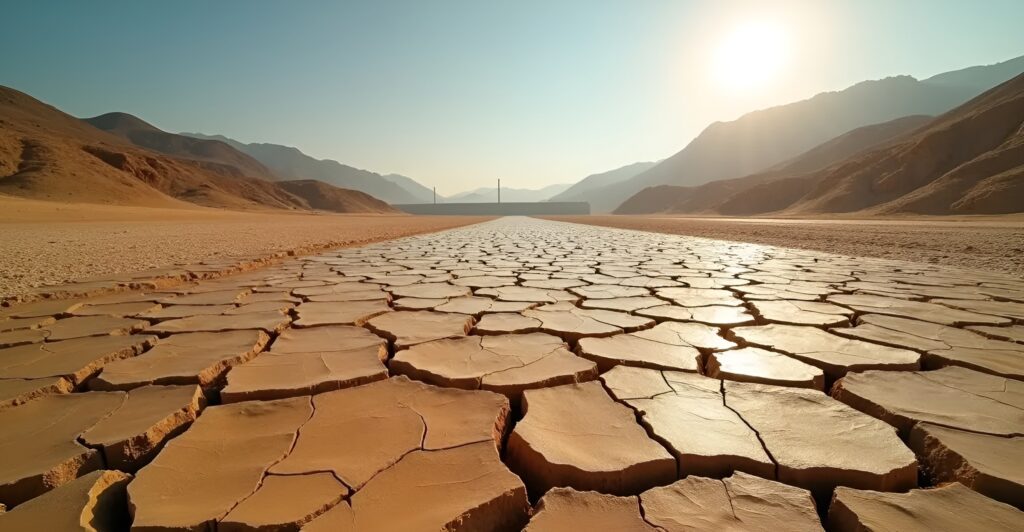
Agriculture is at the center of global water geopolitics 2026. According to FAO, it consumes 72% of global freshwater withdrawals, making it by far the largest water‑using sector. FAO also estimates that 1.2 billion people live in agricultural regions facing severe water constraints, a number that reveals how deeply water stress is connected to food security.
When water availability declines, agricultural production suffers. When production falls, food prices rise. When food prices rise sharply, governments face social pressure. And when that pressure accumulates in countries already dealing with economic fragility or political instability, water becomes a national‑security issue. This chain reaction does not mean drought automatically produces conflict, but it does mean water stress amplifies vulnerabilities that already exist.
In regions where irrigation is essential, even small fluctuations in river flow can disrupt planting seasons. In countries dependent on food imports, global price spikes can trigger domestic unrest. And in places where agriculture supports millions of livelihoods, water scarcity becomes a slow‑burning crisis that touches every layer of society.
Rivers, Dams and the Politics of Upstream Power
Global water geopolitics 2026 is shaped by river basins where upstream and downstream interests collide. The Nile Basin is one of the clearest examples. Egypt and Sudan depend heavily on the Nile, while Ethiopia has invested massively in the Grand Ethiopian Renaissance Dam (GERD) on the Blue Nile. For Ethiopia, the dam represents electricity generation, development and national pride. For Egypt, it raises existential concerns about water security.
The real conflict is not the dam itself. It is the management of the reservoir — how quickly it is filled, how water is released during drought, and what rules govern long‑term operation. UNESCO emphasizes that cooperation, data sharing and flexible agreements are essential, especially as climate pressures increase. The Nile demonstrates a fundamental principle: control over infrastructure can create strategic leverage, but that leverage also forces negotiation.
The Indus River system offers a different lesson. India and Pakistan, despite decades of political and military confrontation, have maintained the Indus Waters Treaty since 1960. It shows that water does not automatically lead to conflict; institutions can create stability even between rivals. Yet climate change, population growth and rising demand are placing new pressure on the system, reminding us that cooperation must evolve to remain effective.
In the Middle East, the Tigris and Euphrates rivers connect Turkey, Syria and Iraq. Turkey’s upstream position gives it enormous influence, while Syria and Iraq depend on downstream flows. Large infrastructure projects, irrigation, hydropower and prolonged drought create a complex web of interdependence. Water problems here rarely exist alone — they interact with agriculture, energy, migration, economic development and political instability. This region shows that water geopolitics is never just about water; it is about everything connected to it.
Asia offers yet another dimension. Several major rivers originate on the Tibetan Plateau before flowing toward India, Bangladesh and other countries. China’s upstream position gives it strategic influence over seasonal flows, hydropower, irrigation and data sharing. The issue is not ownership. It is control — of timing, infrastructure, information and risk.
Climate Instability, Migration and the Invisible Crisis Beneath Our Feet
Global water geopolitics 2026 is also shaped by climate instability. Freshwater is continuously renewed through the hydrological cycle, but availability is becoming more variable and less predictable. UNESCO warns that climate instability can reinforce inequalities, disrupt agriculture, destabilize cities and complicate international negotiations. Governments plan reservoirs based on historical data; farmers plan planting seasons based on expected rainfall; hydropower operators plan electricity generation based on river flows. When climate patterns shift, the assumptions behind these systems collapse.
Water insecurity also interacts with migration. It can damage agricultural livelihoods, increase competition for resources and expose vulnerable communities to economic shocks. But it is essential to be precise: water scarcity does not automatically cause migration, and migration does not automatically cause conflict. Water stress becomes one factor among many — alongside governance, food prices, climate events and economic conditions.
Perhaps the most underestimated battlefield is underground. Groundwater supports agriculture and drinking water for hundreds of millions of people, yet aquifers are politically invisible. A river can be monitored from satellites; an aquifer can be depleted silently for decades before the consequences become obvious. UN‑Water identifies 592 transboundary aquifer systems, showing that international water politics extends far beyond visible rivers and dams. In some regions, the next major water‑security crisis may begin not with a dam dispute, but with a declining water table.
The Future: Conflict, Cooperation and the Geography of Power
Global water geopolitics 2026 does not predict a dramatic “water war.” The evidence shows that water can contribute to instability, but it can also create cooperation. UNESCO highlights that shared rivers can produce economic, social and political benefits. Only 32 of the 153 countries sharing transboundary waters have operational cooperation covering 90% of their shared basins — a number that reveals both the scale of the challenge and the potential importance of diplomacy.
Water could become one of the defining strategic resources of the twenty‑first century because it is essential to food, energy, industry, cities, health and ecosystems. Its geopolitical significance will depend on availability, location, infrastructure and governance. Some nations possess abundant water but lack the infrastructure to manage it. Others have sophisticated infrastructure but face severe physical scarcity. Some depend on rivers originating beyond their borders. Others control upstream dams but rely on stable relations with downstream neighbors. Hydrology and geopolitics are merging into a single map.
The greatest risk may not be a dramatic “water war,” but a series of slow, interconnected crises: drought‑driven food inflation, competition over agricultural water, pressure on cities, migration, energy shortages caused by reduced hydropower, disputes over dams, groundwater depletion and diplomatic tensions between upstream and downstream states. Water acts as a force multiplier, amplifying existing vulnerabilities.
Yet water can also become an instrument of peace. UNESCO highlights the Sava River Basin — shared by Bosnia and Herzegovina, Croatia, Montenegro, Serbia and Slovenia — as an example of transboundary cooperation contributing to post‑conflict recovery and regional development. A shared river can divide, but it can also unite. The outcome depends on institutions, diplomacy, infrastructure and the ability of governments to distribute benefits and risks.
The twenty‑first century will not necessarily be defined by wars over water. But water will be impossible to separate from geopolitics. As populations grow, agriculture demands more resources, climate variability increases and countries develop new dams and irrigation systems, the strategic importance of rivers and aquifers will continue to rise. Nations controlling critical water infrastructure will gain leverage. Nations dependent on upstream flows will face vulnerability. Nations capable of building strong water‑sharing institutions may gain stability.
The real question is not whether the next global conflict will be fought over water. The more useful question is who will control, manage and negotiate the world’s most important water systems as scarcity and geopolitical competition increase. And that may be one of the defining geopolitical questions of the coming decades.
If you want to explore how environmental pressures are already reshaping human movement, you can continue with Aria Lorne’s analysis on climate‑driven displacement: The Urgent Science Behind Climate Migration A deep look at how degraded landscapes, drought‑stricken regions and collapsing ecosystems are pushing communities toward new frontiers.
To understand how rising temperatures intensify water scarcity and destabilize entire regions, you can read: Extreme Heat 2026: A Dangerous New Era of Global Warming An investigation into how unprecedented heat anomalies are reshaping agriculture, river flows and national security.
If you want a closer look at how rivers worldwide are undergoing rapid, invisible transformations, this article expands the picture: The Great Freshwater Shock — Why Rivers Worldwide Are Losing Oxygen Faster Than Oceans A powerful examination of collapsing river oxygen levels and the silent crisis unfolding beneath the surface.
