Halloween Asteroid 2026: Mysterious Space Rock Will Pass Closer Than the Moon
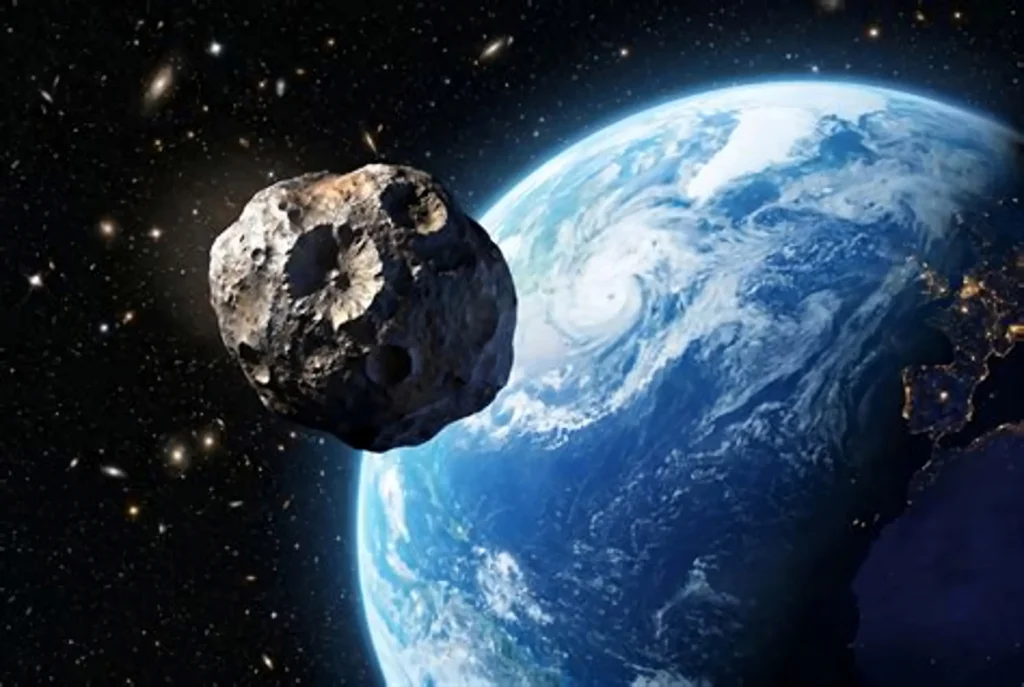
Halloween Asteroid 2026 is set to become one of the most intriguing astronomical events of the year. During the early hours of October 31, asteroid 2025 UK9 will pass Earth at a distance closer than the Moon, offering scientists a rare opportunity to study a near-Earth object during a close flyby. Just two days later, another remarkable visitor, the Venus quasi-moon Zoozve, will make its closest approach to our planet. Although neither object poses any danger, both encounters are expected to attract significant attention from astronomers and skywatchers around the world.
Halloween Asteroid 2026 Will Pass Closer Than the Moon
On Halloween night 2026, Earth will receive an unusual celestial visitor. While the occasion sounds like the opening scene of a science fiction film, astronomers are not sounding any alarms. Instead, skywatchers around the world are preparing to observe a small asteroid that will make a remarkably close pass by our planet, traveling at a distance even shorter than that of the Moon.
The asteroid, officially designated 2025 UK9, is expected to reach its closest approach to Earth during the early hours of October 31, 2026, at approximately 3:35 a.m. Current calculations indicate that it will pass at a distance of about 315,000 kilometers from Earth’s center, significantly closer than the Moon’s average distance of 384,400 kilometers.
Despite the dramatic timing and proximity, there is no reason for concern. With an estimated diameter of only 3 to 7 meters, 2025 UK9 is an extremely small near-Earth object. It was first discovered on October 28, 2025, by the Mt. Lemmon Survey, part of the Catalina Sky Survey operated by the University of Arizona. During its Halloween flyby, the asteroid is expected to travel relative to Earth at roughly 28,000 kilometers per hour.
Scientists caution that the exact distance and timing of the encounter may still be refined. The asteroid was observed for only a brief period after its discovery, providing limited data for long-term orbital calculations. As more observations become available, astronomers may slightly adjust current predictions. Even so, the object’s tiny size ensures that it poses no threat to Earth.
For those hoping for a spectacular celestial display, the news is less exciting. 2025 UK9 will remain far too small and faint to be visible with the naked eye. There will be no fiery streak across the sky and no dramatic Halloween light show. Its importance lies primarily in the scientific opportunity it offers to astronomers tracking near-Earth objects.
Yet the Halloween asteroid will not be the only cosmic attraction in the days ahead.
Just two days later, on November 2, 2026, another asteroid will make its closest approach to Earth. This one is far larger and considerably more intriguing from a scientific perspective. Known today as 524522 Zoozve, and previously designated 2002 VE68, the asteroid has an estimated diameter ranging between 200 and 500 meters.
Unlike 2025 UK9, Zoozve will pass at a much greater distance, approximately 6 million kilometers from Earth, which is about sixteen times farther than the Moon. Nevertheless, its unique orbital relationship with Venus has made it one of the most fascinating small bodies in the Solar System.
Zoozve is classified as a quasi-moon of Venus. Unlike a true natural satellite, it does not orbit Venus directly. Instead, it follows its own orbit around the Sun while maintaining a unique gravitational relationship with the planet. From certain perspectives, its motion can appear as if it is accompanying Venus through space. This unusual behavior earned it a place in astronomical history as the first identified quasi-satellite of a major planet.
The asteroid was originally discovered on November 11, 2002, by astronomer Brian Skiff. More than two decades later, it received worldwide attention not because of its orbit, but because of its name.
The now-official name “Zoozve” emerged from an unexpected mistake. In 2024, illustrator Alex Foster was creating a Solar System poster when he misread the asteroid’s designation, 2002 VE68, as the word “Zoozve.” What began as a simple visual error quickly caught the public’s imagination. Eventually, the name was formally approved by the International Astronomical Union, turning an accidental typo into a permanent part of astronomical nomenclature.
For astronomy enthusiasts in Italy and across Europe, Zoozve may provide an exciting observing opportunity. Around its closest approach on November 2, the asteroid is expected to appear high in the sky within the constellation Andromeda, a favorable position for northern hemisphere observers. However, spotting it will not be easy. The asteroid’s brightness will remain extremely low, making binoculars insufficient for observation.
Observers will need at least a modest amateur telescope and, ideally, photographic equipment capable of capturing long exposures. Through careful imaging, it may be possible to detect the faint object and observe its movement against the background stars. While it will remain invisible to casual stargazers, dedicated amateurs could obtain memorable photographs of one of the Solar System’s most unusual celestial travelers.
Together, these two encounters offer a reminder that Earth exists within a dynamic cosmic environment populated by thousands of asteroids crossing the inner Solar System. Neither 2025 UK9 nor Zoozve poses any danger, but both highlight the importance of ongoing astronomical monitoring and the remarkable ability of modern science to predict the movements of distant objects with extraordinary precision.
Halloween 2026 may not deliver a celestial spectacle visible to the naked eye, but it will offer something equally fascinating: a close encounter with a tiny asteroid passing nearer than the Moon, followed days later by a visit from Venus’ famous quasi-moon, the asteroid with the accidental name that became a permanent part of space history.
Related Reading
If you enjoyed learning about the Halloween Asteroid 2026 and the Venus quasi-moon Zoozve, you may also be interested in these astronomy stories from Zemeghub.
Hunter’s Moon 2026: How to See October’s Spectacular Full Moon
Explore the science and observation tips behind October’s spectacular Hunter’s Moon, one of the most anticipated lunar events of the year.
NASA Nuclear Reactor: The Breakthrough That Could Power Humanity’s Future on Mars and the Moon
Learn how advanced nuclear power systems could support future human settlements on the Moon and Mars.
