
NASA HAVOC Mission: Floating Cities Above Venus
For decades, Mars has been considered the leading candidate for humanity’s future expansion into space. Its desert landscapes, traces of ancient rivers, and the possibility of building structures on its surface have inspired scientific projects and ambitions for colonization. Yet there is another world that could offer surprising opportunities, despite being widely described as one of the most hellish places in the Solar System: Venus.
Its surface is an extreme environment, with temperatures reaching approximately 465°C (869°F) and atmospheric pressure around 92 times greater than that of Earth. Its atmosphere, composed primarily of carbon dioxide, traps enormous amounts of heat, while its clouds contain sulfuric acid. Under these conditions, human survival would be impossible without extremely sophisticated protective systems. But what if, instead of attempting to reach the surface, we searched for a habitable environment much higher above the clouds?
HAVOC: Exploring Venus Without Landing
This question lies at the heart of HAVOC, short for High Altitude Venus Operational Concept, a conceptual study developed by NASA engineers to evaluate the possibility of exploring Venus using aerostatic vehicles and floating habitats within its atmosphere. The idea is radically different from that of a traditional mission: rather than confronting the scorching surface directly, astronauts and scientific instruments would operate dozens of kilometers above the ground, in a region where some environmental conditions are surprisingly close to those found on Earth.
HAVOC is not an approved program to build Venusian colonies, nor is it a crewed mission currently scheduled. It is a preliminary study showing how established physical principles could potentially be applied to future human exploration.
The Surprising Habitable Layer of Venus
At approximately 50–60 kilometers above the surface, Venus presents an environment very different from the one encountered on the ground. Within this atmospheric layer, pressure can approach Earth-like levels, while temperatures can range approximately from 20°C to 75°C (68°F to 167°F), depending on altitude and local conditions. These values are considerably less extreme than the 465°C temperatures found at the surface.
However, this similarity applies only to certain physical parameters: the atmosphere remains unbreathable, rich in carbon dioxide, and the surrounding clouds contain sulfuric acid droplets. Humans would still require pressurized habitats, oxygen supplies, environmental control systems, and appropriate chemical protection. Venus’s atmospheric layer is therefore not naturally habitable, but it could provide conditions in which constructing an artificial living environment might be less difficult than on the planet’s surface.
Another advantage concerns radiation shielding. Venus’s relatively dense atmosphere can absorb a significant portion of energetic particles arriving from space, potentially providing natural protection that is much more limited on the surface of Mars. This does not eliminate radiation risks, which would depend on altitude, mission duration, solar activity, and habitat design, but it represents an interesting factor when planning future human presence.
The Secret of Buoyancy: Why Earth-Like Air Could Be Enough
One of the most fascinating aspects of the HAVOC concept is the principle that would allow a vehicle to remain suspended in the Venusian atmosphere. On Earth, aerostatic balloons generally use helium or hydrogen, gases that are less dense than the surrounding air. On Venus, however, the atmosphere is composed primarily of carbon dioxide, which under the relevant conditions is denser than Earth’s air. As a result, an envelope filled with a nitrogen-and-oxygen mixture could generate upward buoyancy without necessarily requiring a specialized lifting gas.
The principle is simple, but its applications could be extraordinary. An aerostatic vehicle could carry scientific instruments, power systems, and, in the future, a habitat for astronauts. Naturally, buoyancy would not automatically solve every problem: the mass of the structure, material strength, altitude control, and safety margins would all need to be calculated with great precision. Nevertheless, the possibility of using Venus’s atmosphere as a natural lifting medium remains one of the most promising elements of the entire concept.
From Scientific Platforms to Floating Cities
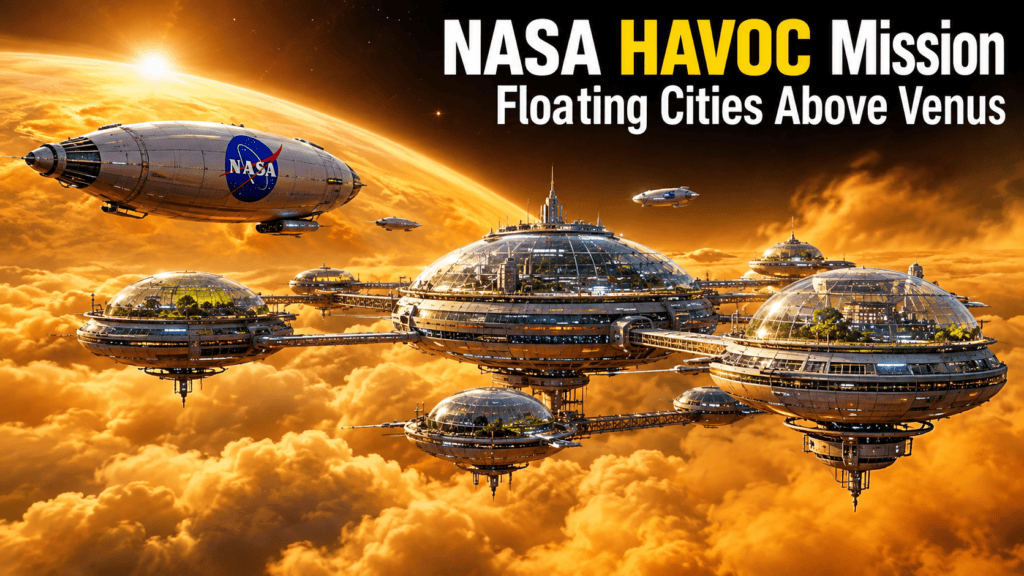
Imagining a floating city above Venus means going beyond HAVOC’s immediate objectives, but it allows us to explore the potential of this idea. In an initial phase, a crewed aerostatic vehicle could host laboratories, atmospheric analysis instruments, and planetary observation systems. Later missions might experiment with larger habitats capable of supporting longer stays and recycling some of the water and air used by astronauts.
In a much more advanced scenario, interconnected structures could accommodate greenhouses, research facilities, and energy production systems. The abundance of sunlight could support the use of solar panels, although clouds and environmental conditions would influence the amount of energy actually available. A permanent settlement would also require reliable systems for recovering resources, producing replacement materials, managing waste, and maintaining equipment without constantly depending on supplies from Earth.
This vision should not be confused with a project already ready for implementation. The technological distance between a scientific airship and a city capable of supporting thousands of people is enormous. Nevertheless, the concept demonstrates that a future human presence on another planet might not necessarily require building bases on solid ground.
The Challenge of Sulfuric Acid
Venus’s upper atmosphere offers interesting opportunities, but it remains a hostile environment. One of the most serious problems is the presence of sulfuric acid clouds, which can gradually damage coatings, mechanical components, sensors, and exposed surfaces. Habitats would therefore need materials and protective systems capable of resisting corrosion over extended periods without compromising astronaut safety.
Maintenance would be another major challenge. A failure in an altitude-control system, solar panel, or essential component could threaten the entire vehicle. Redundant systems, reliable diagnostic instruments, and procedures for repairing equipment under difficult conditions would be necessary. Atmospheric winds, heat management, communications with Earth, and the ability to evacuate the crew quickly would also need to be addressed before considering a long-duration crewed mission.
Solar energy, although promising, would not provide a complication-free solution. Available sunlight varies with altitude and cloud characteristics, while power systems would need to continue operating despite exposure to the chemical environment. A permanent presence would therefore require reliable energy systems, storage capabilities, and careful planning of power consumption.
Venus or Mars: Which World Would Be Better for Humans?
The comparison between Venus and Mars has no simple answer. Mars offers a solid surface on which to build bases, store materials, and develop infrastructure. However, its atmosphere is extremely thin, temperatures are generally low, and inhabitants would be exposed to higher radiation levels than in a sufficiently protected atmospheric layer of Venus.
Venus presents the opposite situation: some atmospheric conditions are relatively favorable, but there is no usable solid ground at the altitude under consideration. Every structure would need to remain suspended, be continuously controlled, and withstand a chemically aggressive environment. The choice between the two worlds would therefore depend on mission objectives, available technologies, and the costs required to maintain a human presence.
For this reason, it would be inaccurate to claim that Venus is simply more habitable than Mars. A more reasonable conclusion is that Venus could offer an interesting environment for specific types of missions, particularly those based on aerostatic vehicles and atmospheric exploration.
A New Way of Imagining Space Exploration
HAVOC encourages us to rethink an idea deeply rooted in our imagination: that exploring a planet necessarily means landing on its surface. In reality, every world presents different conditions, and an effective strategy may require solutions completely different from those used on Earth. In the case of Venus, the atmosphere would not simply be an obstacle to overcome, but also an environment in which buoyancy could be used to transport people and equipment.
This principle could inspire new strategies for exploring other celestial bodies, although every planet would require its own assessment of physical and chemical conditions. For now, floating cities above Venus belong to the realm of theoretical possibilities and futuristic visions, not colonies under construction. Before reaching a permanent settlement, it would be necessary to demonstrate that vehicles, habitats, and life-support systems could operate safely for increasingly long periods.
Will Humanity Really Live Among the Clouds of Venus?
The answer remains uncertain. HAVOC does not prove that building floating cities is easy or inevitable, but it demonstrates that the idea of exploring Venus from above has a solid scientific foundation. Atmospheric buoyancy is a well-understood phenomenon, while temperature and pressure conditions at certain altitudes provide an interesting starting point for developing aerostatic vehicles.
The technological, economic, and operational challenges remain enormous. Engineers would need sulfuric-acid-resistant materials, reliable life-support systems, robust energy sources, and maintenance strategies capable of operating far from Earth. A permanent city would require even greater advances, as well as a scientific and economic justification that has not yet been demonstrated.
Yet this is precisely where HAVOC’s value lies. The concept reminds us that space exploration is not only about reaching new places, but also about learning to interpret the environments we encounter in different ways. Perhaps Venus will never become a second home for humanity, and perhaps its floating cities will remain only a theoretical possibility. But the prospect of exploring such an extreme world by taking advantage of its own physical characteristics already represents an extraordinary scientific challenge. Humanity’s next great step into space may not take us to the surface of another planet, but into the clouds of a world that, until recently, seemed completely inaccessible.
Related Reading
The idea of floating cities above Venus may sound like science fiction, but it belongs to a growing collection of ambitious concepts that could reshape humanity’s future in space. If you are fascinated by the challenges and opportunities of exploring the Solar System, these related Zemeghub stories offer additional perspectives on some of the most remarkable discoveries and missions currently capturing the attention of astronomers and space enthusiasts.
Halloween Asteroid 2026: Mysterious Space Rock Will Pass Closer Than the Moon
Discover how asteroid 2025 UK9 will make a rare close approach to Earth, passing at a distance shorter than the Moon’s orbit. The event will be followed by the flyby of Zoozve, the famous quasi-moon of Venus.
NASA Nuclear Reactor: The Breakthrough That Could Power Humanity’s Future on Mars and the Moon
Explore how advanced nuclear reactor technologies could provide reliable energy for future lunar settlements, Martian colonies, and deep-space missions that venture far beyond Earth’s orbit.
