The Future of Humanity: 10 Incredible Inventions That Could Change Our World
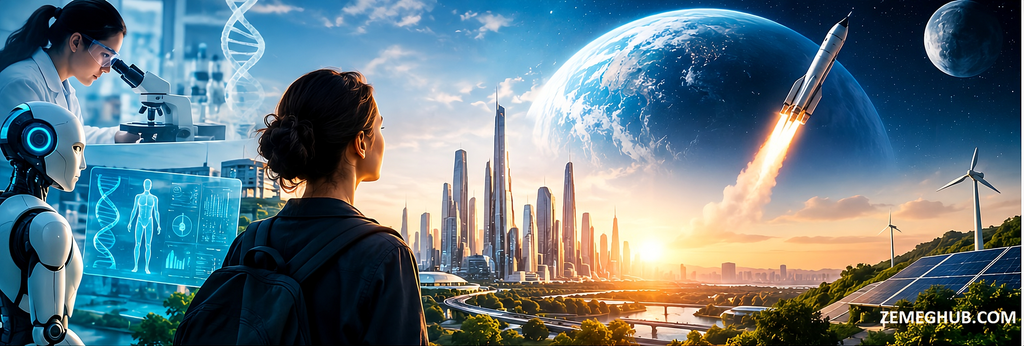
The Future of Humanity is one of the most fascinating subjects of our time. From artificial intelligence and robotics to medical breakthroughs, nuclear fusion, and space exploration, new technologies are transforming the way we live and reshaping our vision of the future. What once belonged to science fiction is gradually becoming reality, raising an essential question: how far can human innovation take us?
There was a time when flying was nothing more than a dream, speaking to someone on the other side of the world seemed impossible, and curing certain diseases was beyond the reach of medicine. Today, we board airplanes, communicate in real time with people thousands of kilometres away, and use tools capable of analysing enormous amounts of information in just a few seconds. What once belonged to science fiction has become part of our everyday lives. Yet, if we take a closer look at what is happening in scientific laboratories, universities, and research centres around the world, we can begin to imagine that the transformation just getting underway may be even more profound than anything we have experienced before.
The question we should be asking, therefore, is not simply what the next inventions will be, but where humanity is ultimately trying to go. For centuries, we have sought to master our environment, build more efficient tools, and improve the conditions of our existence. Today, however, we are beginning to intervene in far more delicate areas: intelligence, the functioning of the brain, the structure of matter, the biological mechanisms of ageing, and even the possibility of living beyond Earth. Technology is no longer merely something we use to change the world around us. Increasingly, it is becoming a means through which we attempt to transform ourselves.
Artificial Intelligence: The Beginning of a New Era
One of the most important revolutions of our time is artificial intelligence. For the first time in history, we have developed computer systems capable of understanding natural-language instructions, producing texts, generating images, writing code, and assisting people with tasks that require specialised knowledge and reasoning. These systems are not infallible, do not necessarily process information in the same way humans do, and can produce incorrect answers. Despite these limitations, they are already changing the way we work, study, and access information.
In the future, artificial intelligence could become a constant presence in everyone’s life. Imagine waking up in the morning to find a digital assistant capable of organising appointments, comparing important information, helping manage expenses, planning journeys, and adapting its suggestions to your needs. At work, these systems could collaborate with doctors, engineers, teachers, researchers, and entrepreneurs, reducing the time required for certain tasks and allowing people to focus more on complex decisions.
The transformation could become even more noticeable when artificial intelligence is integrated into robots capable of moving through the physical world. Industrial machines have been used for decades, but future robots could become more flexible, performing different tasks without having to be completely reprogrammed for every individual activity. They might assist older people, transport materials, help with household chores, and operate in environments that are dangerous for humans.
This does not mean that every home will necessarily have a robot within the next few years. Cost, safety, reliability, and the ability to understand unexpected situations remain significant obstacles. Nevertheless, the direction of research is clear: making machines capable of performing an increasing number of tasks in the real world.
This transformation raises a fundamental question. If machines eventually become capable of performing a substantial proportion of the work required to produce goods and services, what will humanity’s role be? We might devote more time to family, research, art, and knowledge. But we could also face new inequalities, particularly if the economic benefits of automation remain concentrated in the hands of a few. The future, therefore, will depend not only on the power of our inventions but also on the rules and social choices through which we decide to use them.
Medicine and the Human Body: The Search for a Longer, Healthier Life
Another major frontier concerns the human body. For much of our history, medicine has primarily focused on treating diseases after they appear. Today, thanks to genetics, molecular biology, data analysis, and new diagnostic technologies, research is increasingly focused on prevention, personalised treatments, and the ability to intervene in the biological mechanisms responsible for disease.
Concrete progress has already been made in several areas. Gene therapies can treat certain diseases by modifying or replacing genetic material, while cellular technologies are making it possible to develop treatments that would once have seemed unimaginable.
Regenerative Medicine and the Possibility of Repairing the Body
Regenerative medicine represents one of the most promising prospects. Scientists are investigating how cells, biomaterials, and tissue-engineering techniques can be used to repair damaged structures in the body. Three-dimensional printing is already used in medicine to create anatomical models, prosthetics, and certain medical devices, while the creation of fully functional complex organs for transplantation remains a scientific challenge. The process is difficult because an organ is not simply a structure to be manufactured. It must receive a blood supply, communicate with other tissues, function correctly, and integrate into the body without causing complications.
The most ambitious dream is to slow down ageing. The goal is not simply to live for more years, but to preserve health, mobility, and independence for longer. Researchers are studying cellular processes associated with ageing, the damage that accumulates over time, metabolic changes, and the role of the immune system.
These studies could help prevent or delay certain age-related diseases. However, it is important to distinguish scientific possibilities from commercial promises. At present, there is no proven therapy capable of completely stopping human ageing, and we cannot claim that living to 150 or 200 years old will become commonplace.
If we succeeded in significantly extending the number of years people spend in good health, almost every aspect of society would change. People might have more time to learn, change careers, build relationships, and pursue projects that currently seem too long to complete. At the same time, we would need to rethink pension systems, the organisation of work, access to healthcare, and relationships between generations. Greater longevity would be an extraordinary achievement, but it would need to be accompanied by an equally important social and economic transformation.
The Human Brain and the Connection Between Biology and Technology
Another fascinating possibility emerges from the intersection of the human brain and computing. Brain-computer interfaces are technologies that record certain neural signals and translate them into commands for a device. In medical settings, they have already been tested to allow some people with severe paralysis to control digital tools through brain activity.
This is a genuine area of research, with potential benefits for communication and independence among people who have lost certain motor abilities. In the future, these interfaces could become more precise and less invasive. They might help people control advanced prosthetics, operate computers without conventional movements, and restore certain functions impaired by neurological injuries.
However, the distance between these applications and the idea of a direct connection capable of transferring memories, knowledge, or entire personalities remains enormous. The brain is an extraordinarily complex biological system, and we still do not fully understand the mechanisms through which memory, identity, and conscious experience emerge.
Could We Ever Transfer the Human Mind Into a Computer?
The idea of transferring the human mind into a computer is one of the most radical possibilities of the future. Achieving it would require much more than copying information or reconstructing a network of neurons. We would need to understand which details of brain function are necessary to reproduce mental abilities and, above all, clarify what it would mean to preserve a person’s identity.
Even if it became possible to create an extremely faithful simulation of a brain, we would not automatically have demonstrated that the original consciousness had been transferred. We might produce a functioning copy without knowing whether the person’s subjective experience had continued. This is a question where neuroscience, computer science, and philosophy meet, but one for which there is currently no proven solution.
The Energy Revolution: Could Fusion Power Change the World?
While we seek to understand the body and the mind, we must also address one of civilisation’s most pressing challenges: energy. Modern society depends on electricity to power hospitals, industries, homes, communication systems, and infrastructure. The spread of electric vehicles, data centres, and digital technologies makes access to reliable, low-emission energy even more important.
Renewable energy sources, particularly solar and wind power, already play an important role in the energy transition. Batteries and energy-storage systems can help manage variations in electricity production, while smarter power grids can improve energy distribution. However, another technology has generated enormous expectations for decades: nuclear fusion, the process that produces energy in stars.
Fusion aims to release energy by combining light atomic nuclei under conditions of extremely high temperature and pressure. In theory, it offers attractive prospects for low-carbon energy production during operation, but turning experiments into commercial power plants remains a complex challenge.
The international ITER project, being built in France with the participation of seven major members, including the European Union, the United States, China, India, Japan, South Korea, and Russia, is one of the largest scientific experiments ever undertaken in this field. According to ITER’s updated programme, the initial research phase is scheduled to begin in 2034, while the deuterium-tritium plasma phase is planned for 2039. These dates represent milestones in an experimental programme; they do not indicate when a commercial electricity-generating power plant will open.
This distinction matters because it highlights the difference between a scientific objective and a technology that is already available. If fusion eventually becomes economically competitive, it could fundamentally transform energy production. For now, however, we cannot consider it an immediate solution to the energy crisis.
Source: ITER, official project programme and updates.
Space Exploration: Humanity’s Next Great Frontier
Energy is also connected to one of humanity’s oldest ambitions: exploring space. For thousands of years, we have looked at the sky, trying to understand our place in the universe. During the twentieth century, we succeeded in sending humans to the Moon. Today, we are developing new robotic and crewed missions to explore increasingly distant environments.
In 2026, NASA’s Artemis programme reached an important milestone with Artemis II, the crewed mission that carried four astronauts on a journey around the Moon. The mission represented a significant step towards testing systems intended for future human exploration of deep space. The programme aims to develop the capabilities needed to return to the lunar surface and, over the longer term, prepare for human missions to Mars.
Source: NASA, Artemis exploration programme.
Robotic missions are also expanding our knowledge. The Perseverance rover, which has been exploring Mars since February 2021, had travelled a total of 45.2 kilometres by October 2026, setting a new record for the distance covered by a vehicle on another planet. The rover analyses rocks and soil to investigate Mars’s geological history and identify conditions that might have supported microbial life in the past. These findings do not prove that life once existed on Mars, but they help scientists identify the locations and materials most worthy of further investigation.
Source: Reuters, 13 October 2026, reporting on data from the NASA mission.
Could Humans One Day Live on the Moon or Mars?
The possibility of living permanently on the Moon or Mars is far more complicated than films often suggest.
Humans would need protection from radiation, reliable systems for obtaining water and oxygen, food production, durable structures, and solutions to the effects of reduced gravity on human health. On Mars, the enormous distances would make resupply difficult and prevent immediate communication with Earth. For these reasons, the first extraterrestrial bases, if they are built, will probably be highly controlled environments dedicated to research and supported by extensive infrastructure.
Nevertheless, space exploration could also produce benefits for people who will never leave our planet. The development of sensors, durable materials, recycling systems, and technologies for using resources in extreme environments can contribute to scientific research and engineering. Space exploration also forces us to view Earth from a different perspective. From a distance, our planet appears as a limited system, without visible borders, supporting all the forms of life on which we depend.
The Inventions That Could Transform Everyday Life
Alongside these major frontiers, less spectacular but potentially equally important technologies are developing. New materials could make buildings, batteries, and vehicles more efficient. Advances in desalination could help produce fresh water in certain regions, although energy costs and the management of concentrated saline waste remain challenges. Precision agriculture could use sensors, satellite imagery, and computer models to improve the management of water and fertilisers. Robotics could make some industrial activities safer, while new recycling techniques could help recover valuable materials from discarded products.
Not all these technologies will necessarily succeed, and not all will become accessible at the same time. The World Economic Forum’s report Top 10 Emerging Technologies of 2026 examined emerging technologies across several fields, including energy, materials, healthcare, and computing, selected for their potential impact and technological progress. The value of such analyses does not lie in predicting the future with certainty, but in identifying areas where research is advancing and where important applications may emerge.
Source: World Economic Forum and Frontiers, report published on 23 June 2026.
Will Technology Make Humanity Happier?
At this point, however, a deeper question emerges. If humanity succeeds in building increasingly intelligent machines, developing more effective treatments, producing energy through innovative systems, and enabling people to live longer, will we necessarily become happier? The answer is far from obvious. Technology can reduce suffering, expand individual opportunities, and solve practical problems, but it cannot guarantee fulfilling relationships, inner balance, or a sense of meaning in our existence.
A highly automated society might offer more free time, but it would also need to find new ways to distribute income and maintain a sense of participation. Medicine capable of extending life could be an extraordinary achievement, but if it were accessible only to a small portion of the population, it could increase inequality. Intelligent systems capable of collecting vast quantities of data could improve certain services, but they could also become instruments of surveillance.
The same technology that enables us to solve problems can create new ones when it is used without responsibility. The greatest invention of the future may therefore not be a specific machine, but a new way of organising the relationship between human beings and technology.
We will need systems capable of innovating, alongside institutions that can establish reasonable limits, protect individual freedom, and distribute the benefits of progress. We must learn to use artificial intelligence without abandoning our ability to think independently, exploit resources without damaging ecosystems, and advance medicine without forgetting the dignity of the people it serves.
The Future of Humanity: What Kind of Civilisation Do We Want to Build?
The future may lead us towards a civilisation in which the distinction between the natural and the artificial becomes less clear. We will have devices increasingly integrated into everyday life, more sophisticated prosthetics, digital tools capable of adapting to our needs, and treatments designed around individual characteristics.
However, it is not inevitable that every technological possibility will be realised, nor that everything that becomes possible will automatically be desirable. The direction of progress will depend on collective decisions, investment, scientific discoveries, and our ability to recognise risks before they become difficult to manage. Perhaps, a few decades from now, we will look at today’s tools with the same sense of wonder with which we look at old typewriters, early computers, or the aircraft built by aviation pioneers. Some inventions that seem extraordinary today will become ordinary, while other possibilities we imagine now will prove impractical.
The history of science teaches us that the future rarely follows a perfectly predictable path. It advances through attempts, failures, unexpected discoveries, and ideas that change the way we interpret reality. Human beings, after all, have always been driven by curiosity. We crossed oceans without knowing for certain what we would find, studied the sky before knowing how to reach it, and investigated the human body when many of its mechanisms remained mysterious.
Today, we continue to do the same, but we have far more powerful tools at our disposal. We can analyse genomes, observe distant planets, simulate complex systems, and build machines capable of assisting us with activities that once required exclusively human intervention. The real turning point will arrive when we must decide not only what we are capable of inventing, but also what kind of civilisation we want to become.
Do we want to use progress to reduce suffering, expand knowledge, and protect our planet? Or do we risk confusing the ability to do more and more with the need to do so at any cost? The inventions of the future could extend life, transform work, improve medicine, change the way we communicate, and open new paths into space. Yet none of these achievements will, on its own, determine what makes a life worth living. Technology can expand our possibilities; it is up to us to decide how to use them.
Perhaps humanity’s destiny does not simply lie in becoming more intelligent, more powerful, or longer-lived. It may lie in learning to manage the capabilities we are developing responsibly, without losing what makes our existence meaningful: curiosity, creativity, freedom, solidarity, and the desire to understand the world.
The future has not yet been written. And precisely because of that, rather than passively waiting for the next inventions, we should begin asking ourselves what kind of future we want to build with them. Because the greatest question of our time is not merely how far technology can take us, but whether we will be capable of using it to make human life genuinely better.
Sources and Further Reading
World Economic Forum, Top 10 Emerging Technologies of 2026, published 23 June 2026: Official report.
ITER Organization, updates on the nuclear fusion project and its experimental milestones: Official website.
NASA, lunar and Martian exploration through the Artemis programme: Official website.
Reuters, 13 October 2026, reporting on the Perseverance rover’s driving-distance record on Mars: News article.
Note: Documented scientific developments are presented as established facts, while potential future inventions are described as possibilities rather than guaranteed outcomes.
