
The Rising Threat of Geoeconomic Fragmentation
The concept of geoeconomic fragmentation has moved from being a theoretical concern discussed by economists to one of the most pressing challenges facing the global economy. Over the past decade, increasing geopolitical tensions, trade disputes, sanctions, and strategic competition among major powers have begun reshaping the way countries trade, invest, and cooperate. What was once considered a deeply interconnected global system is now showing signs of division, raising concerns about the emergence of competing economic blocs.
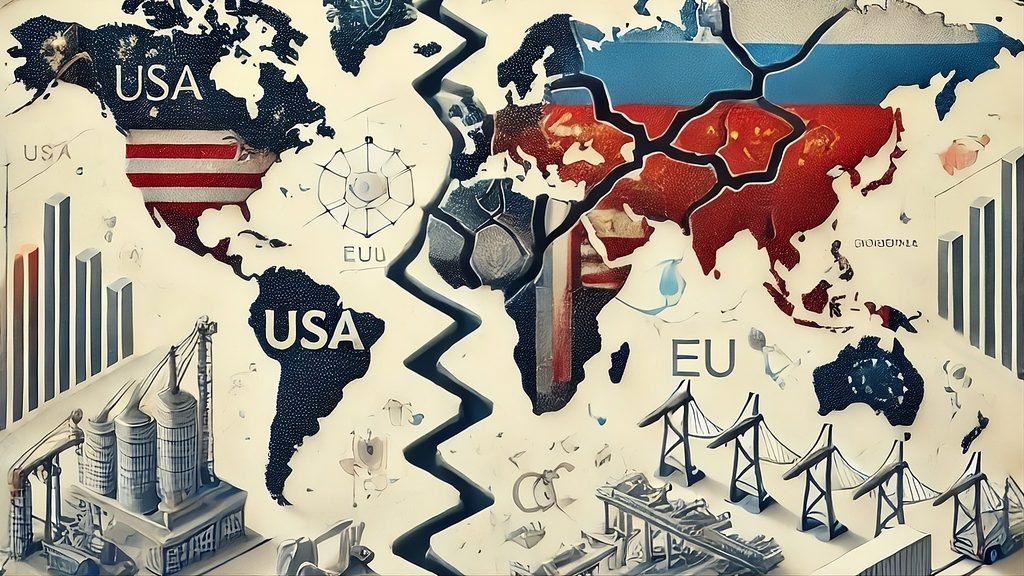
According to the International Monetary Fund (IMF), geoeconomic fragmentation ranks among the most significant threats to global growth in the twenty-first century. As political and security considerations increasingly influence economic decisions, governments and corporations are rethinking supply chains, investment strategies, and trade partnerships. The result is a gradual shift away from purely efficiency-driven globalization toward a world where resilience, security, and geopolitical alignment play a much greater role.
The Economic Cost of a Divided World
One of the IMF’s central concerns is the possibility that the global economy could become increasingly segmented into rival blocs centered around major powers. Such a scenario would not simply alter trade patterns. It could fundamentally reduce economic efficiency, weaken innovation, and slow long-term growth.
Research conducted by the IMF suggests that under extreme fragmentation scenarios, global economic output could decline by as much as 7 percent. This figure represents trillions of dollars in lost economic activity and highlights the scale of the risk associated with a world where political divisions increasingly override economic integration.
The implications extend far beyond headline growth figures. A fragmented global economy would likely result in higher production costs, reduced access to international markets, lower productivity gains from technology transfer, and greater uncertainty for investors. Developing economies, many of which depend heavily on open markets and foreign investment, could face some of the most severe consequences.
Commodity Markets Under Pressure
The impact of geoeconomic fragmentation is not limited to trade and manufacturing. Commodity markets are also becoming increasingly vulnerable to geopolitical divisions.
The IMF has examined how a more fragmented global trading environment could affect energy, metals, agricultural products, and other strategic commodities. Its findings indicate that the segmentation of trade networks could trigger significant changes in pricing patterns and market volatility. Some countries could benefit from shifting trade routes and supply shortages, while others might experience rising import costs and reduced economic competitiveness.
Because commodities remain essential for industrial production, food security, and energy systems, disruptions in these markets can have ripple effects across the global economy. In a fragmented world, access to critical resources may become increasingly influenced by geopolitical relationships rather than purely market-based considerations.
Why Europe Faces Particular Vulnerabilities
Among the world’s major economic regions, the European Union occupies a uniquely sensitive position. The IMF has repeatedly highlighted Europe’s exposure to geoeconomic fragmentation due to its high degree of economic openness and its deep integration into global trade networks.
Europe relies extensively on international supply chains, cross-border investments, technological partnerships, and export-oriented industries. As geopolitical tensions intensify, the region faces the difficult challenge of balancing economic interests with strategic concerns.
The IMF argues that policies promoting fragmentation should be approached with caution, especially in the European context. Rather than encouraging economic decoupling, the institution recommends strengthening the EU Single Market while continuing to support a rules-based multilateral trading system. Maintaining openness while improving resilience may ultimately prove more sustainable than pursuing broad economic separation.
A New Era of Global Economic Relations
The growing focus on geoeconomic fragmentation reflects a broader transformation in international relations. For decades, globalization was largely driven by the pursuit of lower costs, greater efficiency, and expanded markets. Today, those objectives increasingly compete with concerns related to national security, technological leadership, supply chain resilience, and strategic autonomy.
This does not necessarily mean that globalization is ending. Global trade continues to operate on a massive scale, and economic interdependence remains a defining feature of the modern world. However, the nature of globalization is changing. Economic relationships are becoming more selective, and governments are placing greater emphasis on trusted partners and strategic industries.
The emerging landscape suggests that future economic networks may be shaped not only by market forces but also by geopolitical considerations. In this evolving environment, countries and businesses alike must adapt to a reality in which political alignment, security interests, and economic cooperation are becoming increasingly interconnected.
The evidence presented by international institutions paints a clear picture: geoeconomic fragmentation is no longer a distant possibility but an ongoing process that is already influencing global trade, investment flows, and commodity markets. While a complete division of the world into rival economic camps remains uncertain, the trend toward greater strategic separation is becoming increasingly visible.
For policymakers, businesses, and investors, the challenge lies in navigating a world where economic decisions can no longer be separated from geopolitical realities. The coming decades may not be defined by the end of globalization, but by its transformation into a more fragmented, more politically driven, and ultimately more complex global system.