
Albania’s Political Crisis and the Geopolitical Stakes for Europe: Edi Rama Under Pressure as the Western Balkans Face a Test of Democratic Credibility
Albania’s political crisis has become more than a confrontation between Prime Minister Edi Rama and his opponents. The protests in Tirana expose a deeper struggle over democratic accountability, the credibility of European integration and the strategic direction of a country whose stability matters to both the European Union and the wider Western Balkans.
A Domestic Crisis With Consequences Beyond Albania
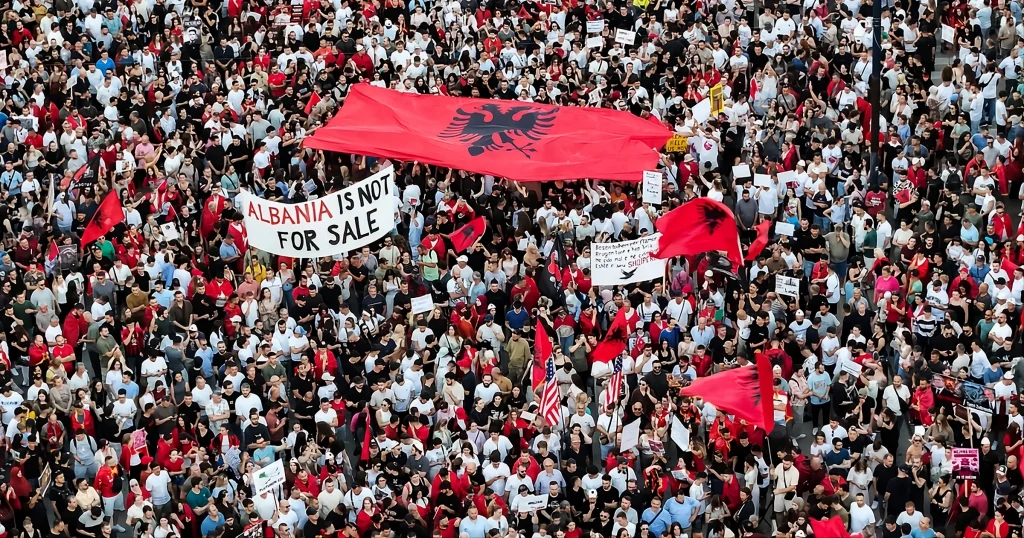
Albania’s escalating political crisis has become more than a confrontation between Prime Minister Edi Rama and his opponents. The protests sweeping Tirana expose a deeper struggle over democratic accountability, the credibility of European integration and the strategic direction of a country whose stability matters to both the European Union and the wider Western Balkans. What began as a movement driven by opposition to controversial development plans, corruption allegations and frustration over education and living standards has evolved into a direct challenge to the government’s authority.
Its consequences now extend beyond the immediate question of whether Rama can remain in office: the crisis raises questions about how political power is exercised in a NATO member seeking EU membership, how foreign investment intersects with domestic governance, and how external actors may seek to exploit divisions inside a strategically important part of southeastern Europe.
The protests have intensified amid anger over corruption, university conditions, tuition costs, limited economic opportunities and the government’s handling of controversial investment projects. Demonstrations have included clashes between protesters and police, with tear gas, water cannon and other forms of force used to disperse crowds. Associated Press reported that the unrest had drawn students and young people into a broader movement demanding Rama’s resignation, while authorities reported substantial numbers of arrests and injuries.
The police response has itself become part of the political confrontation, particularly after the police chief announced the suspension of seven officers under investigation for allegedly excessive force. These developments illustrate the dual challenge confronting the Albanian state: it must protect public order without undermining the rights and political legitimacy that are central to a functioning democracy.
Rama has rejected calls to resign, arguing that the protests threaten Albania’s progress towards European Union membership rather than the survival of his government. That argument reflects the central geopolitical tension of the crisis. EU accession is not simply a diplomatic objective or a promise of future economic prosperity; it is also the framework through which Albania seeks to consolidate its institutions, attract investment, strengthen the rule of law and anchor itself more firmly within the Western political order.
Yet the same European perspective that gives Rama’s government strategic importance also raises expectations of transparency, institutional independence and accountability. If citizens come to believe that the language of European integration is being used to shield those in power from scrutiny, the accession process risks losing credibility among the very people it is intended to benefit.
The European Union’s Strategic Dilemma
Enlargement as a geopolitical instrument
For Brussels, Albania occupies a position that cannot be understood solely through the size of its economy or the scale of its domestic political disputes. EU enlargement in the Western Balkans is a strategic project designed to reduce political instability, reinforce democratic institutions and prevent the region from becoming more vulnerable to competing external influences.
Albania’s integration into the Union would help consolidate the European orientation of a region marked by unresolved disputes, fragile institutions and different levels of alignment with Western foreign and security policy. In this context, the country’s political stability is not merely an internal matter: it forms part of a broader European effort to make the Western Balkans more predictable, resilient and institutionally connected to the EU.
The difficulty for European policymakers is that geopolitical priorities and democratic conditionality can pull in different directions. European governments have strong reasons to avoid a political vacuum in Tirana, particularly at a time when regional stability remains important. At the same time, offering unconditional political support to an incumbent government facing serious public discontent could weaken the credibility of the accession process.
If Brussels appears willing to overlook concerns about corruption, accountability or the treatment of demonstrators because a government is considered strategically useful, it risks reinforcing public perceptions that European integration is a diplomatic bargain between political elites rather than a transformation based on enforceable standards.
The crisis therefore places the EU in a delicate position. It must distinguish between the legitimacy of peaceful demonstrations, acts of violence committed during unrest and the government’s responsibility to respond proportionately.
Condemning violence should not mean dismissing legitimate grievances, just as defending the right to protest should not imply support for attacks on public institutions or police officers. This distinction is particularly important because the credibility of the EU depends not only on what it says about Albania but also on whether its principles are applied consistently across candidate countries. The wider enlargement debate is already shaped by questions of accountability in several parts of the region, making Albania’s crisis part of a broader test of the Union’s capacity to combine strategic ambition with institutional standards.】
Accession credibility and the rule of law
Albania’s European ambitions also depend on its ability to demonstrate that the rule of law applies to political leaders, public institutions, investors and ordinary citizens alike. The fight against corruption, the independence of the judiciary and the effectiveness of anti-corruption institutions are not technical details to be addressed after accession. They are fundamental conditions for membership and for the long-term confidence of European partners. Public anger over perceived corruption becomes geopolitically significant when it creates doubts about whether the state can deliver the institutional reforms on which its European future depends.
The role of Albania’s Special Anti-Corruption Structure, known as SPAK, is therefore relevant to the broader political environment. Anti-corruption investigations can intensify tensions between the government, opposition and judicial institutions, particularly when they touch influential figures or networks. But the existence of political conflict around accountability should not itself be interpreted as proof of guilt or as evidence that institutions are acting under foreign direction.
The essential question is whether investigations and judicial procedures can operate independently, on the basis of evidence and due process, without political interference. A credible European trajectory requires institutions strong enough to withstand pressure from all sides.
For the EU, the central issue is consequently not whether Rama remains prime minister at any cost, nor whether his government must fall in response to street pressure. It is whether Albania’s institutions can manage the crisis in a way that preserves constitutional order, protects fundamental freedoms and maintains a credible path towards membership. Political continuity without accountability could deepen distrust; instability without institutional safeguards could weaken the state. The strategic interest of Europe lies in a resilient democratic system rather than in the indefinite survival of any particular leader.
The Kushner-Linked Resort and the Geopolitics of Foreign Investment
When an investment project becomes a political symbol
One of the most important dimensions of Albania’s unrest is the controversy surrounding a proposed luxury tourism development associated with Jared Kushner, the son-in-law of US President Donald Trump, and his investment firm, Affinity Partners. The project has become a focal point for environmental activists, local residents and critics of the government’s approach to development.
The proposed resort near the Vjosa-Narta protected landscape has raised concerns about ecological damage, land rights, the pace of authorisation and the extent to which public interests are being weighed against the expectations of international investors. Reuters reported in June that the development had become the subject of protests, with opponents warning about the effects on sensitive coastal habitats and the government defending the potential economic benefits.
The project’s political significance extends well beyond tourism. Large international investments can offer Albania employment, infrastructure, foreign capital and increased visibility in global markets. For a country seeking to move up the economic value chain, attracting investors is a legitimate policy objective. However, the strategic value of investment depends on the credibility of the legal and institutional framework through which it is approved. When a project is perceived to receive preferential treatment, particularly in an environmentally sensitive area, the debate can shift from whether the investment is economically desirable to whether the state applies the law consistently.
That perception becomes even more politically sensitive when an investment is associated with people close to a sitting US president. The association does not, in itself, establish wrongdoing or prove that American political influence has determined the project’s treatment. It does, however, make the issue more visible internationally and encourages questions about the relationship between commercial interests and political power.
The controversy has been amplified by criticism of the speed with which the project is being advanced and by concerns over changes to the legal framework governing development in protected areas. The Guardian reported on 19 October that critics had questioned whether the project was being pushed forward before environmental safeguards and European standards could be fully applied, while Rama’s government has defended the development as an opportunity for economic growth.
Washington, Tirana and the risks of political association
For Albania, the connection to a project associated with the US president’s family creates a difficult diplomatic situation. The country has strong reasons to maintain close relations with Washington, which has played an important role in its security and international orientation. But those relationships can become politically vulnerable if domestic critics believe that proximity to influential foreign figures grants investors advantages unavailable to others. A government that presents itself as a reliable Western partner must also demonstrate that its investment decisions are transparent, legally defensible and consistent with public obligations.
This is where the controversy becomes a geopolitical issue rather than merely an environmental or economic dispute. The concern is not that foreign investment is inherently undesirable, nor that every project linked to a politically connected investor must be viewed with suspicion. It is that the perception of privileged access can damage trust in institutions and create a gap between Albania’s international image and the experiences of its citizens. If that gap widens, foreign investment itself may become a source of political polarisation rather than a tool for development.
There is also a wider regional dimension. The Western Balkans have become a destination for competing investment interests, including projects involving tourism, property, energy, transport and strategic infrastructure. Governments in the region often present such deals as evidence of international confidence and economic modernisation. Yet the long-term value of these investments depends on sound governance, respect for property rights, environmental protection and public consent. Albania’s experience could therefore become a broader test of whether economic diplomacy in the Western Balkans strengthens institutions or reinforces concerns that political access matters more than transparent rules.
Russia, Iran and the Government’s Claims of Foreign Interference
The difference between geopolitical risk and proven responsibility
As the protests have intensified, Rama has suggested that foreign actors are exploiting the unrest. He has specifically referred to Russia and Iran, alleging that outside forces are attempting to amplify domestic tensions through social media and other forms of interference. He has also referred to a reported attempt involving an explosive drone directed at the government headquarters in Tirana. According to ANSA, Rama said the drone had been neutralised and argued that the incident pointed to foreign involvement. These are serious allegations, but they must be treated with care: public statements by a political leader do not, by themselves, establish who was responsible for an incident or prove that foreign governments organised the protests.
The geopolitical context makes the allegations worthy of scrutiny. Albania is a NATO member and a candidate for EU membership, and its foreign policy is closely aligned with the Western security framework. A destabilisation campaign targeting its institutions would therefore carry significance beyond its borders. Russia has a strategic interest in exploiting divisions within European societies and in weakening confidence in Western institutions, while tensions between Iran and Western governments have created other potential channels of confrontation. Online influence operations, covert financing and the amplification of polarising narratives are recognised risks in contemporary European security.
Nevertheless, the existence of these risks cannot be used as a substitute for evidence. The fact that foreign-linked accounts may promote a protest movement, or that an outside commentator expresses support for demonstrators, does not automatically prove operational control over events on the ground. Nor does evidence of online manipulation mean that the underlying grievances are fabricated. Corruption concerns, dissatisfaction with education, frustration over living standards and opposition to controversial development projects have their own domestic political origins. Foreign actors, if involved, could seek to exploit these grievances without having created them.
This distinction is essential to understanding Albania’s crisis. If there is credible evidence of foreign interference, it should be investigated and presented transparently through appropriate institutions. But if the government attributes widespread dissent primarily to external enemies without substantiating the claim, it risks discrediting legitimate opposition and deepening political polarisation. A democratic state must be able to confront hostile interference while recognising that its own citizens can have serious and legitimate reasons to challenge those in power.
Albania’s position on the Western security frontier
Albania’s strategic alignment gives the crisis a wider significance. Its NATO membership places it within the alliance’s collective security framework, while its EU candidacy connects domestic reform to a broader European political project. In such a setting, internal instability can create opportunities for external actors to magnify divisions, undermine trust and portray democratic institutions as ineffective. But Albania’s most effective defence against such interference is not simply a tougher security response. It is institutional credibility.
Public trust is a strategic asset. Citizens who believe that investigations are independent, that public contracts are transparent and that peaceful dissent is protected are less likely to accept narratives claiming that all political institutions are illegitimate. Conversely, where public confidence is already low, external disinformation can find a more receptive environment. The resilience of the Albanian state therefore depends on the relationship between national security and democratic accountability: security measures must protect institutions, while those institutions must demonstrate that they serve the public rather than a narrow political or economic circle.
For NATO and Albania’s Western partners, the prudent response is to distinguish clearly between verified security incidents, credible evidence of foreign operations and allegations made amid a domestic political struggle. Cooperation on intelligence, cybersecurity and the protection of critical institutions can be important, but it should complement rather than replace independent investigations and political accountability. The objective should be to make Albania more resistant to interference without turning every episode of domestic opposition into a geopolitical confrontation.
The €2,500 Police Payment: Security, Political Messaging and Institutional Trust
On 19 October, Rama announced a payment of €2,500 for every police officer deployed on the front line during the unrest, alongside substantial salary increases due to take effect from 1 January. The announcement followed violent clashes in Tirana and was presented as recognition of the risks faced by officers confronting attacks during demonstrations. Euronews Albania reported that the payment was intended for each officer assigned to the front line, with the government stressing the collective nature of the measure.
The announcement has immediate domestic significance, but it also illustrates the political challenge facing the state. Police officers are required to maintain public order, protect public buildings and prevent violence. Their safety matters, and attacks against them cannot be justified by the legitimacy of peaceful protest. At the same time, the state’s use of force must remain proportionate and subject to oversight. The reported suspension of seven officers under investigation for excessive force reinforces the importance of ensuring that police conduct is scrutinised independently rather than treated as beyond question.
The €2,500 payment can be understood as a form of financial recognition for officers exposed to exceptional risks. Yet, in the middle of a major political crisis, it also carries a powerful symbolic message: the government is publicly rewarding the forces responsible for containing the unrest while refusing to step down. That does not, by itself, establish that the payment is improper or that it is intended to influence police behaviour. The important questions concern the measure’s eligibility criteria, its legal and budgetary basis, its implementation and whether it is part of a transparent policy for frontline personnel or an exceptional response to a politically charged moment.
From a geopolitical perspective, the issue connects to a broader question about state capacity. A government’s authority is not measured solely by its ability to deploy police or restore order in the streets. It also depends on whether security institutions are professional, accountable and trusted by citizens. If police are seen as serving the constitutional order rather than a particular political leader, they can help preserve stability during a crisis. If their legitimacy becomes inseparable from the fortunes of the government, the risk is that public-order disputes deepen the very divisions they are supposed to contain.
The payment and promised salary increases will therefore be judged not only by police officers but also by the public. Transparent implementation, fair treatment of personnel and credible investigations into alleged misconduct would help demonstrate that the state is responding institutionally. If the announcement is perceived principally as a political gesture, it may do little to address the underlying grievances driving the protests. The decisive test is whether the government can restore public confidence as well as physical order.
The Western Balkans: Regional Stability and the European Question
Albania as part of a wider regional equation
Albania’s crisis is unfolding in a region where EU integration remains a central political objective but where institutional trust and democratic accountability continue to be contested. Developments in Tirana matter because the Western Balkans are interconnected through migration, trade, infrastructure, security cooperation and political relationships. A prolonged crisis in one country can influence the calculations of neighbouring governments, opposition movements and external powers, even when it does not directly trigger instability elsewhere.
For the EU, the regional stakes are particularly important. Enlargement is intended to anchor the Western Balkans within a common political and economic framework, reducing the risk that unresolved disputes or institutional weaknesses become permanent sources of vulnerability. If Albania continues to advance towards membership while facing serious domestic concerns over governance, Brussels will have to demonstrate that progress in negotiations does not mean that accountability standards are negotiable. If the crisis instead produces a breakdown in institutional functioning, it could slow reform and weaken confidence in the accession process.
The effects on neighbouring countries should not be exaggerated. Albania’s political turmoil does not automatically imply a wider regional crisis, nor is there evidence that protests in Tirana are part of a coordinated regional campaign. But the situation provides a revealing example of the pressures facing candidate countries: governments must demonstrate that they can deliver economic development and political stability while respecting democratic constraints. This is a challenge shared, in different forms, across the region.
Kosovo, Serbia and the credibility of Western engagement
Albania’s close relationship with Kosovo adds another layer to the regional picture. Tirana has consistently supported Kosovo’s international integration and its security relationship with Western partners. A prolonged period of domestic instability in Albania could complicate political coordination and distract attention from shared regional priorities, although it would not automatically alter the strategic relationship between the two. The broader concern is whether democratic institutions across the Western Balkans can maintain public trust while managing economic pressures, political competition and external influence.
Relations with Serbia form part of the same strategic landscape, though the political contexts are different. The Western Balkans remain affected by unresolved questions of regional security and international recognition, while the EU continues to treat normalisation between Belgrade and Pristina as a central issue. Albania’s crisis is not directly equivalent to Serbia’s political challenges, but it reinforces the importance of a consistent European approach across the region. If democratic standards are applied selectively according to strategic convenience, the Union’s influence as a reform partner may weaken.
For Western policymakers, the lesson is that regional stability cannot be secured through diplomatic alignment alone. Governments may support Western security priorities and endorse EU membership while still facing serious questions about transparency, public accountability and the treatment of political opposition. Long-term resilience requires both strategic cooperation and credible institutions at home. Albania’s trajectory will therefore be watched not only for its immediate impact on Tirana but also as an indication of how effectively the European project can connect geopolitical objectives with democratic reform.
Rama’s Political Survival and the Limits of Stability
Rama’s refusal to resign signals that the government intends to withstand the protests rather than treat them as a direct mandate for a change of leadership. His position may be strengthened by the institutional advantages of incumbency and by the strategic importance that Western partners attach to Albania’s European path. But neither international support nor the government’s control of state institutions can resolve the underlying crisis of confidence on its own.
The central political risk for Rama is that a movement initially fuelled by specific grievances becomes a broader rejection of the government’s legitimacy. When protests bring together students, environmental activists, opposition supporters and citizens frustrated by corruption or economic conditions, their demands may extend beyond any single policy. The government can attempt to isolate violent groups from peaceful demonstrators, and that distinction is important. Yet it cannot assume that the entire movement is reducible to the actions of those who engage in violence. A durable response requires a political strategy that addresses substantive grievances as well as security concerns.
The government’s handling of the crisis will also influence its international credibility. A measured response, transparent investigations and meaningful engagement with public concerns could help preserve Albania’s European trajectory. By contrast, a response dominated by confrontation, broad accusations of foreign interference or an unwillingness to address questions of governance could intensify distrust. These outcomes are not predetermined, and the current unrest does not by itself establish that the government is approaching collapse. The decisive factor will be whether the authorities can demonstrate that the state remains accountable to the public even when its political leadership is under pressure.
Nor should Rama’s departure be treated as an automatic solution. A change of government could open a path towards renewed political dialogue, but it could also produce a period of uncertainty if it were not accompanied by credible institutional safeguards and a clear reform agenda. The central question is therefore not simply who occupies the prime minister’s office. It is whether Albania can strengthen the institutions that make political transitions peaceful, ensure that corruption allegations are addressed through independent procedures and maintain a credible framework for EU accession.
The Vienna Visit and the Limits of Political Speculation
Reports and speculation surrounding Rama’s international travel have also become part of the wider political narrative. Any cancellation or alteration of a diplomatic visit can attract attention during a period of unrest, particularly when opponents interpret it as evidence of international isolation or concern within the government. However, a cancelled visit does not, by itself, establish that a leader is preparing to leave office, seeking refuge abroad or facing the imminent collapse of his administration. Such conclusions require independent confirmation.
In a geopolitical crisis, the distinction between diplomatic fact and political rumour matters. Speculation about a possible move to Vienna or an eventual exile should not be treated as an established scenario unless supported by reliable evidence. The same standard should apply to claims that foreign governments are orchestrating protests or that international partners have withdrawn support. These narratives can shape perceptions, but they should not replace verified information.
The relevant strategic question is how Albania’s partners respond to the political situation, not whether unconfirmed rumours can be used to predict Rama’s fate. Statements by EU institutions, Washington and other Western capitals should be assessed on their substance: whether they emphasise restraint, due process, protection of peaceful protest and progress on reform. Diplomatic silence or the cancellation of a meeting may have multiple explanations and should not be assigned a geopolitical meaning without further evidence.
Three Possible Scenarios for Albania’s Future
A controlled stabilisation
One possible outcome is that the government gradually restores public order while attempting to contain the political damage. In this scenario, the authorities would distinguish peaceful demonstrators from those responsible for violence, investigate allegations of excessive force and seek to reduce tensions without abandoning the European reform agenda. The government could remain in office, but its ability to regain credibility would depend on whether it responds to concerns over corruption, education, public services and controversial investment decisions. For the EU, this would be the least disruptive path, provided that stability was accompanied by meaningful institutional accountability rather than simply the suppression of dissent.
A prolonged political confrontation
A second scenario is a drawn-out confrontation in which demonstrations continue, the government refuses to resign and opposition groups attempt to sustain pressure. Such a situation could weaken investor confidence, delay policy decisions and consume political attention that would otherwise be directed towards EU-related reforms. The longer the confrontation lasts, the greater the risk that peaceful protest, political competition and street violence become increasingly difficult to separate in public debate. External actors could also attempt to exploit the divisions, although the existence and extent of such efforts would need to be established through evidence rather than assumed.
A political transition with uncertain consequences
A third possibility is that pressure eventually produces a leadership change, a negotiated political arrangement or a broader reorganisation of the government. Such an outcome would not automatically mean that Albania’s strategic orientation had changed. The country’s NATO membership, its EU candidacy and the wider incentives for integration would remain important factors. However, a transition could create uncertainty over the pace of reform and the management of major investment projects. Its long-term value would depend on whether it strengthened institutional independence and public accountability or merely shifted political power between competing elites.
None of these scenarios should be presented as inevitable. The current evidence demonstrates a serious crisis, but not a definitive outcome. The most useful geopolitical analysis is therefore one that identifies the forces shaping the situation and the decisions that could change its trajectory, rather than treating any single prediction as established fact.
Albania’s Crisis Is a Test of Europe’s Strategic Credibility
Albania’s unrest exposes a central dilemma in European geopolitics: Western alignment can provide a country with security, diplomatic support and a pathway towards integration, but it cannot substitute for public trust and credible institutions. The government’s ability to contain violence is important, yet the deeper challenge is to demonstrate that the state can protect peaceful dissent, investigate allegations of misconduct and apply transparent rules to political power and foreign investment.
The controversy surrounding the Kushner-linked resort illustrates how international capital can become entangled with questions of sovereignty, environmental protection and political legitimacy. Rama’s allegations of Russian and Iranian interference highlight the real security concerns facing a NATO member, but those claims require evidence and should not be used to dismiss domestic grievances. The €2,500 payment promised to frontline police officers, together with planned salary increases, adds another dimension to the state’s response: the government is attempting to reinforce the institutions responsible for restoring order while confronting a wider crisis of confidence. Each of these developments raises the same fundamental question about the relationship between state authority and democratic accountability.
For Brussels, Washington and NATO, Albania remains strategically important. But the most effective way to preserve that importance is not to prioritise political continuity above all else. It is to support a stable, democratic and accountable Albanian state capable of resisting external interference precisely because its citizens have confidence in its institutions. European integration will be credible only if it is accompanied by tangible improvements in the rule of law, public services, transparency and the protection of fundamental rights.
Ultimately, the geopolitical significance of Albania’s crisis lies less in whether Edi Rama survives the immediate confrontation than in what the country’s institutions become afterwards. If the unrest leads to greater accountability and a more transparent relationship between government, investors and citizens, Albania could emerge with a stronger basis for European integration. If it instead deepens polarisation, weakens trust and turns the European project into a rhetorical instrument in domestic political battles, the damage will extend beyond Tirana. It will become a challenge to the credibility of the EU’s enlargement strategy and to the wider Western ambition of building a stable, democratic and resilient Western Balkans.