
The Rare Earth War: Inside the Global Fight for Critical Minerals
🎧 Listen to the Full Article
Experience The Rare Earth War: Inside the Global Fight for Critical Minerals in a fully narrated audio edition, featuring two voices and immersive background music.
Discover the geopolitical struggle reshaping global power, as China, the United States, and Europe compete for control of the critical minerals powering artificial intelligence, clean energy, and advanced defense technologies.
Sit back, press play, and explore the story through a dynamic blend of narration and sound.
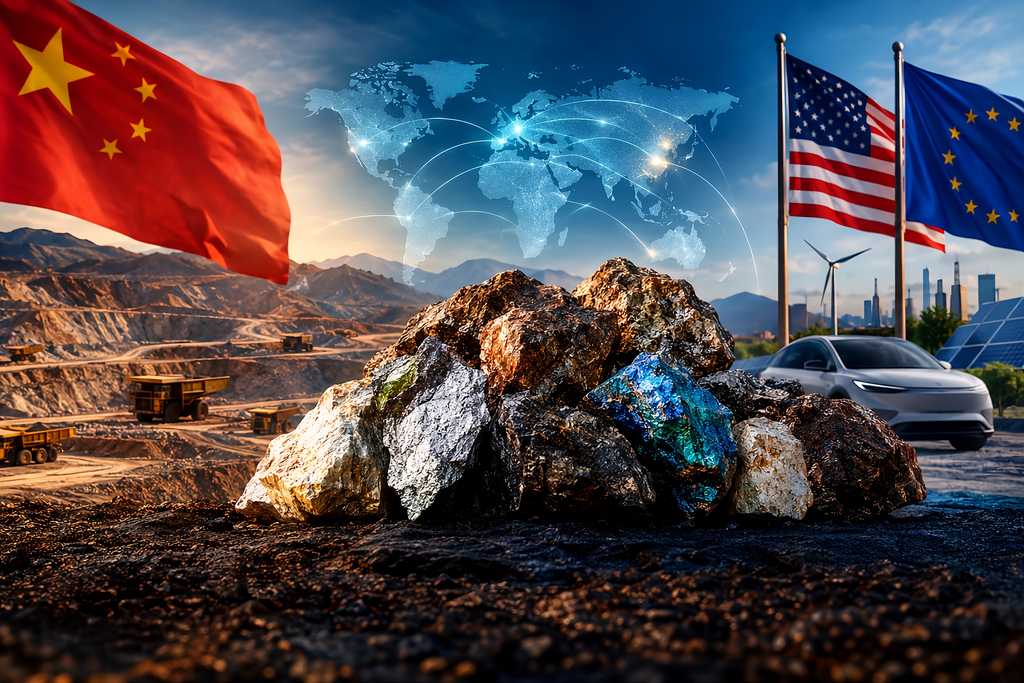
Rare Earth War is no longer a theoretical geopolitical concept. From the vast mining complexes of Inner Mongolia to government offices in Washington, Brussels, Canberra, and Beijing, control over critical minerals has become one of the defining strategic challenges of the twenty-first century.
At the center of this competition stands Bayan Obo, an enormous mining district in China’s Inner Mongolia Autonomous Region. Known primarily for its iron ore resources and large concentrations of rare earth elements, the site represents far more than an industrial asset. It symbolizes a profound shift in global power dynamics. While previous eras were shaped by access to coal, oil, and natural gas, today’s technological and industrial transformation increasingly depends on minerals such as neodymium, dysprosium, terbium, lithium, cobalt, gallium, and germanium.
These materials are essential to electric vehicles, wind turbines, advanced semiconductors, artificial intelligence infrastructure, and modern defense systems. As governments pursue energy security, digital transformation, and military modernization, access to these minerals has become a matter of national strategy rather than ordinary trade.
China’s Dominance and the Refining Bottleneck
Public discussions about critical minerals often focus on mining, yet extraction represents only one stage of a much longer and more complex value chain. The true strategic bottleneck lies in separation, purification, and refining. These processes require highly specialized chemical and metallurgical expertise, substantial capital investment, and the ability to manage significant environmental impacts.
According to the U.S. Geological Survey (USGS) Mineral Commodity Summaries 2025, China remained the world’s leading producer of rare earths in 2024. Depending on the specific segment being measured, estimates of China’s market influence can differ considerably. Mining output, refining activity, and magnet manufacturing each reflect different levels of concentration.
The International Energy Agency (IEA) reported in its 2025 rare earth analysis that China accounted for approximately 91% of global rare earth refining output for magnet materials in 2024, highlighting the country’s extraordinary position in one of the most critical stages of the supply chain. iea.org, iea.blob.c…indows.net
China’s influence becomes even more significant in the production of neodymium-iron-boron (NdFeB) permanent magnets, which are widely used in electric vehicle motors, offshore wind turbines, industrial robotics, and advanced defense technologies. High-performance permanent magnets are crucial components in radar systems, sensing equipment, guidance technologies, and numerous military applications.
This dominance did not emerge by accident. Beginning in the 1990s, while many Western economies reduced domestic mining and processing activities because of environmental costs and economic pressures, China invested heavily in building integrated supply chains, technical expertise, and refining capacity. Decades later, those investments continue to shape global mineral markets.
Export Controls and the Rise of Mineral Diplomacy
China’s strategic position became increasingly visible as export restrictions expanded beyond traditional trade measures. Between 2023 and 2024, Beijing introduced licensing requirements for exports of gallium, germanium, and antimony, materials that play essential roles in semiconductor manufacturing, telecommunications equipment, and specialized optical technologies.
A major escalation followed on April 4, 2025, when China’s Ministry of Commerce (MOFCOM) and the General Administration of Customs announced export controls on medium and heavy rare earth-related items, including products associated with samarium, gadolinium, terbium, dysprosium, lutetium, scandium, and yttrium. The measure required exporters to obtain licenses rather than imposing a blanket export ban. english.mo…com.gov.cn], [iea.org
The policy immediately attracted global attention because several of these elements are indispensable for permanent magnets, precision optics, electronics, aerospace systems, and defense applications. Yet global mineral diplomacy remains fluid. In November 2025, the White House announced a trade agreement between the United States and China that included Chinese commitments to suspend certain export-control measures and issue broader export licenses covering rare earths, gallium, germanium, antimony, and graphite for U.S. end users and suppliers. whitehouse.gov, china.usem…ina.org.cn
The agreement demonstrated how critical minerals have evolved into powerful geopolitical bargaining tools capable of influencing broader economic and diplomatic negotiations.
The Western Response and the Critical Raw Materials Act
Concerns over excessive supply-chain dependence have prompted governments across Europe and North America to accelerate diversification efforts. The European Union’s Critical Raw Materials Act (CRMA) establishes a series of benchmarks to strengthen strategic autonomy by 2030. The framework aims for at least 10% of annual EU demand to come from domestic extraction, 40% from domestic processing, and 25% from recycling. It also seeks to ensure that no more than 65% of the Union’s annual requirements for a strategic raw material originate from a single third country at any relevant stage of processing. commission.europa.eu, consilium.europa.eu
In the United States, federal programs and Department of Defense initiatives have supported the expansion of domestic mining, refining, and magnet-manufacturing capabilities, including investment associated with the Mountain Pass rare earth operation in California.
Despite growing political support, diversification remains difficult. The IEA notes that bringing a new mining project from exploration through permitting, financing, construction, and commissioning can often take more than a decade. Long development timelines, complex permitting frameworks, and shortages of specialized technical expertise continue to challenge efforts to build alternative supply chains. iea.blob.c…indows.net, iea.org
The Global South and the New Resource Race
The search for reliable supplies of critical minerals has increasingly focused attention on resource-rich regions across the Global South. Among the most important areas is the Lithium Triangle, which spans Chile, Argentina, and Bolivia. Together, these countries hold some of the world’s largest lithium resources, making them central to the future of battery production and energy storage technologies.
Meanwhile, the Democratic Republic of the Congo remains the dominant source of mined cobalt. According to USGS data, the country accounted for approximately 73% of global cobalt mine production in 2024, underscoring its strategic importance to global battery supply chains. usgs.gov, data.usgs.gov
Because many Congolese mining operations involve Chinese investment and joint ventures, Western governments have supported infrastructure initiatives such as the Lobito Corridor, designed to improve transport links and diversify export routes away from existing logistical networks. Australia and Canada have also emerged as major beneficiaries of what policymakers increasingly describe as “friend-shoring.” Their stable regulatory environments, substantial mineral reserves, and close alignment with Western economies have attracted growing investment in mining, refining, and processing facilities.
A New Industrial Order Defined by Strategic Resources
Critical minerals are no longer treated as ordinary commodities governed exclusively by market forces. Governments now view supply security as a core economic and national security concern. Export controls, production concentration, and supply-chain disruptions have reinforced the perception that access to strategic minerals is essential for maintaining industrial competitiveness and technological leadership.
The International Energy Agency has repeatedly identified geographical concentration in supply chains as a major vulnerability for the global economy. As demand for lithium, cobalt, nickel, and rare earth elements continues to rise, competition for control over refining capacity, manufacturing expertise, and resource access is expected to intensify. iea.blob.c…indows.net, iea.org
The emerging contest is not simply about ownership of mineral deposits. It is about who controls the technologies, processing capacity, and industrial ecosystems required to transform raw materials into batteries, magnets, semiconductors, and advanced manufacturing components. In the decades ahead, countries with leading positions in mineral refining and advanced permanent magnet manufacturing are likely to exert significant influence over industrial production, clean-energy deployment, and defense supply chains. The Rare Earth War is therefore not a future scenario. It is already reshaping the global economy.
Related Articles
Explore more insights into the geopolitical, economic, and technological forces reshaping our world.
The Death of the Open Web: How AI Is Reshaping the Future of Knowledge
Artificial intelligence is transforming access to information and reshaping the global digital economy. Discover how technological dependence, control over knowledge, and the rise of AI platforms are changing the balance of power.
Global Crisis of Trust: The Alarming Reason Protests Are Spreading Across the World
From economic pressure to political instability, declining public trust is reshaping societies worldwide. Explore the deeper forces driving protests and challenging governments across the international landscape.
Food Geopolitics: Supply Chains and National Security
Critical resources extend beyond minerals and advanced technologies. Discover how agricultural supply chains, fertilizer dependencies, and global grain trade have become strategic instruments in the struggle for national security and geopolitical influence.