
Military Drones and Modern Warfare: How Unmanned Warfare Is Changing Global Conflicts
The Revolution of Mass Production and the Decline of Traditional Military Superiority
Military drones and modern warfare are reshaping the global balance of power, changing how states fight conflicts, defend their territory, and compete for strategic influence. From the battlefields of Ukraine to the growing use of artificial intelligence in military operations, unmanned systems are challenging traditional concepts of military superiority. Their impact extends beyond the battlefield, affecting defense spending, critical supply chains, electronic warfare, and the geopolitical competition between major powers.
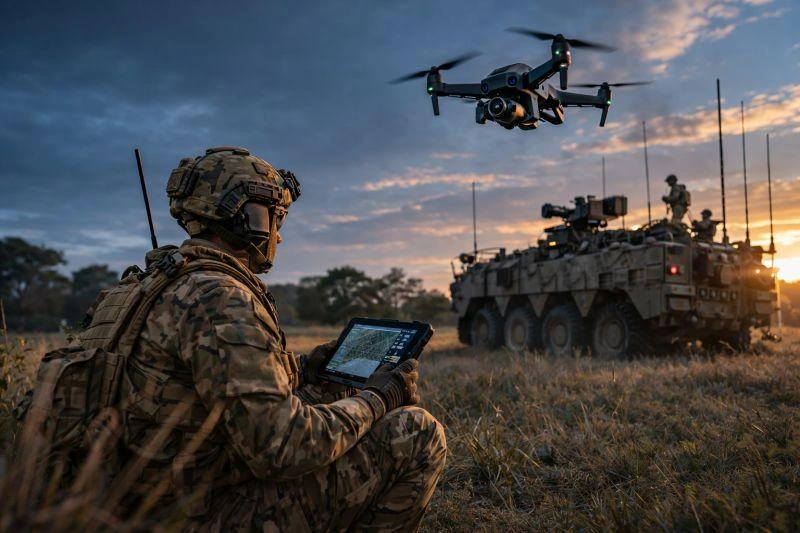
The most significant transformation concerns the relationship between cost, scale and effectiveness. For decades, military superiority was largely associated with sophisticated platforms such as fighter aircraft, bombers and armored vehicles, all of which require substantial financial resources and lengthy industrial production cycles. The war in Ukraine has demonstrated, however, that relatively inexpensive systems, produced in large quantities and rapidly upgraded, can place considerable pressure on militaries equipped with far more expensive conventional weapons.
First-person-view (FPV) drones, controlled by operators using real-time video feeds, are among the clearest examples of this shift. They can support battlefield surveillance, identify targets and conduct precision strikes while potentially reducing the direct exposure of military personnel. Their widespread deployment has also blurred the traditional distinction between reconnaissance and attack, allowing information gathered on the battlefield to be converted into operational action within increasingly short timeframes.
Figures published by Ukraine’s National Security and Defense Council in January 2026 illustrate the industrial scale of this transformation. According to Ukrainian authorities, the country’s annual production capacity exceeds eight million FPV drones, involving more than 160 companies. The same source attributes more than 60% of Russian military losses in 2025 to these systems. That percentage should be treated cautiously: it reflects an official Ukrainian assessment and does not, by itself, constitute independent verification of total battlefield losses.
The most important development is not simply the number of drones available, but the ability to manufacture, modify and replace them rapidly. In a prolonged conflict, large quantities of relatively inexpensive systems can become a strategic advantage, particularly when an adversary must expend costly ammunition to neutralize them. The economics of warfare are changing accordingly. Success increasingly depends not only on the quality of individual platforms, but also on the ability to sustain a continuous cycle of production, deployment, battlefield learning and technological improvement.
This dynamic has direct consequences for military mobility. In some sectors of the Ukrainian front, the persistent presence of reconnaissance and attack drones has made the movement of armored vehicles, logistics convoys and infantry units significantly more dangerous. Concentrating forces, once essential to achieving local superiority, can become a liability when movements are detected quickly and targeting information is transmitted to strike units.
This does not mean that tanks or conventional forces have become obsolete. Rather, their deployment increasingly depends on integration with electronic warfare, air defense, deception, reconnaissance and other protective measures. Battlefield superiority is becoming less a matter of the effectiveness of individual weapons and more a question of how effectively different capabilities can operate together.
The scale of the transformation is also reflected in Ukrainian military reporting. In October 2026, Ukraine’s Ministry of Defense reported hundreds of thousands of Russian drones intercepted or neutralized during the first ten months of the year. Such figures illustrate the intensity of the aerial contest, but they should be attributed explicitly to Ukrainian authorities rather than presented as independently verified totals.
The drone revolution extends far beyond the front line. Its development depends on a global industrial network encompassing semiconductors, electronic components, optical sensors, batteries, motors and communication systems. Even when a drone’s external structure is relatively simple, its performance may depend on components that are difficult to manufacture or obtain. Sustaining a high-intensity conflict has therefore become a question of industrial capacity, technological access and economic security.
From Mass Production to Algorithms: Electronic Warfare and Autonomy
The proliferation of drones has triggered an equally rapid technological response. Electronic warfare systems designed to disrupt communications and interfere with satellite navigation have become increasingly important components of counter-drone operations. The result is a continuous contest between systems attempting to maintain reliable control and adversaries seeking to deny them access to communications and navigation signals.
Two broad technological approaches have gained prominence: control methods that do not depend on conventional radio transmissions, and the integration of onboard navigation and image-processing capabilities.
Fiber-optic drones are among the most prominent examples of the first approach. Rather than relying exclusively on radio communications, these systems transmit commands and video through a cable that unwinds during flight. This arrangement can substantially reduce their vulnerability to radio-frequency jamming directed at the control link. It also introduces limitations, including cable weight, the risk of physical damage and constraints on maneuverability. Fiber-optic control does not make a drone invisible to every detection method or immune to all forms of countermeasure.
At the same time, artificial intelligence is expanding the ability of unmanned systems to process information onboard. Computer vision can analyze images, distinguish objects and support navigation when external data or communication links are limited. In military applications, these capabilities may reduce dependence on continuous operator input, although the degree of autonomy varies considerably between systems.
It is essential to distinguish between a drone that assists an operator in identifying an object, one that automatically maintains a flight path and a weapon capable of selecting and attacking a target without a further human decision. These are different capabilities, with different operational and legal implications.
The central issue is not simply how accurately an algorithm performs, but under what conditions it is used, what errors it may produce and who remains responsible for its decisions. Battlefield imagery can be incomplete, objects can be misidentified and environmental conditions can compromise recognition. When the time available for intervention is limited, even a relatively small error can have irreversible consequences.
The competition over military technology should therefore not be understood solely as a race toward increasingly autonomous systems. It is also a contest to develop capabilities that are reliable, controllable and compatible with international humanitarian law.
The Geopolitics of Supply Chains and Critical Minerals
Behind the proliferation of drones lies a geopolitical issue extending far beyond the battlefield: the concentration of industrial capabilities and resources required for advanced manufacturing.
Semiconductors, batteries, electronic sensors, electric motors and permanent magnets depend on complex supply chains distributed across multiple countries. Mining, mineral processing, component manufacturing and final assembly may take place in geographically distant locations. This interdependence creates economic opportunities, but it also exposes states to strategic vulnerabilities.
Access to mineral resources does not automatically translate into the ability to transform them into advanced components. Similarly, possessing assembly facilities does not guarantee continued production if critical supplies are interrupted. Industrial security consequently depends on the entire value chain, from raw materials to finished products.
China occupies a significant position in several segments of critical-mineral processing and electronics manufacturing. The United States and European countries are seeking to reduce their most consequential dependencies through industrial investment, supplier diversification and policies supporting domestic production. Rebuilding entire supply chains, however, requires time, capital, expertise and access to sufficiently large markets.
The competition has acquired a distinctly geoeconomic dimension. Export restrictions, sanctions and industrial policies can influence a country’s ability to manufacture military systems, while also increasing costs for businesses and encouraging the emergence of separate technological ecosystems.
For a broader perspective on this transformation, see The Rising Threat of Geoeconomic Fragmentation, which examines how strategic competition and the formation of economic blocs are reshaping global trade and investment.
The drone industry also demonstrates that military innovation is no longer concentrated exclusively within major defense contractors. Technology companies, commercial component manufacturers, research institutions and smaller industrial firms can all contribute to the development of systems with military applications. This wider distribution of innovation makes technological diffusion more difficult to control and, in certain areas, reduces the traditional advantages enjoyed by large defense manufacturers.
Strategic advantage increasingly belongs to countries that can integrate technologies, manufacture them at scale and adapt them rapidly to operational requirements. In a prolonged conflict, the ability to replace losses and update systems may prove as important as the technical superiority of an individual platform.
These developments are closely connected to the broader struggle over strategic resources. As demand for batteries, advanced electronics and electric propulsion grows, access to critical minerals becomes an increasingly important element of national security. The Rare Earth War: Inside the Global Fight for Critical Minerals explores how China’s position in rare-earth processing and Western diversification efforts are reshaping industrial dependencies and geopolitical competition.
The United States, Europe and the New Economics of Defense
The United States is attempting to adapt its military procurement model to an environment in which production scale and speed have become increasingly important. The Drone Dominance program illustrates this shift. According to the program’s official website, the initiative involves approximately $1.1 billion in prototype procurement, with the objective of selecting and moving relatively inexpensive unmanned aerial systems toward production.
Washington faces two interconnected challenges. It must preserve its advantage in sophisticated military platforms while developing the capacity to produce large quantities of less expensive systems quickly. This does not necessarily require replacing traditional weapons. Instead, it calls for integrating different capabilities into a more flexible operational structure.
The challenge also concerns military institutions themselves. Commercial technologies and software often evolve faster than conventional defense procurement programs, which are characterized by complex procedures and lengthy development cycles. To take full advantage of new capabilities, military organizations must adapt not only their purchasing systems, but also personnel training, maintenance, data management and decision-making processes.
Europe faces a similar dilemma. The war in Ukraine has demonstrated the importance of sustaining continuous industrial production, securing access to components and coordinating investment among allied countries. Dependence on external suppliers, fragmented national procurement programs and differences between acquisition procedures can all limit the ability to respond quickly to operational requirements.
The European challenge is therefore not simply to increase military spending, but to determine how that spending can create durable industrial capabilities. Investing in drones without developing the necessary software expertise, maintenance capacity and supply chains risks creating new dependencies on systems that may quickly become obsolete or difficult to replace.
Market forecasts reflect this transformation, although they must be interpreted carefully. According to MarketsandMarkets, the global military robotics market could grow from an estimated $42.15 billion in 2026 to $128.92 billion by 2031, representing a projected compound annual growth rate of 25.1%. These figures are commercial forecasts rather than guaranteed future expenditure. Actual growth will depend on government decisions, the evolution of conflicts, economic conditions and the definition of the market itself.
For major powers, the challenge will be to prevent the race for mass production from becoming an industrial competition without strategic coordination. Producing large numbers of systems does not automatically guarantee military or political advantage. Effective doctrine, reliable command structures and the ability to protect deployed forces remain essential.
The Human Dimension and the Limits of Technological Power
The transformation of warfare cannot be understood solely through the cost of platforms or the number of systems manufactured. Every technological innovation also changes the experience of those who fight and those who live in conflict zones.
For military personnel, persistent surveillance can make movements that once appeared routine considerably more dangerous. The presence of relatively small drones capable of observing large areas and transmitting information quickly creates a condition of near-constant exposure. Threats no longer emerge exclusively from major offensives; they can also come from systems that are difficult to detect and attacks that occur with little warning.
For civilians, the proliferation of unmanned systems raises equally serious concerns. Energy infrastructure, communication networks, transportation systems and residential areas can become targets or suffer the consequences of attacks. The relative accessibility of some drone technologies also expands the range of actors capable of deploying them, making the spread of these capabilities more difficult to control.
Automation introduces another question: the distribution of responsibility. When a military decision depends on an algorithmic system, it becomes necessary to establish who authorized its deployment, what limitations were imposed and whether meaningful human supervision remained possible. Technological progress does not remove the legal responsibilities of those who plan and conduct military operations.
International humanitarian law continues to require compliance with the principles of distinction between civilians and combatants, proportionality and precautions in attack. Applying these principles to increasingly autonomous systems presents significant challenges that concern not only technical accuracy, but also meaningful human control over the use of force.
The issue, therefore, is not whether technology should become part of warfare. It already is. The challenge is to determine which applications are acceptable, what limits should apply and how to ensure that the speed of technological decision-making does not exceed the capacity of human beings to understand its consequences.
Military Superiority in the Age of Unmanned Systems
The future of military drones and modern warfare will depend not only on technological innovation, but also on industrial capacity, resilient supply chains, electronic warfare capabilities, and the ability of governments to adapt their military doctrines to an increasingly complex strategic environment.
The expansion of drones is transforming the relationship between technology, industry and military power. Mass production, electronic warfare, artificial intelligence and competition over critical minerals are changing the conditions under which states build and sustain their defense capabilities.
The central lesson is not that traditional weapons have become irrelevant, nor that military superiority now depends exclusively on algorithms. Rather, no single platform can guarantee a lasting advantage on its own. Military strength increasingly derives from the integration of different systems, the quality of information, industrial resilience and the ability to learn rapidly from operational experience.
The competition among the United States, China, Russia, Ukraine and Europe is therefore about more than who possesses the most advanced drones. It concerns who can produce them in sufficient quantities, protect them against countermeasures, maintain them and sustain the supply chains on which they depend. Technology has become an increasingly important component of national sovereignty and international influence.
Yet a fundamental contradiction remains. The same systems that can reduce soldiers’ direct exposure and improve surveillance can make battlefields more persistent, dispersed and difficult to control. Lower barriers to entry for certain offensive capabilities may expand the options available to smaller actors, but they can also multiply risks for civilian populations and complicate crisis management.
The future of warfare will not be determined solely by how quickly new technologies are developed. It will also depend on the ability of states to govern their use, the resilience of their institutions, international cooperation and respect for the rules governing the use of force.
The strategic challenge of the drone age is to reconcile innovation with control, industrial production with economic sustainability, and military effectiveness with human responsibility. In a world where technology enables faster strikes over greater distances, superiority will be measured not simply by the number of systems available, but also by the ability to prevent technological advantage from becoming a permanent source of instability.