AI Life Expectancy Prediction: Will Artificial Intelligence Really Tell Us How Long We Have Left to Live?
AI life expectancy prediction is becoming one of the most fascinating frontiers in artificial intelligence research. From analyzing health records to identifying patterns associated with mortality, AI systems are opening new possibilities for understanding human longevity. But can artificial intelligence really tell us how long we have left to live? Projects such as life2vec suggest that machine learning can estimate certain mortality risks, although predicting the exact date of an individual’s death remains beyond the capabilities demonstrated by current research.
There is a question almost nobody wants to ask out loud. Not because it is difficult to formulate, but because everyone already knows the final answer. Sooner or later, life comes to an end. The real uncertainty is when.
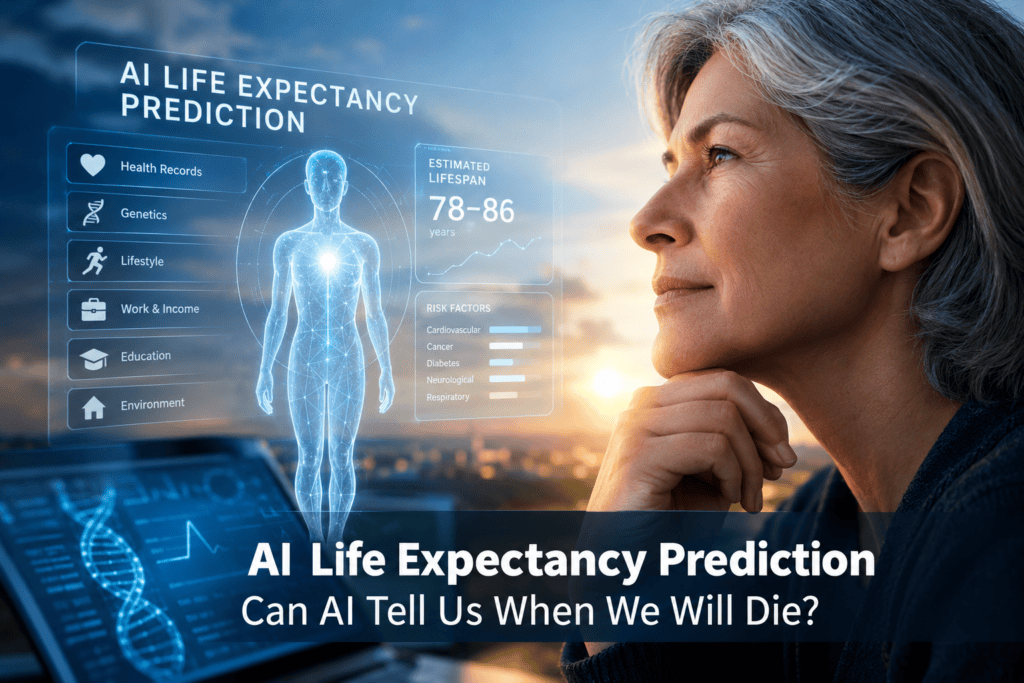
For centuries, this question belonged to philosophy, religion, and medicine. Today, however, it is entering an entirely new territory: artificial intelligence. Algorithms are no longer limited to recommending what we should buy or which movie we might enjoy. They can analyze enormous amounts of data to identify patterns associated with disease, mortality, and other future outcomes. One of the most fascinating frontiers in this field is the attempt to reconstruct human life trajectories from data, using techniques similar to those employed to understand language. It is a genuine scientific possibility, but still a long way from having a machine that can tell us exactly how many years we have left to live.
AI Life Expectancy Prediction: The Age When We Begin to Think About Time
Many people spend much of their youth without seriously reflecting on mortality. The years seem endless, the body recovers quickly, and physical discomfort feels temporary. Then a certain age arrives. A pain that refuses to go away, an unexpected medical appointment, a friend who becomes seriously ill, or a parent who begins to grow old. Suddenly, time no longer feels like an unlimited resource. It becomes something tangible.
Demographic data can help us understand how our statistical outlook changes as we grow older. According to the US National Center for Health Statistics, life expectancy at birth in the United States reached 79 years in 2024, the highest level ever recorded in the country. For people who have already reached the age of 65, however, average remaining life expectancy is 19.7 years: 20.8 additional years for women and 18.4 for men. These figures appear in the official CDC report, Mortality in the United States: 2024, published in January 2026.
These numbers describe population averages, not individual destinies. Life expectancy at birth does not mean that a person will necessarily reach a particular age. Similarly, remaining life expectancy at 65 is not a personal deadline. It is a statistical estimate based on observed mortality rates. Someone who reaches 65 has already passed through many of the risks associated with earlier stages of life and may therefore have a different statistical outlook from someone assessed at birth.
AI Life Expectancy Prediction: When Life Becomes Data
Every day, we leave behind a trail of information. Where we live, the work we do, how much we earn, the education we receive, the medical treatment we undergo, and the way our circumstances change over time. Considered separately, these details may seem like disconnected fragments. Analyzed together, they can reveal relationships that would be difficult for a human observer to identify.
This is the idea behind life2vec, one of the research projects that has attracted international attention to the relationship between artificial intelligence and the prediction of human life trajectories. The study Using Sequences of Life-Events to Predict Human Lives, by Germans Savcisens and colleagues, was published online in Nature Computational Science on December 18, 2023, and appeared in the journal’s January 2024 issue. The research is available through Nature and the arXiv scientific archive.
The researchers used Danish administrative records covering a population of more than six million people. The data included information about health, education, employment, income, residence, and working hours, recorded over time. The principle behind the model is compelling: just as words acquire meaning through context and sequence, events in a human life may also form patterns from which useful predictions can be derived.
Using machine-learning architectures inspired by language models, life2vec represented these sequences in a shared mathematical space, identifying relationships between life events and subsequent outcomes. The researchers demonstrated promising performance in predicting several outcomes, including early mortality, outperforming the comparison models used in their study.
That result, however, needs to be interpreted carefully. The system was not designed to calculate the exact age at which every individual will die. Among other tasks, the researchers evaluated its ability to distinguish between particular mortality outcomes within a defined population and time frame. On the official life2vec website, the researchers clarify that the 78.8% accuracy figure frequently cited in media coverage relates to a specific classification task involving a selected cohort of people aged between 35 and 65, using data to evaluate outcomes over the following four years. It does not mean that the model can predict the date of someone’s death or determine their total lifespan with 78.8% accuracy.
The distinction is crucial. A model can identify statistical patterns associated with higher risk without knowing an individual’s future. Furthermore, the data come from a specific national and institutional context. Whether the same results can be applied to other countries, populations, and healthcare systems must be tested rather than assumed.
AI Life Expectancy Prediction: The Myth of the Day We Will Die
The idea of knowing our own expiration date has always held an unsettling fascination. Films, novels, and science-fiction stories have imagined societies in which every person knows their destiny in advance. In scientific reality, however, things work differently.
Predictive algorithms operate through probabilities, statistical distributions, and risk estimates. Medicine and insurance statistics have used similar principles for decades. A doctor may estimate that a patient faces a higher-than-average cardiovascular risk. An algorithm may identify people who share characteristics associated with an increased probability of death. Neither result makes it possible to determine with certainty what will happen to a particular individual.
Artificial intelligence may make these estimates more sophisticated, especially when it can integrate many variables and identify complex relationships. But statistical accuracy does not automatically translate into reliable predictions for every individual. Personal risk continues to be influenced by biological, environmental, social, and random factors that may be missing from the data or impossible to anticipate.
This is precisely why the life2vec researchers have warned against sensational interpretations. The original model is not available as a public application or online calculator for predicting death. The authors explain this clearly on the official life2vec website, which also warns users about unauthorized websites claiming to use their technology.
The Dark Side of Prediction
If an app capable of reliably estimating our risk of dying within the next ten years existed tomorrow, would we really want to use it? The question is not merely technological. It is psychological, social, and ethical. For some people, learning that they face an elevated risk could encourage them to undergo medical checks, change certain habits, or seek treatment before a condition becomes more serious. In healthcare, properly validated predictive tools could help identify patients who need closer attention.
For others, however, such a prediction could become a difficult psychological burden. A statistical result might be interpreted as a sentence, influencing personal decisions, relationships, and future plans. Even when an algorithm provides only a probability, people may attribute a level of certainty to the result that it does not possess.
There is also the risk that such information could be used to discriminate. If predictions about health or mortality were used without adequate safeguards to determine who qualifies for insurance, credit, or certain opportunities, technology designed to help us understand society could end up reinforcing existing inequalities. These concerns connect to a broader debate about the unintended consequences of increasingly powerful AI systems. AI Risks: The Hidden Dangers of Artificial Intelligence explores the wider challenges of keeping artificial intelligence beneficial while controlling its potential harms.
The problem, therefore, is not simply how to improve predictive accuracy. We must also decide who should have access to these predictions, how they should be communicated, and which decisions it is legitimate to make on their basis. The ability to predict a risk does not automatically grant the right to use that information in every context.
Growing Older in the Age of Artificial Intelligence
Demographic data also tell a story of progress. In the United States, life expectancy recovered after the decline associated with the COVID-19 pandemic, reaching 79 years in 2024. According to the CDC report on mortality in the United States, the age-adjusted death rate fell by 3.8% between 2023 and 2024. In the same year, heart disease remained the leading cause of death, followed by cancer and unintentional injuries.
Artificial intelligence could contribute to further progress by helping researchers identify risk signals, improving certain diagnostic tools, and supporting the assessment of patients. But moving from an experimental model to a clinical tool requires independent testing, validation across different populations, rigorous data-quality checks, and evidence that using the system actually improves health outcomes.
Individual behavior matters, too. Physical activity, a balanced diet, blood pressure management, preventive care, and access to appropriate medical treatment can influence several risk factors. None of these guarantees a particular lifespan, but they remind us that the future is not simply something to be predicted. It is also something we can influence.
The challenge for future medicine may therefore be less about announcing how many years an individual has left and more about identifying risks early enough to do something about them. In this scenario, the value of artificial intelligence would not lie in delivering a verdict on someone’s destiny, but in helping people make better-informed decisions at the right time.
The rise of AI agents offers another perspective on this transformation. As systems evolve from answering questions to carrying out multi-step tasks, their role in healthcare research, information management, and everyday decision-making may expand. AI Agents Are Changing the Digital World: Acting on Our Behalf examines this broader shift toward systems that increasingly perform tasks on behalf of humans. Any use in healthcare, however, would require particularly strong safeguards, human oversight, and clear accountability.
The Question That Really Matters
Perhaps the point is not whether artificial intelligence will eventually become better at estimating how long we are likely to live. It is plausible that statistical models will continue to improve as richer datasets and more sophisticated analytical techniques become available. But how reliable these predictions will be for an individual, how well they can be transferred from one population to another, and what consequences they may have for human life remain open questions.
If an algorithm told us that our risk of dying within the next five or ten years was high, would we live differently? Would we change our jobs, priorities, relationships, and plans? Or would we end up organizing our lives around a number that, however scientifically calculated, would still represent a probability rather than a certainty?
Technology can analyze data, recognize patterns, and estimate risks that human intuition might overlook. It can help us better understand some of the forces that shape our lives. But it cannot automatically turn a statistical prediction into an individual truth, nor can it decide what meaning each of us should give to the time we have left.
Perhaps the real frontier is not an artificial intelligence capable of telling us the day we will die. It is a technology that helps us recognize dangers earlier, improve the quality of the years we live, and make more informed decisions without confusing risk with destiny. Because even in a world where algorithms can predict more and more, one question will remain beyond the reach of statistics alone: what do we choose to do with the time we have right now?
