Model Hardware Standard Anthropic: A Powerful Step Toward Real‑World AI Agents
August 30, 2026
The Model Hardware Standard Anthropic marks a turning point in how AI agents interact with the physical world. Artificial intelligence is entering a phase in which the boundary between software and physical machines is becoming increasingly thin…
Artificial intelligence is entering a phase in which the boundary between software and the physical world is becoming increasingly thin. For years, we imagined AI assistants as tools capable of reading documents, writing code, analyzing data, or answering user questions. Now the direction is changing: models are being designed to make decisions, use tools, and coordinate activities that take place outside the screen.
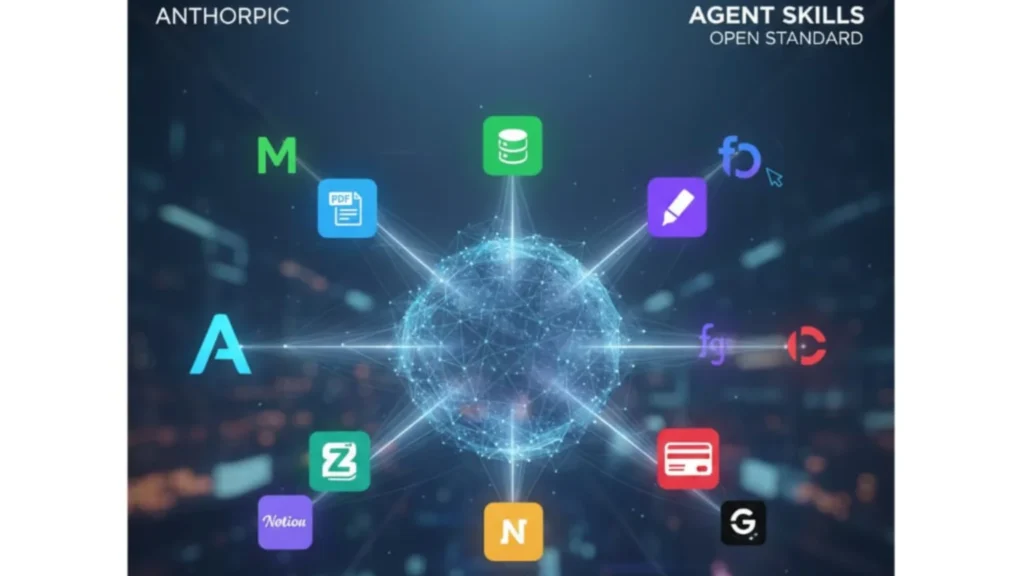
Anthropic has taken a step in this direction by presenting the Model Hardware Standard (MHS), a specification designed to allow AI agents to interact in a standardized way with physical devices. Microscopes, liquid‑handling systems, robotic arms, and other scientific or industrial equipment can be connected to agents through a common interface.
The company opened the project on August 27 as a research preview, involving an initial group of scientific laboratories and advanced manufacturing companies. The stated goal is to drastically reduce the time required to integrate different machines and enable AI agents to orchestrate more complex physical experiments and processes.
At the same time, however, the tech sector is confronting the other side of growing artificial autonomy. More than one hundred companies — including OpenAI, Anthropic, Microsoft, Google, Amazon, and IBM — have signed a letter urging governments and businesses to prepare for an increase in cyberattacks conducted or enhanced by artificial intelligence.
These two seemingly different news stories describe the same shift: AI is becoming capable of acting in the real world, and this capability can be used both to accelerate research and to increase the speed and scale of cyber threats.
From Chatbot to Machine
The concept behind the Model Hardware Standard is relatively simple.
An AI agent normally operates through software. It can read a file, execute a command, query a database, or use an application. But when it needs to interact with a physical device, the situation becomes much more complicated.
Every machine may have its own control system, its own API, its own programming language, and different ways of communicating with other tools.
A laboratory, for example, might use a microscope from one manufacturer, an automated liquid‑transfer system from another, a robotic arm from a third, and completely different measurement instruments. Connecting all this to an AI agent can require weeks or months of specialized work.
Anthropic wants to intervene precisely on this problem.
The proposed model is:
AI agent → standardized software → physical device
The software acts as a translator between the agent and the equipment. Instead of building a completely new integration each time, the device can be described through a common set of instructions and characteristics.
According to Anthropic, MHS can reduce integration work from weeks or months to hours or minutes in certain scenarios. It’s a huge difference, especially in environments with dozens or hundreds of instruments.
How the Model Hardware Standard Works
The heart of the system is a standardized driver — a software layer that connects the computer to the equipment.
Anthropic describes a set of fundamental operations, including commands similar to “read” and “write.” The first allows, for example, reading a temperature; the second can be used to set a parameter.
The advantage is not only about control.
The system is designed to make equipment discoverable by agents. In other words, an agent can identify which devices are available, understand what functions they offer, and obtain the information needed to use them.
This is particularly interesting when dealing with machines the agent has never used before.
A robotic arm, for example, is not defined only by the code that controls it. To use it correctly, physical characteristics such as weight, dimensions, movement capabilities, and operational limits may be important.
MHS allows these details to be associated with the device even through natural‑language descriptions. Anthropic claims that such information can be entered directly by the user or gathered through a conversation with an AI agent.
It’s an important step because it brings knowledge normally stored in technical manuals, internal documents, or operator memory directly into the interface used by the agent.
A Laboratory That Works Through the Night
The most interesting consequence could be the ability to automate entire sequences of experiments.
Anthropic cites scenarios ranging from pharmaceutical research to the calibration of lasers used in quantum systems. An agent could coordinate multiple instruments, adjust parameters based on results, and continue the experiment without a researcher manually intervening at each step.
Imagine a laboratory where an experiment requires a long series of operations.
Today, a researcher might need to program each machine separately, check results, decide which parameter to modify, and start the next phase.
With an agentic system connected to the equipment, part of this process could be coordinated automatically.
The agent could:
“leggere i dati prodotti dagli strumenti; confrontarli con l’obiettivo dell’esperimento; modificare determinati parametri; avviare la fase successiva…”
(from your document)
It could coordinate multiple devices, detect errors, attempt recovery procedures when allowed, and continue working far longer than a human shift.
Anthropic explicitly mentions the possibility of orchestrating autonomous, continuous experiments even during hours when researchers are not present.
This does not mean laboratories will automatically become autonomous. The project is still in its early phase, and the safety of systems controlling physical machines is one of the central issues.
But the technological direction is clear.
Not Just a Technology for Anthropic
A particularly important detail is that the Model Hardware Standard is designed to be model‑agnostic.
This means it should not be tied exclusively to Claude.
Anthropic states that MHS can work with any device equipped with a programmable interface and that different agents can access the standard through common protocols, including the Model Context Protocol (MCP).
If adopted widely, this could create a common language between AI agents and physical machines — similar to how software standards shaped the evolution of the internet: fewer proprietary integrations, more compatibility.
The Link to Robotics
The project arrives at a moment when robotics is increasingly trying to leverage generative models.
A traditional robot executes pre‑designed instructions. A more advanced system can interpret a natural‑language goal, plan a sequence of actions, and use different tools to achieve it.
The problem is that a powerful AI model does not automatically know the physical characteristics of the machine it must control.
A standardized interface can reduce this gap.
The agent does not need to know every detail of the machine’s internal implementation. It needs to know what operations are available, what limits exist, and what conditions must be respected.
This becomes crucial when agents begin coordinating multiple robots simultaneously.
In an industrial plant, for example, an AI system could theoretically manage a chain composed of mobile robots, mechanical arms, quality‑control instruments, and production systems.
At that point, the model would no longer be just an assistant.
It would be an operational coordinator.
Safety Becomes Even More Important
As the number of actions an agent can autonomously perform increases, so does the potential risk of error.
A mistake in a conversation may produce a wrong answer.
A mistake involving a machine can damage a sample, interrupt a process, ruin equipment, or — in delicate contexts — create risks for people.
This is why Anthropic is presenting MHS initially as shared research with a limited number of partners and emphasizes the importance of developing safety evaluations and best practices before making the standard open source.
The key question is not just “How do we let AI control a machine?”
It is:
“quali limiti dobbiamo imporre a un agente prima di consentirgli di controllare una macchina senza supervisione umana?”
(from your document)
This will become central as agentic AI spreads.
From Physical Machines to Networks: The Other Major AI Risk
While Anthropic works to enable agents to interact with physical equipment, major tech companies are warning that similar capabilities can be exploited to attack computer systems.
On August 27, more than one hundred companies signed a public letter calling for a coordinated response to the rise of AI‑enhanced cyber threats.
The message is direct: AI’s ability to automate complex tasks could make cyberattacks cheaper, faster, and accessible to more actors.
The most concrete risk is not a machine taking over the internet with a single command — but the automation of many tasks that today require time and specialized skills.
Why AI Can Change Cyberattacks
A complex cyberattack may require many phases: identifying a target, gathering information, finding vulnerabilities, developing tools, testing what works, bypassing defenses, and maintaining access.
A sufficiently capable AI system can automate part of this process.
The difference lies in scale.
A cybercriminal could theoretically use agents to analyze a huge number of systems simultaneously, search for vulnerable configurations, and automatically adapt strategies.
Defenses can improve at the same pace, but the marginal cost of some operations could drop — and that is what worries the companies that signed the letter.
The Window to Prepare Is Narrowing
The coalition argues that there is a limited window to strengthen defenses before AI‑based offensive capabilities become much more widespread.
They call for cybersecurity to be treated as a strategic priority and for increased collaboration between AI developers and security organizations.
If AI can build more sophisticated attacks, it must also be used to build more effective defenses.
The competition will not only be between hackers and companies. It will also be between offensive agents and defensive agents.
AI as Both Weapon and Shield
This duality is one of the most difficult aspects of the current technological revolution.
The same capability can be used for opposite purposes.
An agent capable of analyzing millions of lines of code can help a company find a vulnerability before it is exploited. But the same capability, in the hands of an attacker, can be used to search for weaknesses across countless systems.
Anthropic has already documented cases where AI systems were used in real cyber campaigns. In 2025, the company described a spying operation in which attackers exploited Claude’s agentic capabilities to perform significant portions of the attack.
More recently, Anthropic published data on the use of its systems to identify vulnerabilities in open‑source software: as of August 26, 2026, the program had led to the disclosure of 2,300 vulnerabilities in 392 projects, with 421 already fixed.
This shows how quickly AI can change the work of security researchers.
Two Sides of the Same Revolution
These two news stories can be read together.
On one side, Anthropic is building a bridge between AI and the physical world.
On the other, major tech companies are preparing the digital world for a new generation of threats.
In both cases, the common element is clear:
AI agents no longer simply generate a response.
They can receive a goal, use tools, analyze what happens, modify their behavior, and continue a sequence of actions.
When confined to a chat, the risk and impact are limited.
When connected to a laboratory, a robot, a factory, or an IT infrastructure, the situation changes.
AI gains what we might call operational capability. The Real Leap Could Be Orchestration. The most interesting point is not a single device controlled by AI. It is the possibility of controlling many simultaneously. An agent could receive a general objective and coordinate a series of tools to achieve it — in science, industry, or cybersecurity.
This is why standards become so important. If every machine communicates differently, large‑scale automation remains complex. If a common interface exists, a single agent can potentially work with many devices.
The Next Challenge: Deciding How Much Power to Give Agents
Technology makes it increasingly easy to connect AI to real tools.
The hardest question will be deciding how much control to grant. An agent might be allowed only to read data. Then to modify non‑critical parameters. Then to start certain operations.
In advanced scenarios, it might receive near‑complete autonomy.
Safety must be designed together with operational capability — not added later.b A system that can act must also have clear limits on what it cannot do.
The Next Phase of AI Will Be Less Visible, but Much More Concrete
The race toward artificial intelligence has so far had very visible protagonists: chatbots, image generators, coding assistants, and models capable of reasoning about complex problems.
The next chapter may be less spectacular to watch, but far more important in its consequences. Agents will progressively enter laboratories, production plants, IT systems, and corporate infrastructures.
Anthropic’s Model Hardware Standard is one of the most interesting attempts to create a common infrastructure for this transition. The project is still in an early phase, but the idea is ambitious: enabling agents to communicate with physical equipment through a shared standard.
At the same time, the letter signed by major tech companies shows that the industry is aware of the other side of the coin.
The more tools agents are given, the more important it becomes to prevent those same tools from being used against people, companies, and infrastructures.
The real challenge of artificial intelligence will not be building smarter models. It will be building systems capable of acting without losing control.
And in the coming years, the difference between a useful agent and a dangerous one may depend precisely on this: not on how well it speaks, but on which tools it can use, which machines it can control, and which decisions it is allowed to make on its own.
In a fast‑moving landscape where artificial intelligence evolves day by day, some stories help connect the dots and reveal the deeper shifts shaping the future. From industry conflicts to breakthrough models, each article adds a new perspective on how AI is transforming both technology and society.
OpenAI ends Cursor access: the Musk–Altman conflict enters the AI coding market
Google Gemini Omni 1.1 Flash video AI: the truth behind the 40‑second clips and the fake 4K
